IC3 OSCE Lower Limb Sensory
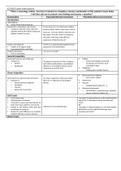
“This is a neurology station. You have 5 minutes to complete a sensory examination of this patient’s lower limbs.
I will then ask you to present your findings and answer a question”.
Examination Expected/Normal Comments Potential/Abnormal Comments
Introduction
Hand hygiene
• Cleans hands with alcohol gel
Introduction, explanation and consent ‘Hi my name is X. I’m a third year medical
• Introduces self with name and level, student at RCSI. What’s your name? Nice to
explains what he/she will be doing and meet you. I’ve been asked to examine your
obtains consent for same
legs today. That will involve checking the
sensation of the legs using different
equipment. Would that be ok?’
Position and exposure ‘Mr/Mrs A is appropriately positioned and
• Patient at 45 degree angle exposed for this examination.’
• Legs exposed from mid-thigh
Enquires about pain ‘Are you in any pain?’
• Prior to examining
General Inspection
Performed from the end of the bed Patient
Inspects for ‘On general inspection Mr/Mrs A appears o Posture (hemiplegic posturing),
o Patient well, with normal posture, no peripheral involuntary movements, focal
o Equipment stigmata of neurological disease and no neurological signs
equipment around the bed.’ Equipment
o Walking aids, assistive devices
Closer Inspection
Neurocutaneous stigmata
Performed from right had side of the bed ‘On closer inspection of the lower limbs o Scars, ulcers, rashes
Inspects for there are no stigmata of neurological Asymmetry
o Neurocutaneous stigmata disease. Muscles
o Symmetry o Wasting/hypertrophy, R/L _x_
o Muscles Abnormal movements
o Abnormal movements
o Fasciculations, myoclonic jerks, dystonia,
chorea, athetosis, ballism, tics
Soft Touch
Uses cotton wool ‘Sensation is reduced/absent on the right/left/both
Demonstrates at sternum legs in the ‘X’ dermatome when assessing soft
Proceeds to assess each dermatome on touch’
both lower limb, patient’s eyes closed Or
Patient to tell student when they feel ‘Soft touch is normal bilaterally.’ ‘Sensation is reduced/absent in a non-dermatomal
something by saying yes distribution on the right/left/both legs when
Student to ask if difference in sensation assessing soft touch’
between the legs or versus sternum
Sharp Touch
“This is a neurology station. You have 5 minutes to complete a sensory examination of this patient’s lower limbs.
I will then ask you to present your findings and answer a question”.
Examination Expected/Normal Comments Potential/Abnormal Comments
Introduction
Hand hygiene
• Cleans hands with alcohol gel
Introduction, explanation and consent ‘Hi my name is X. I’m a third year medical
• Introduces self with name and level, student at RCSI. What’s your name? Nice to
explains what he/she will be doing and meet you. I’ve been asked to examine your
obtains consent for same
legs today. That will involve checking the
sensation of the legs using different
equipment. Would that be ok?’
Position and exposure ‘Mr/Mrs A is appropriately positioned and
• Patient at 45 degree angle exposed for this examination.’
• Legs exposed from mid-thigh
Enquires about pain ‘Are you in any pain?’
• Prior to examining
General Inspection
Performed from the end of the bed Patient
Inspects for ‘On general inspection Mr/Mrs A appears o Posture (hemiplegic posturing),
o Patient well, with normal posture, no peripheral involuntary movements, focal
o Equipment stigmata of neurological disease and no neurological signs
equipment around the bed.’ Equipment
o Walking aids, assistive devices
Closer Inspection
Neurocutaneous stigmata
Performed from right had side of the bed ‘On closer inspection of the lower limbs o Scars, ulcers, rashes
Inspects for there are no stigmata of neurological Asymmetry
o Neurocutaneous stigmata disease. Muscles
o Symmetry o Wasting/hypertrophy, R/L _x_
o Muscles Abnormal movements
o Abnormal movements
o Fasciculations, myoclonic jerks, dystonia,
chorea, athetosis, ballism, tics
Soft Touch
Uses cotton wool ‘Sensation is reduced/absent on the right/left/both
Demonstrates at sternum legs in the ‘X’ dermatome when assessing soft
Proceeds to assess each dermatome on touch’
both lower limb, patient’s eyes closed Or
Patient to tell student when they feel ‘Soft touch is normal bilaterally.’ ‘Sensation is reduced/absent in a non-dermatomal
something by saying yes distribution on the right/left/both legs when
Student to ask if difference in sensation assessing soft touch’
between the legs or versus sternum
Sharp Touch