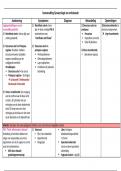
Summary economic challenges
Greatest part of economic challenges summarized: Module 3 until Model 6.
Module 3; Mercantilists, Physiocrats & Adam Smith
From the Middle Ages to the age of enlightenment powerful changes in European feudalism, such
as land, labour and capital become factors of production and the emergence of social classes.
Mercantilism refers to the period between feudalism and liberalism. Mercantilists; advisors to
European monarchs in the 16-18 century not an organized school of thought.
- Countries consolidate their borders and fight for overseas colonies
- Money and wealth depends on the amounts of silver and gold (bullionism)
Mercantilism caused a clear shift in economic thinking from justice materialism.
A consistent positive trade balance causes an inflow of gold and silver
international trade as a zero-sum game.
Economic policy prescriptions under mercantilism; positive trade balance, import = raw materials.
Criticism on Mercantilism
- Price-specie flow mechanism: export > import gold flows into the country more gold
for an equal amount of real goods causes prices to rise discourages exports and stimulates
imports gold flows out of the country
- Adam Smith: true wealth should be measured by stand of living, not by the amount of gold.
- David Ricardo; comparative advantage international trade a win-win situation.
Situation in France around 1700: long decline in production; national income had been halved since
1660, due to expensive wars and under-consumption because of high taxes
self-sufficiency and hatred towards foreign countries
The physiocrats (Physiocracy = ‘order of nature’)
- First real school of thought in economics
- Supporters of natural law (rules emerging spontaneously and not by the government)
- Emphasizes the importance of agriculture only land provides a ‘gift of nature’
Tableau économique
- First attempt to model an entire economy; zig-zag model
- Three social classes: farmers, manufactures (sterile class), landowners (nobility)
- Physiocratic theory of rent: agriculture surplus (=’gift of nature’) is paid by the farmers to the
landowners as rent.
Adam Smith, The Moral Philosopher
Study of human emotions
When people are confronted with moral choices, they imagine an impartial spectator:
, - Due to this people make decisions based on sympathy and empathy, not selfishness.
The wealth of nations; selection of topics
Division of labour; innovations + division of labour = tremendous economic growth
- Lesson: productivity is not only determined by technology.
- Also depends on the organization of labour and the size of the market
price theory:
- Difference in use value vs. exchange value: diamond-water paradox.
- Labour theory of value: the relative prices of goods are determined by the relative amounts
of labour necessary for the production
- direct relation between nominal and real prices through the real price of gold.
- Price theory fir ab advanced society; shift of labour theory of value to more general cost-of-
production theory.
- Natural price of goods is the sum of:
- natural wages (labour) subsistence t theory of wages; wages ensure the reproduction of the
working class.
- natural profit (capital)
Natural rent (land)
invisible hand,
growth theory (growth theory on basis on interaction between two ‘laws of motion’:
- Law of accumulation: division labour increase profits more investmentsmore
machinesmore demand for labourhigher wages.
- Law of population: higher wagesmore childrenincrease in number of workerslower
wages (back to subsistence)more division of labourhigher profits more investments
cycle continues.
Role of the government; The wealth of nations is not an unreserved recommendation for laissez-
faire economics (Smith speaks of a system of perfect freedom):
The state has four tasks according to Smith:
Prevent monopolies, protect society from foreign threats, protect internal order against injustice and
oppression, provide public goods.
Consumers interest/first:
Smith was critical to dangers of the free market, free competition is constantly under threat of cartel
agreements.
Consumer interest come rather first than producers interest.
Neo-mercantilism = protectionism (Brexit & Trumponomics)
Greatest part of economic challenges summarized: Module 3 until Model 6.
Module 3; Mercantilists, Physiocrats & Adam Smith
From the Middle Ages to the age of enlightenment powerful changes in European feudalism, such
as land, labour and capital become factors of production and the emergence of social classes.
Mercantilism refers to the period between feudalism and liberalism. Mercantilists; advisors to
European monarchs in the 16-18 century not an organized school of thought.
- Countries consolidate their borders and fight for overseas colonies
- Money and wealth depends on the amounts of silver and gold (bullionism)
Mercantilism caused a clear shift in economic thinking from justice materialism.
A consistent positive trade balance causes an inflow of gold and silver
international trade as a zero-sum game.
Economic policy prescriptions under mercantilism; positive trade balance, import = raw materials.
Criticism on Mercantilism
- Price-specie flow mechanism: export > import gold flows into the country more gold
for an equal amount of real goods causes prices to rise discourages exports and stimulates
imports gold flows out of the country
- Adam Smith: true wealth should be measured by stand of living, not by the amount of gold.
- David Ricardo; comparative advantage international trade a win-win situation.
Situation in France around 1700: long decline in production; national income had been halved since
1660, due to expensive wars and under-consumption because of high taxes
self-sufficiency and hatred towards foreign countries
The physiocrats (Physiocracy = ‘order of nature’)
- First real school of thought in economics
- Supporters of natural law (rules emerging spontaneously and not by the government)
- Emphasizes the importance of agriculture only land provides a ‘gift of nature’
Tableau économique
- First attempt to model an entire economy; zig-zag model
- Three social classes: farmers, manufactures (sterile class), landowners (nobility)
- Physiocratic theory of rent: agriculture surplus (=’gift of nature’) is paid by the farmers to the
landowners as rent.
Adam Smith, The Moral Philosopher
Study of human emotions
When people are confronted with moral choices, they imagine an impartial spectator:
, - Due to this people make decisions based on sympathy and empathy, not selfishness.
The wealth of nations; selection of topics
Division of labour; innovations + division of labour = tremendous economic growth
- Lesson: productivity is not only determined by technology.
- Also depends on the organization of labour and the size of the market
price theory:
- Difference in use value vs. exchange value: diamond-water paradox.
- Labour theory of value: the relative prices of goods are determined by the relative amounts
of labour necessary for the production
- direct relation between nominal and real prices through the real price of gold.
- Price theory fir ab advanced society; shift of labour theory of value to more general cost-of-
production theory.
- Natural price of goods is the sum of:
- natural wages (labour) subsistence t theory of wages; wages ensure the reproduction of the
working class.
- natural profit (capital)
Natural rent (land)
invisible hand,
growth theory (growth theory on basis on interaction between two ‘laws of motion’:
- Law of accumulation: division labour increase profits more investmentsmore
machinesmore demand for labourhigher wages.
- Law of population: higher wagesmore childrenincrease in number of workerslower
wages (back to subsistence)more division of labourhigher profits more investments
cycle continues.
Role of the government; The wealth of nations is not an unreserved recommendation for laissez-
faire economics (Smith speaks of a system of perfect freedom):
The state has four tasks according to Smith:
Prevent monopolies, protect society from foreign threats, protect internal order against injustice and
oppression, provide public goods.
Consumers interest/first:
Smith was critical to dangers of the free market, free competition is constantly under threat of cartel
agreements.
Consumer interest come rather first than producers interest.
Neo-mercantilism = protectionism (Brexit & Trumponomics)