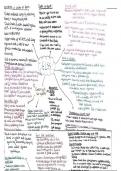
POLITICAL CHANGE
Aspect/Policy Change Continuity
Elections to the First Small number of Duma members were active supporters of the The success of the Kadets does not indicate a shift in beliefs because they only won
Duma in spring 1906 Tsarist regime = change because the Tsar has less political control as the SRs, Mensheviks and Bolshevik boycotted the elections.
and support.
Kadets were still liberal.
Emergence of other political parties because the Kadets was largest
party (had 182 of 448 seats) = they have ideas that do not align with Election results caused reactionary policy - Fundamental Laws
the autocracy of Tsarism
Representation for the peasantry because the Trudovik party gained
107 seats. This showed that the peasants were gaining more power
= they wanted to transfer landowners estate to the peasantry.
Evidence of change - Witte’s dismissal because he promised a local
peasant Duma but that was not the outcome
The government did not influence the outcome of the election or
outwardly support right wing parties
, Aspect/Policy Change Continuity
Fundamental Laws Put the October Manifesto into law - therefore was a essentially a Article 4 - reinforced the “supreme autocratic power” of the Tsar. Therefore reverting
constitution that would hold Tsar to account by law. back to the Tsar have centralised power and authority to create laws alone.
23 April 1906
As it was put into law - guarantee freedom of association, freedom Defence and foreign affairs were outside of Duma’s jurisdiction = Tsar still had
of assembly, freedom of speech. - therefore allowed radical beliefs prerogative powers of waging war - this ultimately led to WW1 and the failures of the
to become more popular and widespread - newspapers like government
Liberation could be widely published without fear of repression from
the Okhrana Imposed limits on the Duma’s powers which was too conservative for the Kadets
(Milyukov spoke out against it)
The fact that Tsar had control over defence and foreign affairs meant
he was able to be criticised openly for WW1 = more responsibility to Reversed the October Manifesto promises that the Duma would be more than an
him (eval - failures may not have happened and the regime was not advisory body - Article 87 allowed the Tsar to proclaim new laws when the Duma was
stable - not a change and not beneficial) not in session. This consequently led to the Duma being dissolved by the Tsar to limit
its power.
Reactionary reform in response to the growing liberalism that opposes Tsarism.
Imperial State Council created alongside the Duma to create a bicameral system of
government - this was continuity because it was a reforming of the State Council
made in 1810 and they could block Duma as they had the same level of power.
The Duma had not power to force resignation of ministers - therefore could not hold
the Tsarist government to account and therefore, continued corruption under
autocracy.
Imperial State Council were appointed by conservatives, the nobility, the Orthodox
Church and zemstva. And half was chosen by the Tsar!!
Because the Tsar could pass any laws - he could restrict individual rights so freedoms
were not fully guaranteed.
Stolypin violated the Fundamental Laws in 1907 when he changed the electoral law
after dissolving the 2nd Duma.
Increased distrust for the regime.
Introduction of the Imperial State Council = increased political tensions and instability
due to clashes between the two bodies. Likely to be no reform if there is tension.
Liberal were disillusioned with the regime - likely to oppose it in the Duma leading to
political instability and lack of reforms.
- SRs - no land reform
- Bolsheviks - no change to workers grievances
- Liberals - did not address underlying problems in Russia and still feared a mob rule.
Aspect/Policy Change Continuity
Elections to the First Small number of Duma members were active supporters of the The success of the Kadets does not indicate a shift in beliefs because they only won
Duma in spring 1906 Tsarist regime = change because the Tsar has less political control as the SRs, Mensheviks and Bolshevik boycotted the elections.
and support.
Kadets were still liberal.
Emergence of other political parties because the Kadets was largest
party (had 182 of 448 seats) = they have ideas that do not align with Election results caused reactionary policy - Fundamental Laws
the autocracy of Tsarism
Representation for the peasantry because the Trudovik party gained
107 seats. This showed that the peasants were gaining more power
= they wanted to transfer landowners estate to the peasantry.
Evidence of change - Witte’s dismissal because he promised a local
peasant Duma but that was not the outcome
The government did not influence the outcome of the election or
outwardly support right wing parties
, Aspect/Policy Change Continuity
Fundamental Laws Put the October Manifesto into law - therefore was a essentially a Article 4 - reinforced the “supreme autocratic power” of the Tsar. Therefore reverting
constitution that would hold Tsar to account by law. back to the Tsar have centralised power and authority to create laws alone.
23 April 1906
As it was put into law - guarantee freedom of association, freedom Defence and foreign affairs were outside of Duma’s jurisdiction = Tsar still had
of assembly, freedom of speech. - therefore allowed radical beliefs prerogative powers of waging war - this ultimately led to WW1 and the failures of the
to become more popular and widespread - newspapers like government
Liberation could be widely published without fear of repression from
the Okhrana Imposed limits on the Duma’s powers which was too conservative for the Kadets
(Milyukov spoke out against it)
The fact that Tsar had control over defence and foreign affairs meant
he was able to be criticised openly for WW1 = more responsibility to Reversed the October Manifesto promises that the Duma would be more than an
him (eval - failures may not have happened and the regime was not advisory body - Article 87 allowed the Tsar to proclaim new laws when the Duma was
stable - not a change and not beneficial) not in session. This consequently led to the Duma being dissolved by the Tsar to limit
its power.
Reactionary reform in response to the growing liberalism that opposes Tsarism.
Imperial State Council created alongside the Duma to create a bicameral system of
government - this was continuity because it was a reforming of the State Council
made in 1810 and they could block Duma as they had the same level of power.
The Duma had not power to force resignation of ministers - therefore could not hold
the Tsarist government to account and therefore, continued corruption under
autocracy.
Imperial State Council were appointed by conservatives, the nobility, the Orthodox
Church and zemstva. And half was chosen by the Tsar!!
Because the Tsar could pass any laws - he could restrict individual rights so freedoms
were not fully guaranteed.
Stolypin violated the Fundamental Laws in 1907 when he changed the electoral law
after dissolving the 2nd Duma.
Increased distrust for the regime.
Introduction of the Imperial State Council = increased political tensions and instability
due to clashes between the two bodies. Likely to be no reform if there is tension.
Liberal were disillusioned with the regime - likely to oppose it in the Duma leading to
political instability and lack of reforms.
- SRs - no land reform
- Bolsheviks - no change to workers grievances
- Liberals - did not address underlying problems in Russia and still feared a mob rule.