Describe the purpose of accounting for an organisation.
Explain the difference between capital and revenue items of expenditure and
income.
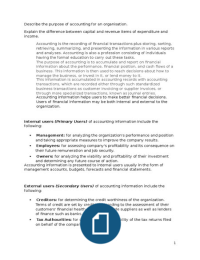
Accounting is the recording of financial transactions plus storing, sorting,
retrieving, summarizing, and presenting the information in various reports
and analyses. Accounting is also a profession consisting of individuals
having the formal education to carry out these tasks.
The purpose of accounting is to accumulate and report on financial
information about the performance, financial position, and cash flows of a
business. This information is then used to reach decisions about how to
manage the business, or invest in it, or lend money to it.
This information is accumulated in accounting records with accounting
transactions, which are recorded either through such standardized
business transactions as customer invoicing or supplier invoices, or
through more specialized transactions, known as journal entries.
Accounting information helps users to make better financial decisions.
Users of financial information may be both internal and external to the
organization.
Internal users (Primary Users) of accounting information include the
following:
Management: for analyzing the organization's performance and position
and taking appropriate measures to improve the company results.
Employees: for assessing company's profitability and its consequence on
their future remuneration and job security.
Owners: for analyzing the viability and profitability of their investment
and determining any future course of action.
Accounting information is presented to internal users usually in the form of
management accounts, budgets, forecasts and financial statements.
External users (Secondary Users) of accounting information include the
following:
Creditors: for determining the credit worthiness of the organization.
Terms of credit are set by creditors according to the assessment of their
customers' financial health. Creditors include suppliers as well as lenders
of finance such as banks.
Tax Authourities: for determining the credibility of the tax returns filed
on behalf of the company.
1
Explain the difference between capital and revenue items of expenditure and
income.
Accounting is the recording of financial transactions plus storing, sorting,
retrieving, summarizing, and presenting the information in various reports
and analyses. Accounting is also a profession consisting of individuals
having the formal education to carry out these tasks.
The purpose of accounting is to accumulate and report on financial
information about the performance, financial position, and cash flows of a
business. This information is then used to reach decisions about how to
manage the business, or invest in it, or lend money to it.
This information is accumulated in accounting records with accounting
transactions, which are recorded either through such standardized
business transactions as customer invoicing or supplier invoices, or
through more specialized transactions, known as journal entries.
Accounting information helps users to make better financial decisions.
Users of financial information may be both internal and external to the
organization.
Internal users (Primary Users) of accounting information include the
following:
Management: for analyzing the organization's performance and position
and taking appropriate measures to improve the company results.
Employees: for assessing company's profitability and its consequence on
their future remuneration and job security.
Owners: for analyzing the viability and profitability of their investment
and determining any future course of action.
Accounting information is presented to internal users usually in the form of
management accounts, budgets, forecasts and financial statements.
External users (Secondary Users) of accounting information include the
following:
Creditors: for determining the credit worthiness of the organization.
Terms of credit are set by creditors according to the assessment of their
customers' financial health. Creditors include suppliers as well as lenders
of finance such as banks.
Tax Authourities: for determining the credibility of the tax returns filed
on behalf of the company.
1