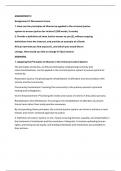
Marketing summary
Lecture 1: Intro & marketing analysis
Marketing: Marketing is the activity, set of institutions, and processes for creating, communicating,
delivering, and exchanging offerings that have value for customers, clients, partners and society at
large.
Building a relationship between organization and customer
From creating and accommodating value to co-creating value
Micro environment
• The internal analysis: dynamics and processes that take place within the organization itself.
Evaluation of the current marketing process.
• Analysis of the organization’s potential to go international. identifying potential barriers and
stimuli
Key questions
• Current strategy
• How are we utilizing our marketing mix
• Who are our stakeholders
• How is our organizational structure and is it still efficient?
• Who are we targeting and how?
Meso environment
The industry, environment and markets in which a company operates.
We used to see customers as one, market to the masses.
Nowadays, we want to target specific groups based on specific characteristics
Different ways of assesing customer base
Geographical: Country, city, city layout, …
Demographical: Ages, etnicities, gender, …
Behavioral: Shopping habits, ...
Psychological
Key questions
, • Where do they live
• How does their family look like
• Level of education
• Income levels
• Consumption patterns.
• Big Five Personality Traits.
• Cultural values of Hofstede.
Types of competition
Same product: Coca Cola vs Pepsi
Same type of product: Glue vs Tape
Generic competition: McDonalds vs Panos
Porters’ Five Forces Model
1. Competition in the industry
2. Potential of new entrants into the industry
3. Power of suppliers
4. Power of customers
5. Threat of substitute products
Macro environment
The larger societal forces that affect the micro and meso environment
DESTEP
• Demographic
• Economic
• Social
• Technological
• Ecological
• Political
,Lecture 2: Marketing strategy
Segmentation, targeting and positioning (STP): Incorporating all the acquired knowledge to build a
strategy towards your intended audience and potential audience. Which customers will we serve and
how will we create value for them – also, how are we going to be different from the competitors.
Segmentation: Dividing the mass market into smaller parts with distinguished characteristics, needs
or behaviors that might require separate marketing strategies or mixes.
• Geographic
• Demographic
• Behavioral
• Psychological
Make it effective! MASDA
• Measurable
• Accessible: Reach and serve your segment effectively
• Substantial: Make sure it is large enough or profitable enough to serve.
• Differentiable
• Actionable: To what extend is it actionable. While you can have 6 segments that you want to
focus on, if you only have 2 people as marketing staff – you are strongly hindered.
Targeting
• Based on your segmentation you now determine the segment(s) that you want to target.
• Evaluating each market segment’s attractiveness and selecting one or more market segments
to enter
• Target market – a set of buyers sharing common needs or characteristics that the company
decides to serve.
Positioning
Arranging for a product occupy a clear, distinctive and desirable place relative to competing
products in the minds of target consumers.
Positioning built on meaningful differentiation, supported by appropriate strategy and
implementation, can help a company build competitive advantage
Standardization
, • Economies of scale
• Global competition
• Competitors’ use of standardized concepts
• Converging consumer needs and tastes
• Small cultural differences
• Centralized management of international operations
Adaptation
• Large differences in government and regulatory influences
• Local competition
• Competitors’ use of adapted concept
• Diverging consumer needs and tastes
• Large cultural differences
• Decentralized management
Marketingmix
1. Product
• Straight product extension
o “Extending a group of products that are closely related because they function in a
similar matter and are sold to the same customer groups” (Kotler, 235).
o Extension can be based on flavor, design, smell etc. Offer variation in the products in
the same product line. Adding new products to the same line.
• Product adaptation
o Modifying or adapting products to make it more suitable or marketable for a specific
market/customer (Based on your analysis).
• Product invention
o The invention of new products or modifying existing products into new products.
2. Place
• Channel decision based upon:
• Customer characteristics/Nature of the demand
• Nature of the product
• Competition
• Legal restrictions, local distribution practices
• Environmental factors
• Suppliers (local versus import)
Distribution decisions:
Market coverage:
Lecture 1: Intro & marketing analysis
Marketing: Marketing is the activity, set of institutions, and processes for creating, communicating,
delivering, and exchanging offerings that have value for customers, clients, partners and society at
large.
Building a relationship between organization and customer
From creating and accommodating value to co-creating value
Micro environment
• The internal analysis: dynamics and processes that take place within the organization itself.
Evaluation of the current marketing process.
• Analysis of the organization’s potential to go international. identifying potential barriers and
stimuli
Key questions
• Current strategy
• How are we utilizing our marketing mix
• Who are our stakeholders
• How is our organizational structure and is it still efficient?
• Who are we targeting and how?
Meso environment
The industry, environment and markets in which a company operates.
We used to see customers as one, market to the masses.
Nowadays, we want to target specific groups based on specific characteristics
Different ways of assesing customer base
Geographical: Country, city, city layout, …
Demographical: Ages, etnicities, gender, …
Behavioral: Shopping habits, ...
Psychological
Key questions
, • Where do they live
• How does their family look like
• Level of education
• Income levels
• Consumption patterns.
• Big Five Personality Traits.
• Cultural values of Hofstede.
Types of competition
Same product: Coca Cola vs Pepsi
Same type of product: Glue vs Tape
Generic competition: McDonalds vs Panos
Porters’ Five Forces Model
1. Competition in the industry
2. Potential of new entrants into the industry
3. Power of suppliers
4. Power of customers
5. Threat of substitute products
Macro environment
The larger societal forces that affect the micro and meso environment
DESTEP
• Demographic
• Economic
• Social
• Technological
• Ecological
• Political
,Lecture 2: Marketing strategy
Segmentation, targeting and positioning (STP): Incorporating all the acquired knowledge to build a
strategy towards your intended audience and potential audience. Which customers will we serve and
how will we create value for them – also, how are we going to be different from the competitors.
Segmentation: Dividing the mass market into smaller parts with distinguished characteristics, needs
or behaviors that might require separate marketing strategies or mixes.
• Geographic
• Demographic
• Behavioral
• Psychological
Make it effective! MASDA
• Measurable
• Accessible: Reach and serve your segment effectively
• Substantial: Make sure it is large enough or profitable enough to serve.
• Differentiable
• Actionable: To what extend is it actionable. While you can have 6 segments that you want to
focus on, if you only have 2 people as marketing staff – you are strongly hindered.
Targeting
• Based on your segmentation you now determine the segment(s) that you want to target.
• Evaluating each market segment’s attractiveness and selecting one or more market segments
to enter
• Target market – a set of buyers sharing common needs or characteristics that the company
decides to serve.
Positioning
Arranging for a product occupy a clear, distinctive and desirable place relative to competing
products in the minds of target consumers.
Positioning built on meaningful differentiation, supported by appropriate strategy and
implementation, can help a company build competitive advantage
Standardization
, • Economies of scale
• Global competition
• Competitors’ use of standardized concepts
• Converging consumer needs and tastes
• Small cultural differences
• Centralized management of international operations
Adaptation
• Large differences in government and regulatory influences
• Local competition
• Competitors’ use of adapted concept
• Diverging consumer needs and tastes
• Large cultural differences
• Decentralized management
Marketingmix
1. Product
• Straight product extension
o “Extending a group of products that are closely related because they function in a
similar matter and are sold to the same customer groups” (Kotler, 235).
o Extension can be based on flavor, design, smell etc. Offer variation in the products in
the same product line. Adding new products to the same line.
• Product adaptation
o Modifying or adapting products to make it more suitable or marketable for a specific
market/customer (Based on your analysis).
• Product invention
o The invention of new products or modifying existing products into new products.
2. Place
• Channel decision based upon:
• Customer characteristics/Nature of the demand
• Nature of the product
• Competition
• Legal restrictions, local distribution practices
• Environmental factors
• Suppliers (local versus import)
Distribution decisions:
Market coverage: