Atls post test revised Questions &Answers Latest Update
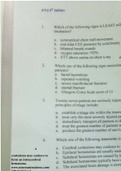
Atls post test revised Questions &Answers Latest Update ATLS 9 £d1tlon I • 2. . . ·sophageal ' · . . . . . 1 · bl for diagnosing c '!' h11:h ol the roJioy,mg s1gns 1S LEAST re 13 e Intubation? n. S)mmclrical chest all mo,ement h. end-tidal C02 presence b' colorimetl') c. bilateral breath sounds ' d. oxygen -.aturation >92°/o c. L I I abo' e carina on chest x -ra • WI · h · · · · in sc'-erc trauma 1!c one of the folio'' ing signs necessitates a ddimU'-e mrwa) pat•cnts'! a· facial lacerations h. repeated vomiting c. sccrc maxillofacial fractures u. ~tcrnal fracture c. < Coma Scale score of 12 'I ~cnty· ~even patients are seriously injured in an aircraft crash at a local airport. The pnnc1plc nf triage include: <1. e-.tablish a triage site within the internal perimeter of the crash site b. ~rcat o~ly the most severely injured patients first c. •mmcdmtcly transport all patients to the nearest hospital u. treat the greatest number of patients in the shortest period of time c. produce the greatest number of suniYors based on available resources L Which one of the follo .... ing statements is correct? s. a. Cerebral contusions rna) coalesce to form an intracerebral hematoma. h. Epidural hematomas are usuall} seen in the frontal region. c. Subdural hematomas are caused b} injul) to the middle meningeal artery. d. Suh<.lural hematomas t)picall) ha"e a lenticular shape on CT scan. c. I he a:.~ociated brain damage is more se,ere in epidural hematomas. An 18-ycar-old male is brought to the emergenc} department afte r having been shot. J tc has one bullet wound just belo'' the right cia" icle and another just below the costal margin in the right posterior axilla~ line. IIi~ ~lood pressure is II ?'60 mm Hg. hcurt rate is 90 beats per minute, and resptratory ~te 1s hs per mmute. After · at•nt airway and inserting 2arge-cahber IV hnel., the next appropriate cnsunng a P• c step is to: 11 obtain a portable chest x-ray . h·. administer n bolus of additional IV flUid c. perform a laparotomYCT d. obtain an abdominal . sceanllavaoc c. perform diagnostic penton a o e c e a a contusions may coalesce to form an intracerebral hematoma. TBI/ICH.html dl II ~ )l!I.I>HIJ) p I *'H' ·I till} ~ tlllolh'lhlll'- 1') "'''~'-lf'h II l I 'I ·Ill . , .. , .. ,,~hldl llh'lhh•~llJ'll 11 h)t''*"'"'" h ,.,,,,ltl!llhl1 . ,,• II 11~ lfllhiNi• "·''"'" ' ,,,,n·o'"''II'HlM' 1'"'~"111 ,. ht h 111l' I lith•· "''"'"In~ 'hMilWilh" r~alw 1,11l't:lllin~ ~h ),WliUWizntll.{1 '" pr-. ~11·1111 t ""'"''' l'·llll'tll .. " [I h ,,, 'ur-. in hlunt 11r Jlc.'tll'h tltin.:. utxl,•tllllll. h II h pr.•.lu~·,•d h) nHtllr d.·~l".'1.'' ''' 1:t,lm.u.·mul h~mNchus.: . . Rh imnHIIllli:l•lhulin themp) '>h~'uld ~· admini,tcr.·J l' pr..:£nall femal. h.-, .,ll,hlln••d 11 i:lllhlllll wound ll• ttw lc ,, I hh ,, not d f'llbl~ m In tnlllnlttilt'd. Rh·JXISiti~ prvgoant p;ticnt:-... 1-'. lniiUIIiPn 111' l~h lmnllmu.:l,,bulin th~·nlp) 1,)('-. nN r.:quir.: pr)(11 of fet.'lln ~~ ~~ h"llllll I hllgt v 11 I~-) ~~ar-1 'llltnllh1".'~ '-'11-.1 ' ll'ttlin-. tn~'sh ~ fad•• I injurk~ in u h :W-on., ...... ~ ptl ._ .up tru1._ It,• j, hn1u~ht "' the- cmcrgcnc) lkpartmem c~..'lnplet~~ unn~t.1 •• '''"S 'f'IIC ~3rJ 11nd "~'1rin» n l'Cr ical C{'llar tlis ~lood prc~),IJI~;; 1:. 1 :()1 ~lli:U t lg. h!!~rl rat~ j, MH Jx·ut' 1)'r minute and regular. and n~'pinuv1 nuc h mimllo t lh r"''pinui,th ure- luhon·d ttnJ 'l)ll)r'U'. H1s I..Ja.. g,. l 'Ina S:'<iru•'.:;•" "' uemph atMllm-.:hcallntubalil'll "ith manual in line- ,labili.LAUI..'ll ~f l¢.~8~i~ "f" UtbUCct>s..,ltl due to bleeding and distl'rC1 anat~oln). be ~ticnt 1 h~ ~t pnCedun.• for airwil) rmmagcmcnt in thi' situativu s: a., nast,tr~ch"al intubation b, emerJlc.'lllC) tracheostom) sura:ical cric,lthynlidolllffi) d. pla"~mont of an orophal') ngeal a~rn-a~ . pl~emont of a nasophar) ngeal aarn-ay e e A narrowed pulse pressure is not seen in neurogenic shock. c c I 1 ro~. "'"'"" I• 11 11 •i ·~ •i ) ' ~ , hnn•hiiTI • tf h, f'•lrlll il'Uiitlll " . Htngcnl iul C'-:"i'm II II ''' th~ n1; ~~~~., '"the ehe' t '-·ra) ,,, a ra1~ "11- ~~~~ "'...., '" '' t~tc 'l u••n•c ruruurc t'scept hrch ,,nc·' n m.:Jra,unal .:mph) scma h f''"' 'cn.:,· ,,fu plcurol cup • ,f:llrt~rall m llfthc u,1nic knob tl, ' '"'' rdl itm ,1f1he Lmchea to the right '• dept'!"""' of the left mainstem bronchu! 1 '. ~0 ) cdr-old oman tell down four stairs landing on c,,n..~rt'tl~ . ~. .itt~""' <1" unl.'•ltlSCious for five minutes beginning immedta~~ -~iN' ~1 'SI!Il' hlll nn~ usness during the ten minute transport''' tM ~ l'nt~rv,cnc) department. she is awake. alen. and responsiv~ ~ a ~ ~ SI.'alc SCli'C of I 5. Her only complaint is a slight ~tit. 1'ttil't fh~ t'ICC 'mcs unresponsive with a Glasgo" Coma Scale ~'ft! ,, , )fl pupil is large and nonreactive. The right pupil i ~1. Tht ,"'nt NN ) most consistent with this patient' entire clink• I rou a. a subdural hematoma b. an epidural hematoma . an occipital lobe hemorrhage d. tbcal subarachnoid hemorrhage c. a cerebellar hemorrhage c Escharotomy is the surgical division of the nonviable eschar, which allows the cutaneous envelope to become more compliantFull-thickness circumferential and nearcircumferential skin burns result in the formation of a tough, inelastic mass of burnt tissue (eschar). The eschar, by virtue of this inelasticity, results in the burn-induced compartment syndrome. This is caused by the accumulation of extracellular and extravascular fluid within confined anatomic spaces of the extremities or digits. The excessive fluid causes the intracompartmental pressures to increase, resulting in collapse of the contained vascular and lymphatic structures and, hence, loss of tissue viability. The capillary closure pressure of 30 mm Hg, also measured as the compartment pressure, is accepted as that which requires intervention to prevent tissue deat . a b 1.: 1-4. , ~" '' .1 ).4 ~,,t1, "- ''"~ "' ~, ;1 "'ll'«,,,lbilt' .• ~ admi~K"d .. ('1. ••wr:' .)."f'11~ v .-ft r '11111' l h, 'bk ... ~ f'C'C''urt' '' 0 ~ mm Hg. heart ,_ 11 ·.st~ . :-.. , .tc. ~ 1''l>J'I 1" t:t 1, ('ll'rt'ath' r« mtnult' , He 15 k!lhlrlte: '~ ·~ •h, ·~ "~ t: • ma"'-. anJ ''"' lar&c "*hhcr ,, ., arr anitaaaod A"tW'"'r••l ""'-''" ~ ... ~~ ,~3u~....t His f30, i .. 11. mm 111!1 t 1" 7 t..ral. rat<~ H> 10 mm Hs {~ I,) f) ~·~ rH ll> ... )l I ht M1 t"l hi' 11' IIJ·h.:l • ~IS11k'r lli ..... ~~'l' • a.. h~ "' •ntilsll ~~ t-_ no•st, r.ll'n ,,f"''"";tl rerfu,j,,n •• initi..lti..'n N ' k'" -J,,:;,· J('l'>lmino: J. .tmma:-tr:ltiNl ,,f Mxlium btctl""'"ntc • • • lntll. "''" ''" rh ·n~ lcphrino: inl'u j,,ll ~ hio;-h ''fth: ~~'Ill) ins should ~ J)!tli.,rmcd tit I ln Ull) J"Uticnl h()C;(' injiJr ~ may mduJ..- multark d)~ocJ c'tremil) fnt turc~·) a. th,,~ ugh ,- so::~mcnt l)f ti.1 ur limb ('k!rfu l(.'n b. }.UH'I'S h) ('fC-C11l11CCI"ll_,iS OflhC <.l,in. •• ,~rem t~ ' ')lliJXIrtmcnt S) ndrome rclcu..,c: d. ensuring mkquotc ox gcnntiM und , cnttlutmn . E aluatit)n l{)r occult crush:.) ndrome. I 5 . J()..)c:lr-nld mule su tains a gun hot Ound to the n~ht "'~r ,N: ... t, m'd"'11. ~l ~n the nipple nnd the co •tul mar~in. lie is hrousht hy amhulnncc ''' 11 hot;pita1 that hn · full surgicul copabilitics. In the emergency def'lllrtmcm he • ~nd tra:tu:a.U) imubutcd. _ liter:- of crystulloid solution arc infuS<!d roptdly through two tar" ~fi'"-cr I lines. and n closed tube thorocostomy ill performed with the n:tum of20U m n blood. A chest x-rn) rcvcnl:, correct pluccment of the chest tube and a mall e~d hcrnothorn.. II is blood prclisure ill now 7010 mm I Jg. and h• heart rau: • 0.b:.a~ per minute. rhc mo:.t approprioLc nct slep in managing thts pal~nt it. t(l; a. insert u second chest tube b. obtain o CT scan of the abdomen c. perfonn a thoracotom)' in the emergency department d. perfonn a laparotomy in the operating room e. pcrtonn a FA T exam I t; 17. •I h A 7'> )'Cnr-ultJ I' 1, i · • emu ( ' trtlulvnl ltt 11 lttnlut vchu .. h; 1.111 h und pr~; ents to the ~~ ~~ y d1.•pnnmen1 . "i · 1 .. uu ( !illllllltlln 1111tl 11 bctu hlnckcr . Whrch of the ll ll.ltnu '<tti!Ctll • II · o · I ' Ill I rut• t,;UIICCIIIIIjlftCI IIIHIIUJ(Cmcnt'/ n. 1 he 1 i:-.1-. ul '<llhdur nllwmu"h'I"C: '"' i'I. II td . : Ab-.cncc tlt'IUI.hyl'llrdut rndtiiiiC thutthc rattcnt '"hemodynamically normal. ~o -u rntl vc ll ll lll O~I.' lCII I ol xl ml 1j urle ~ mo e likely to be successful "'.older udull thnn in )'lllltlf,!cr pulk 11P~ . d. ~~ ~orou-; fluid rc,uCIIUliuu IIIII)' he <~ .,d with ctmliCJrc'!piratory failure. c. Lprncphrtllc ul d h1.• nlu~oc d lmlllt'llluh.: ly lbr hypotension. 18. A 22-ycnr-old mule i'i brought hy umhuln11cc tu 11 <tntllll cumrnunity hospital alter Hilling from the top tll o 2.'1-mctcr ~ lout} !udder . tnitl(tlly, he wa!> found to have a lurgc right pncumo1horux 1 chc,t lllhc was lrhcrtcd und connected to an underwater sent dminngc collcctiM 'Y'IIclll with "'* utivc pressure. 1 rcpcut AI' portable chest xrll) dcmonstrutcs o rc-.rdunl, lur~;;c 1 i~ht pneumothorax. After transferring the patient 10 a veri lied 1rouma center, u th ird chc'>l x-r::•y reveals u persistent right pneumothorax. '1 he chc!>ttuhc appcurs til be fu nctioning nnd in good position. He remains hcmodynomicnlly normal with no ~t ~ of rc.,piratory distress. The most likely cause fo r his pcrsi ... ~·nt 1 i~ht pncumothurux is: 19. n. nail chest b. diaphmgmnric injury • c. pulmonary conlw;ron d. esophageal pcrforo1ion c. tracheobronchial injur A 22-year-old female who is 6 ~mths prc nt presents following a motor vehicle crash. Paramedics reJX•rt vaginal hlccdlng. What is the initial step in her treatment? assess fetal heart sounds a. b. check for fetal movement c. pcrfonn inspection of the cerv~x d. ask the patient what her name 1s . . insert a wedge under the patient's r1ght h1p e. ATt.s 9"' ldltlon 20. 21. 22. A constru · dcparun uon_ worker falls from a . of lo.er ~~ rate is 124 an~~~ and~ ~sfe:1ed to the coeT:>tXXY spine and .. ~mal pa in. After a . pressure b g, 60 mm H:. He ax:-;..azc. · Initiating nu·d . .s~smg the air. a) and chest. ~r · _.,. __ I re susc Jtauon the . IZm:c '"""" cn. F AS-... · next step tS to perform: ' I e)(am b. dctai led n . c. rectal eurologlcal exam exam d . cervical spine x-ray e . urethral catheterization A 22-year-old male susta' range. His blood press ; :. gun " ound to the left shoulder and cr:.es:. ;nccse After 2 liters ofcry ta~:~s ~ 0 mm Hg. and his heart rate is 130 beazs ~c~'2 to 122/84 mm Hg and h I so uudon are rapidly infused. his blood pres-w;e U::..eases . · h . • eartrate ec 100 . .It a respLratory rate o f 28 b beats per mmJl.C. He i5 uC::.: ,x-e,c sounds are decreas d h reaths per mmute. On pb)sical 3tic"L .:S bee!::' caliber (36 F h}e at l e left upper chest ,, jth dullness on percussion. , 1.:!--- - rene tube thoracosto · · lttd · • :- the return of200 mL f bl d my s mse m the fifth intercosul sp:ore -c o oo and no a1r leak. The most appropriate oe:n step~ w: • a . msert a Foley catheter b. begin to transfuse 0-negative blood c. perform thoracotomy d. obtain aCT scan of the chest and abdomen e. repeat the physical examination of the chest Which one of the following statements concerning spine and spina'. cord {I'a'Ol'tl3 5 true? a. A normal lateral c-spine film excludes in jut'). b. A vertebral injury is unlikely in the absence ofph)sica fmdingsofarord nj~ c. A patient with a suspected spine injW') requires immobiz.:nion on a -hort spne board. d. Diaphragmatic breathing in an unconscious patient" ho has fulkn is a sign ot .:- spine injury. e. Detennination of whether a spinal cord lesion is complete or incomplete must be made in the primar) sur. e}. I IIIII! tl I I Ill Loll Phl111<ll'" Ill Oilllll!hl ICIh ' I •: I" ' ''"' I "'"'q • II n "" 1 llo "'"''''"'Y d• P'"'"'.""l"'' flolllr•o•• ,.,. 'lhnl pt ... '""'" ito HI mm II I '"·~~~rw~y h, c;.lt!Br r• .ptMury rate'' 21S orld yi>.QJIC ' "" 'I "'" hi• 1 ~ o • " , 1 "" ~ "" ,~ I ~ ' "I' quo I """"' '"' 1.-looidc> uttl c "" • h~>~• l II hidl tnt.:rl/1.!111 iun Is n~u~t ~~~;~yn:~~e~!lmplains Ill pain ''" pelp; of !1 ~~~ ·· !J ch.1tllll1('1rl!ti~ion oftlw chc .. l h 11' '~ ur~ltrw~ nlc .. is I jM HI llllllllll:!l' lll< fll d lllllll 'l liiOI~ ~ lltl" tlutru•·n,tomy I h· Ullllol l'UIIIIllilH ud~ bu .. .: dbturhancc encountered in injured nrdt lrk n ~~ ""'" J h> ~ ,. -· ' ,, ' '' 1, I Ut i hup~ h l hclll ·~ Ill 11'llllhltlllfl • ''""'"'' hlllllll' .I 11IIHhl hlll., ht.:nrbonatl.! uJm•OI'•nUion ' lu .. ulll'"'"' .. u.Juun hllridc: sJministl'ttion •o I ! •I ,.,., " '" ""'"" " bro o the emcraeney depanmcnt l<oll•>wi"'l ?...m<:ter h»•ll I• II " "'" ""'"'" he ;, unre,pan i.e •nd found to h.-e • ·~'""" • hlo" oJ ""'" "" ,,r >)()160 mm It g. and h .. n r•" of M. I h<: ftr>t p o .. j" .. i It h ,dmtnl ing vn.,oprc .. sors "tuhll.,hin ~ IV u~ 's for rug·a~.,i~tcd intuh:ttiOO 'll "'~ In~ th~ ~a use of her dccrea'Cd eve of con~iou~nes~ uppl} ~ U) en and maintaining uirway '- '~ hading hcn1nrrhugc ns u cau'C of <;hock hkh 11"C l1fthc ll•lhm intt ~lutctncttl'~- j, true rcgntd'"l! tlittlln•• Itt ptrtt'" I llf'llll 0 • lWt ho' nv utilit in the diu!lno~i~ l'fdinphta!!rnati< rupture h. I>PI ~honld he p;lrlimm:d whcnuvcr 1111 httltcolit•n h•r hp trot •mV fot PI' fit c IWI ha!. u hii!h 'JlCcilicit . : I )I' I ctm he Ued 1tr dln~lll~ing rc!rttt>eriltlflcnl iniuru:~ I> PI ha:. n hi~o~h M.:n,ith ih. · • ~ htch n~: 11f the f 11 1 · · . (. • • o 11w 11!! tt ~ ts ~soctntcd with dos~ II hc:mhrrh 1 •6 M It c:-tunatcd bluod lo~s lf7S0- 1500 ml )'! u. role nbovc 140 beats per minute b. urtn~ output lc ~~ thnn 15 tnl per hout ~:. rc~pii'I.HOI) rotc shove 35 hrcuth, r er tttlmttc d. dccrcu~d diu,tolic blood pre~surc c. normul~o) ll c blood prcssurt.: :!9. Ncul')gcnic :.hod. k n. diagnosed by the pre cnce ol nat:cid paroly~i~ h. cuuscd b) bruin injul) C. due lO llCUlC hC111llrrhagc d. due to ' nsculur resistance c. initially munugcd with VUS1prcssor the111py JO. A 23·)Car-old male is admitted to the emergency d t (lillhttl'nt t tlv »fler ~t,unm full-thickness bums 10 his head, 11rms. and up~r tnt"o. otnhn~ot ~(~ .. f>f ht!l h• •I bOO)' surface nn: weighs 80 kg (185 poumh) Jlj<; hh'tld rn:~~ureo '' lh~ l~ mrn Jl and hean rate is 135 beats per minute. A urinury cnthctcr I~ ut~c:rtc:d Wtth th r~htfl (>( 20 rnl of dark amber urine. He has received I 000 ml ,,r tngd~ In 1 tc ,fu tt•tt since the time of his injury. Using the Parkland lbrmulaoc; lll!lllll(, ht e um ue<:l cry stalloid fluid resuscitation volume per hour tbr the nc't It h(lnf' hhuh1 a. 667mL b. 87Sml c. IOOO mL d. 1800mL c. 2000mL 32. 33. .... 110n A 34-,car I dcP3rim -o d female in'IOolvea • bnlising e::!~~llcang. and antericr Cu1 :ra ~=IS=~ ar>d a d' oatJS .ene · •rect J. b. OX " OSCopy to CXelude h~, .• gen b) non-rebreath· .... ,T,;;-...a:. trlmr.a c. protect the spine b mg mask d. palpation of the •=ll'!a her fie down e. attach a pulse o . neclc Xtmeter to her i ~ Compa~·d · h •... "'It adults ch"ldr • • en !-.ave: a . a longer. wider. funnei-'Shapel . h. a less pliable:. calcified sketC:U:..r i3Y c. lo"'er incidence of borl - • • d. a relath el) smaller h~ ~rr.._ ;itt: _neur...gen~e sflcck e. ante · d' ..... '!tt Ja';i rtor rsplacemcnt of C5 on C6 A 30-)car-old m 1 fi re . . a c present'> ollowing a motor ~lucie cosh • s prratol) rate 18. hcan 88 blood ~ - .:a S ·ale 13 • pressur-BOJ - mm g; :rnd. ... ; !>Core · Laparotom!' is indicated ~ . ....,,..,. a. there is a distinct seat belt si~ over tne acdomer. b. the C: sc~n demonst.-ates a ~race A L-.~ic n1ucy c. there rs erdence of an extraperitoneal.;.;;dder ir.'ur d. CT demonstrates retroperitoneal air • e . the abdomen is distended locali:wf r:ght uppc:' cwa&--...nt •l=:;ne<~ 34. A 20-)ear-old male is brought to the hospltai app~ mluruti::> :il~·~~~ stabbed in the chest. There is a 3-<entlmeter ;c.w".d JUSl medial :· ' , .,. blood pressure is 70 33 mm Hg. and heart l.'3te tS .!0 e:k and .ann .:;re. distended. Breath sounds are normaL Hear: SCWids are Juninishcd. :K---~ been established and warm crystalloid is in:fus,rr.g. 1.-.e Qe:X unpi"~ immediate management is: a. CT scan of the chest b. 12-Jead ECG c. left tube thoracostom~ d. begin infusion of packed RBCs e. FASTexam ' ,,, flll•fl H • ill 11ltl ''"'"11)~11 II• bwuglttln urtcr u frorrta1 1mpact colh~•on tits Ita 1 '" '" h,i!ll r '' I Ill hlutid '" urc 8'• (,(1 rnrn Jig. and r~pnaiDf)' rate 36 nrcalh ' 111 "'1 llu O•lfinnl II "WlllrlulnntgiJIUcrl) of ahdomirt:~l p:un lllcrt: seems "' 1" 11 1, ll 1 111!•h dt~~· tlllll~)' und tXtcrnol rvtauon of the ten leg. 'hJCh one of the hllht •IU I •• 111 Itt t:tl ~Cfiiiii!J tlu Jlltllcnt I I rut? ' I'• I •• 1111"' (IIIII>~: rut d nut lta'ICd on the rncch:uusm of injury. ''" llhth '" llllllltl; I) ha~ II dl Uti rcmur frKlUrC ~ tll ft t•l tit• ~ h "' ""'' JlclVtlltrc nntKJrtant•n the initial evaluauon lntlllltll .lnlllll•l"ll' '"'"' nlthc lett lvwcr ltmb i~ expected. ""'"'I'' •Ill I tlll>C 111 Itt"" huulll he On idtrcd '~ I""' 11lol h IIIIth:' lull~ llt~n n lltuht ul tnirJI. She has extensive bruisinS of her 11 " d 'to~ "' tuhllh 11.1 I II 1 lt~:tul till ~ " 1211, hluud prcs~urr: is 'J()/70 mm II g. an rcspll'll • tnh' •~ 'II Ill("'''"'"''" '"lllllllltttl~ lllltlu:.uhly explained by: II "" .,,l,ttnllh'•td til jill y h '""'''''''"''" ,,J,.Jonllnnlw pelvic injury ' llll lllhl h d pi11.11 5hlll J.; ltullllCIVIl•IJ •J'IIIC: injury •' ll~'"'"l!~llh lui: I"'''" ~c:rviutl •JIIIIC injury 17. hi, h ""' .. 1 the lolhJ '"I> t.1to:m~nt~ "true c(lnccming cranial anatomy? 1S. II lllC '',tip is lllllljK.JSCd ol ~kill, uhC:UtilllCOUS tissue, galea aponeurotica,JOOSC Ill l'< •lt~r IISMIC, 111.! dur11 I> I h.· llll'""'S~'· IIIC ~ompn.;cd ul the uuro~, pia, arachnoid. and cystema. t. I ft,• arh:ry ltes bctccn the: dura and pia mater. d I he l'>leAII5, llldt produces ccrebro~pinal fluid, lies in the lateral and thud ClllrtliCS ~· lin• h:lllerchcllt!ICJ>arntes the cerebral bcmisphcres from the temporal lotiii.'S, .!.!•l'·" ,,1,1 ''''""'" fall~ 1hilc skiing. She prcsenb on a spine board "" : · c~n ica ~ oll.u: ,,,~ c''" m. k ,tt S I • und to antecubital IVs. I ler Glasgo Coma "~a.c ,core is 12. pupils ,trl' t'qtrnl, hlnod presltre is mm Hg. hcan rate b 1 O'> ,md rl'spi1 , 111 11 > Ill It' is I 1), < hcst •r!IY is normal. 1 his patient's management priorilic~ are: ll ( · 1 ul llw head und rc pctll C ilasgow Coma Scale I tkliniliH ' aimuy. c·t nf rhc head. and intracranial pressure monitor ), l' 1 y runnn itnl. dclin~ airway.(' I ,,~ he h~:ad. and ncurosurgcl') COthuh If ( · 1 uf rhc ltcud. U <•. cerebral perfusiOn pressure monitorinu ~· and h , · • pcnontc sa I in~· c. IV 1 >ilttntin. IV mannitol, mild hyperventilation. and serial anerial blood gase - 39. A oung male patient is brought to the emergency dcp3nment followin~& 5-met.:r (16-foot) fall from a roof. He responds to pain b) pushing nwoy your hand, op;;nlll~ his eyes, and verbalizing inappropriate words. Pupils ore equal. The l hnporhtnl step in management of this patient would be: a. immediate intubation to protect his airway b. administer 25 mglkg IV bolus mannitol c. insert nvo large-bore IVs d . alcohol and drug screening . e. detennine whether amnesia is present and. if so, for what period ofume 40. ln a patient with a spinal cord injury, sacral sparing: a. refers to a fracture of the sacrum b. is part of the spinal shock syndrome c. is a good prognostic sign d. is diagnostic of a Power's ratio < I . d e . occurs only with complete transection of the lumbosaccal sp•nal cor Mlllt;l lliUI 111.-Uill'lff Ul ~llflJl'OltD MuiHplc-rhoit·· Rt'!'IIHi n 'it' Sheet ATLS® Writh'n Post-h.•st 113 ~r' iwd 201.' ) N;mlc Ah~M.l=<o... 'rv.eM. ...... osrv,blu~.P ).u~ ,_. 1 Course Site ------- l,n•portnnt instructions: Use a pencil only. If y~1u l'l•nngt• u rt·~J'Km~·. pknsc crtt~c your fitst mark completely. Select the one best answer according to the AILS' Cou!'Sl' content 3-1. (a) (b) (c) (d) 3-21. (n) (b) (c) (d) 3-2. (a) (b) (d) (c) 3-22. (a) (b) (c) (e) 1-3. (a) (b) (c) (d) 3-23. (b) (c) (d) (e) 3-4. (a) (b) (c) (d) 3-24. (a) (b) c (d) (e) 3-5. (a) (b) (c) (d) 3-25. (b) (c) (d) (e) 3-6. (a) (b) (c) (d) • 3-26. (a) (b) (c) (e) 3-7. (a) (b) (c) (d) 3-27. (a) (b) (c) (d) 3-8. (a) (b) (c) (e) 3-28. (a) (b) (c) (d) 3-9. (a) (b) (d) (e) 3-29. (a) (b) (c) (d) 3-10. (a) (b) (d) (e) 3-30. (a) (b) (d) (e) 3-11. .I) (b) (c) (d) (e) 3-31. (a) ( (c) (d) (e) 3-J 2. (a) IJ) (c) (d) (c) 3-32. (a) (l'i) (c) (d) (e) 3-13. (a) (c) (d) (e) 3-33. (a) (b) (c) (e) 3-14. (a) (b) (c) ( (e) 3-34. (a) (b) (c) (d) 3-15. (a) (b) (c) (e) 3-35. (a) (b) • (d) (e) 3-16. (b) (c) (d) (e) 3-36. (a) (b) (c) (d) > 3-17. (a) (b) (c) (e) 3-37. (a) (b) (c) (e) 3-18. (a) (b) (c) (d) • 3-38 . • (b) (c) (d) (e) 3-19. (a) (b) (c) • (e) 3-39. • (b) (c) (d) (e) 3-20. (b) (c) (d) (e) 3-40. (a) (b) • (d) (e) Multilumen Esophageal Airway Multilumen esophageal airway devices are used by some prehospital personnel to achieve an airway when a definitive airway is not feasible (n FIGURE 2-9). One of the ports communicates with the esophagus and the other with the airway. The personnel who use this device are trained to observe which port occludes the esophagus and which provides air to the trachea. The esophageal port is then occluded with a balloon, and the other port is ventilated. A CO2 detector improves the accuracy of this apparatus. The multilumen esophageal airway device must be removed and/or a definitive airway provided after appropriate assessment. When diagnostic peritoneal lavage (DPL) is used to detect diaphragmatic injury, a false-negative result may occur An isolated penetrating injury from the chest can cause bleeding into the lesser sac, which may not communicate with the rest of the peritoneal cavity. A DPL in this situation would show no evidence of bleeding. Drainage of lavage fluid from the chest tube has been reported and is a positive result. 7d 8c 30b zsa20mlv/?dl=0 74iiyz0o/n ==e
Written for
- Institution
- Atls
- Course
- Atls
Document information
- Uploaded on
- July 29, 2022
- Number of pages
- 17
- Written in
- 2021/2022
- Type
- Exam (elaborations)
- Contains
- Questions & answers
Subjects
-
atls post test revised questions ampanswers latest update
-
atls 9 £d1tlon i • 2 ·sophageal · 1 · bl for diagnosing c h11h ol the rojioy
-
mg s1gns 1s least re 13 e intuba
Document also available in package deal