PART 3: Assessing and Developing Qualified Employees
Chapter 9: Performance Management and Appraisal
Performance appraisal (PA) – the process of evaluating how well employees perform their
jobs when compared to a set of standards, and then communicating that information to
employees.
Organisations use various terms to describe this process, performance review, annual
appraisal, performance evaluation, employee evaluation and merit evaluation.
Performance management – a process that significantly affects organisational success by
having managers and employees work together to set expectations, review results and
reward performance.
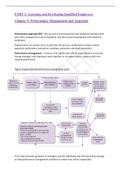
Figure: Organisational performance management cycle:
This model provides guidance to managers and the individuals and the teams they manage
on the performance management activities for which they will be responsible.
,9.1 South Africa’s Performance Appraisal Dilemma
• Existence of negative working culture
• Changes in corporate strategy did not result in corresponding behaviour changes
• Insufficient line management support for performance management
• Periodic and formal performance reviews
- Lack of follow-up of performance reviews
- Overemphasis on the appraisal aspect at the expense of development
- Inadequate performance information
- Inadequately maintained objectivity
• A large number of organisation do not have a formal performance management
system
9.2 Performance Criteria
Three types of performance criterion:
• Trait-based criteria: Focus on the personal characteristics of an employee, for
example loyalty, dependability, creativity and communication skills. Here the focus is
on what a person is and not on what he or she does or accomplishes on the job.
• Behaviour-based criteria: These are concerned with specific behaviours that lead to
job success. For example, instead of ranking leadership ability (a trait), the rater is
asked to assess whether an employee exhibits certain behaviours, (for example
“works well with co-workers”).
• Results or outcome-based criteria: Focus on what was accomplished or produced
rather than how it was accomplished or produced. It is important to note that this
type of criterion is not appropriate for every job and that often it is criticised for
missing important aspects of the job, such as quality.
9.3 Performance Appraisal Objectives
The objectives of PA fall into two categories: evaluation and developmental.
Figure: Evaluation and Developmental objectives in PA:
, 9.3.1 Evaluation objectives
Organisations using PA to determine pay increases use the term merit review or merit
evaluation.
PA normally has a two-part effect on future pay. In the short run, it may determine merit
increases for the following year; in the long run, it may determine which employees are
promoted into higher-paying jobs.
Staffing decisions constitute a second evaluation objective of PA, because the managers and
supervisors must take decisions concerning promotions, demotions, transfers and lay-offs.
Past PAs normally help to determine which employees is most deserving of a promotion or
other desirable job changes.
PAs can also be used to evaluate the recruitment, selection and placement system. The
effectiveness of these can be partially measured by comparing employees’ PAs with their
scores as job applicants.
9.3.2 Development objectives
Encompasses developing employee skills and motivation for further performance.
Performance feedback is a primary developmental need because almost all employees want
to know how their supervisors feel about their performance. Their motivation to improve
their current performance increases when they receive feedback that specifies goals, which
in turn enhances future career moves.
Developmental performance appraisal is mainly focused on giving employees direction for
future performance. Such feedback recognises strengths and weaknesses in past
performances and determines what direction employees should take to improve.
Employees want to know specifically how they can improve. Because PAs are designed to
cope with the problem of poor employee performance, they should be designed to develop
better employees.
The results of appraisals influence decisions about the training and development (T&D)
of employees and how talent is managed. Below-average evaluations may signal areas of
employee behaviour that could be strengthened through on-the-job and away-from-the job
training. Of course, not all performance deficiencies may be overcome through T&D.
Supervisors must distinguish between performance problems resulting from the lack of a
critical skill or ability and those caused by low morale or some form of job dissatisfaction.
Chapter 9: Performance Management and Appraisal
Performance appraisal (PA) – the process of evaluating how well employees perform their
jobs when compared to a set of standards, and then communicating that information to
employees.
Organisations use various terms to describe this process, performance review, annual
appraisal, performance evaluation, employee evaluation and merit evaluation.
Performance management – a process that significantly affects organisational success by
having managers and employees work together to set expectations, review results and
reward performance.
Figure: Organisational performance management cycle:
This model provides guidance to managers and the individuals and the teams they manage
on the performance management activities for which they will be responsible.
,9.1 South Africa’s Performance Appraisal Dilemma
• Existence of negative working culture
• Changes in corporate strategy did not result in corresponding behaviour changes
• Insufficient line management support for performance management
• Periodic and formal performance reviews
- Lack of follow-up of performance reviews
- Overemphasis on the appraisal aspect at the expense of development
- Inadequate performance information
- Inadequately maintained objectivity
• A large number of organisation do not have a formal performance management
system
9.2 Performance Criteria
Three types of performance criterion:
• Trait-based criteria: Focus on the personal characteristics of an employee, for
example loyalty, dependability, creativity and communication skills. Here the focus is
on what a person is and not on what he or she does or accomplishes on the job.
• Behaviour-based criteria: These are concerned with specific behaviours that lead to
job success. For example, instead of ranking leadership ability (a trait), the rater is
asked to assess whether an employee exhibits certain behaviours, (for example
“works well with co-workers”).
• Results or outcome-based criteria: Focus on what was accomplished or produced
rather than how it was accomplished or produced. It is important to note that this
type of criterion is not appropriate for every job and that often it is criticised for
missing important aspects of the job, such as quality.
9.3 Performance Appraisal Objectives
The objectives of PA fall into two categories: evaluation and developmental.
Figure: Evaluation and Developmental objectives in PA:
, 9.3.1 Evaluation objectives
Organisations using PA to determine pay increases use the term merit review or merit
evaluation.
PA normally has a two-part effect on future pay. In the short run, it may determine merit
increases for the following year; in the long run, it may determine which employees are
promoted into higher-paying jobs.
Staffing decisions constitute a second evaluation objective of PA, because the managers and
supervisors must take decisions concerning promotions, demotions, transfers and lay-offs.
Past PAs normally help to determine which employees is most deserving of a promotion or
other desirable job changes.
PAs can also be used to evaluate the recruitment, selection and placement system. The
effectiveness of these can be partially measured by comparing employees’ PAs with their
scores as job applicants.
9.3.2 Development objectives
Encompasses developing employee skills and motivation for further performance.
Performance feedback is a primary developmental need because almost all employees want
to know how their supervisors feel about their performance. Their motivation to improve
their current performance increases when they receive feedback that specifies goals, which
in turn enhances future career moves.
Developmental performance appraisal is mainly focused on giving employees direction for
future performance. Such feedback recognises strengths and weaknesses in past
performances and determines what direction employees should take to improve.
Employees want to know specifically how they can improve. Because PAs are designed to
cope with the problem of poor employee performance, they should be designed to develop
better employees.
The results of appraisals influence decisions about the training and development (T&D)
of employees and how talent is managed. Below-average evaluations may signal areas of
employee behaviour that could be strengthened through on-the-job and away-from-the job
training. Of course, not all performance deficiencies may be overcome through T&D.
Supervisors must distinguish between performance problems resulting from the lack of a
critical skill or ability and those caused by low morale or some form of job dissatisfaction.