Part 4: Retaining Employees
Chapter 11: Managing Compensation and Benefits
Compensation – extrinsic rewards such as salary and benefits, as well as intrinsic rewards
such as achieving personal goals, autonomy and more challenging job opportunities.
Wage and salary administration usually refers strictly to the monetary rewards given to
employees.
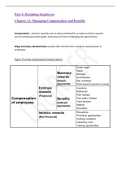
Figure: The total compensation/rewards system:
,11.1 Compensation Objectives
11.1.1 Attracting talented employees
11.1.2 Retaining talented employees
To provide for equity among jobs, administrators usually create a systematic relationship
among the pay scales for various jobs within an organisation. This process is usually called
job evaluation.
If management is able to minimise turnover and lost production due to perceptions of
equitable compensation, then its goal of retaining good employees has been achieved.
Administrators must inform employees about the various wage rates paid for different
positions and how those wage levels are determined. Managers will also have to involve
employees in job classification and compensation matters.
, 11.1.3 Motivating talented employees
Figure: Motivation and performance model:
To safeguard the relationship between employees and the organisation, the organisation
must provide the following, which will benefit both the organisation and employee:
• Accurate appraisal. Management must develop a system of accurate performance
appraisal to identify employees who are outstanding, average and poor performers.
• Performance rewards. Management should identify which rewards relate to
performance levels and tell employees that pay, increased benefits, change in hours
or working conditions, or recognition will be directly related to high performance.
• Supervisors feedback. Supervisors must give complete and accurate feedback to
employees when appraising their performance. Employees must be told what they
are doing well, and which performance areas need improvement.
11.1.4 Legal considerations
The Basic Conditions of Employee Act, No. 75 of 1997, as well as the Basic Conditions of
Employment Amendment Act, No. 11 of 2002, have a direct impact on an organisation’s
compensation strategy.
Table: 10 Cs for assessing the effectiveness of pay rewards:
Chapter 11: Managing Compensation and Benefits
Compensation – extrinsic rewards such as salary and benefits, as well as intrinsic rewards
such as achieving personal goals, autonomy and more challenging job opportunities.
Wage and salary administration usually refers strictly to the monetary rewards given to
employees.
Figure: The total compensation/rewards system:
,11.1 Compensation Objectives
11.1.1 Attracting talented employees
11.1.2 Retaining talented employees
To provide for equity among jobs, administrators usually create a systematic relationship
among the pay scales for various jobs within an organisation. This process is usually called
job evaluation.
If management is able to minimise turnover and lost production due to perceptions of
equitable compensation, then its goal of retaining good employees has been achieved.
Administrators must inform employees about the various wage rates paid for different
positions and how those wage levels are determined. Managers will also have to involve
employees in job classification and compensation matters.
, 11.1.3 Motivating talented employees
Figure: Motivation and performance model:
To safeguard the relationship between employees and the organisation, the organisation
must provide the following, which will benefit both the organisation and employee:
• Accurate appraisal. Management must develop a system of accurate performance
appraisal to identify employees who are outstanding, average and poor performers.
• Performance rewards. Management should identify which rewards relate to
performance levels and tell employees that pay, increased benefits, change in hours
or working conditions, or recognition will be directly related to high performance.
• Supervisors feedback. Supervisors must give complete and accurate feedback to
employees when appraising their performance. Employees must be told what they
are doing well, and which performance areas need improvement.
11.1.4 Legal considerations
The Basic Conditions of Employee Act, No. 75 of 1997, as well as the Basic Conditions of
Employment Amendment Act, No. 11 of 2002, have a direct impact on an organisation’s
compensation strategy.
Table: 10 Cs for assessing the effectiveness of pay rewards: