100% satisfaction guarantee Immediately available after payment Both online and in PDF No strings attached 4,6 TrustPilot
logo-home
Exam (elaborations)

PYC4807 Psychological Assessment (2022 - Semester 1 - Assignment 2 - 1st Attempt

Rating
-
Sold
4
Pages
10
Grade
A+
Uploaded on
04-07-2022
Written in
2021/2022

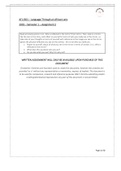
PYC4807 – Psychological Assessment 2022 – Semester 1 – Assignment 2 - 1st Attempt Question 1: Choose the most correct option. The item discrimination index and the item-total correlation are measures of … 1. the frequency of choosing the correct response to an item 2. the predictive value of an item 3. differential item functioning 4. the extent to which an item measures the same aspect as the total test Question 2: Foxcroft (2004) provides guidelines for the development of a multicultural test (please see study note 3 under additional resources on myUnisa). She distinguishes between three approaches, namely theory-based/rational, empirical (criterion-keying), and criterion-referenced methods. The Senior South African Individual Scale – Revised (SSAIS-R) was based on the Wechsler model of intelligence and the test consists of a variety of tasks that require intelligence. In combination these tasks measure a general factor of intelligence consisting of two specific factors, namely verbal and non-verbal intelligence. The content domain of the SSAIS-R was thus defined by means of … 1. a job analysis 2. a theoretical review 3. contrasting groups 4. an analysis of learning outcomes Question 3: Foxcroft (2004) provides guidelines for the development of a multicultural test (please see study note 3 under additional resources on myUnisa). She distinguishes between three approaches, namely theory-based/rational, empirical (criterion-keying), and criterion-referenced methods. In the case of criterion-referenced tests the content domain could be specified in terms of ... (a) a theoretical review (b) contrasting groups (c) an analysis of learning outcomes (d) a job analysis 1. (c) (d) 2. (a) (b) 3. (b) (c) 4. (a) (c) Question 4: A psychologist might specifically consider dynamic assessment of learning potential because ... (a) it measures individual differences in inferred traits such as intelligence (b) it assesses developing skills required by one’s particular environment (c) it minimises the influence of differences in formal education (d) a combination of power and timed tests is appropriate in the local context (e) it is based on the view that cognitive processes are highly modifiable (f) it provides a comprehensive picture of verbal and non-verbal abilities 1. (a) (e) (f) 2. (a) (b) (d) 3. (c) (d) (e) 4. (b) (c) (e) Question 5: Scores on the 16 primary factors of the 16PF are used in different combinations to calculate a score on each of the five second-order factors. Which of the following primary factors contribute to the second-order factor, Anxiety? (a) Dominance (factor E) (b) Emotional Stability (factor C) (c) Social Boldness (factor H) (d) Tension (factor Q4) (e) Perfectionism (factor Q3) (f) Apprehension (factor O) (g) Vigilance (factor L) 1. (b) (d) (f) (g) 2. (b) (c) (d) (g) 3. (d) (e) (f) (g) 4. (a) (b) (d) (f) Question 6: Which of the following statements regarding structured methods of personality assessment and projective assessment techniques is incorrect? 1. Structured methods are characterized by fixed scoring rules and projective assessment techniques are scored intuitively. 2. Structured methods are standardised questionnaires and projective assessment techniques are characterised by ambiguous stimuli. 3. Projective assessment techniques make it easy for people to provide socially desirable responses whereas structured methods do not. 4. Structured methods lead to acquiescence whereas projective assessment techniques do not. Question 7: The purpose, norm group and psychometric properties of the Sixteen Personality Factor Questionnaire (16PF) – Fifth Edition. Based on the information in the table above, which one of the following statements regarding the validity of the 16PF5 is correct? 1. The predictive value of the 16PF5 in a work context is supported. 2. Theory-related group comparisons support the validity of the 16PF5. 3. Correlations with other tests indicate that the 16PF5 is a duplication. 4. Favourable comparisons with similar measures indicate construct validity. Question 8: The purpose, norm group and psychometric properties of the Sixteen Personality Factor Questionnaire (16PF) - Fifth Edition. Indicate whether you agree or disagree with the following statement: The 16PF5 as a measure of normal personality traits should never be used in clinical settings. Choose the most correct response. 1. False, in combination with clinical information a personality profile could aid the therapy. 2. True, only a test developed for diagnosing pathology should be used in clinical settings. 3. False, normal people also have psychological problems. 4. True, testing is not as effective as observation in a clinical setting. Question 9: The purpose, norm group and psychometric properties of the Sixteen Personality Factor Questionnaire (16PF) - Fifth Edition. Is the reliability of the 16PF5 acceptable? Order the following statements from MOST correct to LEAST correct: (a) The values are acceptable to determine stability of performance over time. (b) Decisions will be made about individuals and the values are too low for this. (c) The values are acceptable, because these are based on the consistency of responses to all items. 1. (a) (b) (c) 2. (b) (c) (a) 3. (b) (a) (c) 4. (c) (a) (b) Question 10: Cultural influences should always be considered in child assessment as these ... (a) influence the appearance of developmental milestones (b) influence the arrival of developmental milestones (c) provide important information about the child’s development on a continuum (d) indicate which milestones are relevant for which culture 1. (b) (c) (d) 2. (a) (c) (d) 3. (a) (b) (c) 4. (b) (d) Question 11: According to the person-environment fit approach, a test battery for career counselling would typically consist of a measure of general intelligence, an aptitude test, an interest questionnaire and measures of personality and values. The following results on the Learning Potential Computerised Adaptive Test (LPCAT) and the Differential Aptitude Test (DAT) are available for an individual interested in a career in administration. *These LPCAT scores are suitable for a tertiary diploma and an NQF level 6. ** The DAT scores are stanines with an average of 5 and a maximum of 9. The LPCAT results in the table above indicate that administration is a suitable career choice given the individuals cognitive abilities. Choose the most correct response. 1. False, a learning potential test does not measure cognitive abilities. 2. True, the scores are suitable for a diploma in administration. 3. True, the individual will do better every time he/she is tested. 4. False, a degree in administration requires a higher score on a test of cognitive ability. Question 12: The first step in selection in an organisational context involves the development of a competency profile. Related to each of the competencies included in this profile, is an area (or areas) of measurement. We call these the measurement constructs. Tests to measure each of these constructs are combined in the test battery. Below is an example of a competency matrix consisting of competencies and related measurement constructs. Below are four competency - measurement construct sets. Choose the correct match. 1. analytical and strategic thinking – aptitude 2. project management skills – aptitude 3. interpersonal and networking – integrity 4. client orientation – integrity Question 13: According to the person-environment fit approach, a test battery for career counselling would typically consist of a measure of general intelligence, an aptitude test, an interest questionnaire and measures of personality and values. Which of the following would be appropriate tests to measure these constructs? *These LPCAT scores are suitable for a tertiary diploma and an NQF level 6. ** The DAT scores are stanines with an average of 5 and a maximum of 9. (a) Basic Traits Inventory (BTI) (b) Bar-On Emotional Quotient Inventory (EQ-I) (c) General Scholastic Aptitude Test (GSAT) (d) Rorschach Inkblot Test (Rorschach) (e) Beck Depression Inventory 1. (a) (c) 2. (a) (b) 3. (c) (e) 4. (b) (d) Question 14: According to the person-environment fit approach, a test battery for career counselling would typically consist of a measure of general intelligence, an aptitude test, an interest questionnaire and measures of personality and values. The following results on the Learning Potential Computerised Adaptive Test (LPCAT) and the Differential Aptitude Test (DAT) are available for an individual interested in a career in administration. *These LPCAT scores are suitable for a tertiary diploma and an NQF level 6. ** The DAT scores are stanines with an average of 5 and a maximum of 9. The DAT scores in the table above indicate that the individual is suitable for a career in administration because ... (a) a good verbal aptitude would be an advantage (b) numerical aptitude is essential (c) clerical aptitude should be strong (d) a strong memory would be an advantage 1. (c) (d) 2. (b) (c) 3. (a) (b) 4. (a) (c) Question 15: According to the person-environment fit approach, a test battery for career counselling would typically consist of a measure of general intelligence, an aptitude test, an interest questionnaire and measures of personality and values. The following results on the Learning Potential Computerised Adaptive Test (LPCAT) and the Differential Aptitude Test (DAT) are available for an individual interested in a career in administration. *These LPCAT scores are suitable for a tertiary diploma and an NQF level 6. ** The DAT scores are stanines with an average of 5 and a maximum of 9. Suppose the candidate is a 19-year-old Xhosa-speaking student who attended school in a rural area. The Learning Potential Computerised Adaptive Test (LPCAT) is more suitable in this context than a test of intelligence based on the psychometric approach because ... (a) the test is non-verbal (b) learning potential tests are better predictors of academic performance (c) tests based on the psychometric approach are only available in English (d) the test provides for differences in education 1. (c) (d) 2. (a) (d) 3. (a) (b) 4. (b) (c)

Show more Read less


Whoops! We can’t load your doc right now. Try again or contact support.

Document information

Uploaded on
July 4, 2022
File latest updated on
July 4, 2022
Number of pages
10
Written in
2021/2022
Type
Exam (elaborations)
Contains
Questions & answers

Content preview

PYC4807 – Psychological Assessment
2022 – Semester 1 – Assignment 2 - 1st Attempt


Question 1:
Choose the most correct option. The item discrimination index and the item-total
correlation are measures of …
1. the frequency of choosing the correct response to an item
2. the predictive value of an item
3. differential item functioning
4. the extent to which an item measures the same aspect as the total test

Question 2:
Foxcroft (2004) provides guidelines for the development of a multicultural test (please see
study note 3 under additional resources on myUnisa). She distinguishes between three
approaches, namely theory-based/rational, empirical (criterion-keying), and criterion-
referenced methods.

The Senior South African Individual Scale – Revised (SSAIS-R) was based on the Wechsler
model of intelligence and the test consists of a variety of tasks that require intelligence. In
combination these tasks measure a general factor of intelligence consisting of two specific
factors, namely verbal and non-verbal intelligence. The content domain of the SSAIS-R
was thus defined by means of …
1. a job analysis
2. a theoretical review
3. contrasting groups
4. an analysis of learning outcomes

REMAINING ANSWERS ONLY AVAILABLE UPON PURCHASE OF THIS
DOCUMENT
Disclaimer: Extreme care has been used to create this document, however the contents
are provided ‘as is’ without any representation or warranties, express of implied. This
document is to be used for comparison, research and reference purposes ONLY. Directly
submitting and/or reselling/distribution/reproduction any part of this document is not
permitted.


Page 1 of 10

Get to know the seller

Seller avatar
Reputation scores are based on the amount of documents a seller has sold for a fee and the reviews they have received for those documents. There are three levels: Bronze, Silver and Gold. The better the reputation, the more your can rely on the quality of the sellers work.
studentworx University of South Africa (Unisa)
View profile
Follow You need to be logged in order to follow users or courses
Sold
460
Member since
6 year
Number of followers
313
Documents
0
Last sold
1 year ago
Studentworx

4,2

69 reviews

5
38
4
17
3
9
2
2
1
3

Recently viewed by you

Why students choose Stuvia

Created by fellow students, verified by reviews

Quality you can trust: written by students who passed their exams and reviewed by others who've used these notes.

Didn't get what you expected? Choose another document

No worries! You can immediately select a different document that better matches what you need.

Pay how you prefer, start learning right away

No subscription, no commitments. Pay the way you're used to via credit card or EFT and download your PDF document instantly.

Student with book image

“Bought, downloaded, and aced it. It really can be that simple.”

Alisha Student

Frequently asked questions