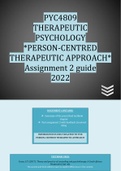
PYC4809
THERAPEUTIC
PSYCHOLOGY
*PERSON-CENTRED
THERAPEUTIC APPROACH*
Assignment 2 guide
2022
DOCUMENT CONTAINS:
Summary of the prescribed textbook
chapter
Past assignment 2 with feedback (received
90%)
INFORMATION IS ONLY RELATED TO THE
PERSON-CENTRED THERAPEUTIC APPROACH
TEXTBOOK USED:
Corey, G.T. (2017). Theory and practice of counseling and psychotherapy: A South African
Perspective (2nd ed).
The second and third editions have no explicit differences in the content.
,Table of Contents
Assignment 2 Instructions................................................................................................................................................. 2
Active link to download pdf version of assignment 2 via MyUnisa: ............................................................................. 2
Assignment 2 format:.................................................................................................................................................... 2
Document Format: ........................................................................................................................................................ 2
Assignment 2..................................................................................................................................................................... 3
PERSON CENTRED THERAPEUTIC APPROACH ................................................................................................................... 5
Chapter 7 Summary ...................................................................................................................................................... 5
Assignment 2 That Received 90% (with feedback) On The Person Centred Approach .............................................. 12
1|Page
,PYC4809 THERAPEUTIC PSYCHOLOGY
Assignment 2 Instructions
In Assignment 02, you will be required to discuss a therapeutic approach of your choice.
You will also be asked to explain how this approach contributes to your self-insight and personal growth.
And how it could be applied in the context where you did your voluntary work.
Active link to download pdf version of assignment 2 via MyUnisa:
https://mymodules.dtls.unisa.ac.za/mod/assign/view.php?id=218619
Assignment 2 format:
Font = Arial 12
Line spacing = 1.5
The margins must be set to normal (25.4 mm)
The page size must be A4
The pages must be numbered
Assignments must be submitted in the PDF format
Document Format:
Cover page
Contents page
Assignment
Plagiarism declaration
Following details must be included on the cover page of your assignment:
Name
Student number
Module code and name
Assignment number and unique number (646427)
Assignment due date
2|Page
,Assignment 2
3|Page
,4|Page
,PERSON CENTRED THERAPEUTIC APPROACH
Chapter 7 Summary
Development of the approach:
In the first period, during the 1940s, Rogers developed what was known as nondirective counseling
Rogers’s theory emphasized the counselor’s creation of a permissive and nondirective climate.
Nondirective counselors avoided sharing a great deal about themselves with clients and instead focused
mainly on reflecting and clarifying the clients’ verbal communications and intended meanings.
In the second period, during the 1950s, Rogers (1951) renamed his approach client-centered therapy,
which reflected his emphasis on the client rather than on nondirective methods.
Rogers assumed that the best vantage point for understanding how people behave was from their own
internal frame of reference.
He focused more explicitly on the actualizing tendency as the basic motivational force that leads to client
change.
The third period, which began in the late 1950s and extended into the 1970s, addressed the necessary and
sufficient conditions of therapy
“becoming the self that one truly is”
he studied the qualities of the client–therapist relationship as a catalyst leading to personality change
The client-centered approach emphasized the role of the therapist as a facilitator of growth and honored
the inherent power of the client. (Corey, G., 2017, p. 166)
The fourth phase, during the 1980s and the 1990s
Because of Rogers’s ever-widening scope of influence, including his interest in how people obtain, possess,
share, or surrender power and control over others and themselves, his theory became known as the
person-centered approach.
In the earliest years of the approach, the client rather than the therapist determined the direction and goals
of therapy and the therapist’s role was to help the client clarify feelings.
This style of nondirective therapy was associated with increased understanding, greater self-exploration,
and improved self-concepts.
Later a shift from clarification of feelings to a focus on the client’s lived experiences took place.
As person-centered therapy developed further, research centered on the core conditions assumed to be
both necessary and sufficient for successful therapy. The attitude of the therapist—an empathic
understanding of the client’s world and the ability to communicate a non- judgmental stance to the client—
along with the therapist’s genuineness were found to be basic to a successful therapy outcome.
The main source of successful psychotherapy is the client. The therapist’s attention to the client’s frame of
reference fosters the client’s utilization of inner and outer resources. (Corey, G., 2017, p. 167)
5|Page
, Key Concepts
A basic sense of trust in the client’s ability to move forward in a constructive manner if conditions fostering
growth are present.
if one is able to get to the core of an individual, one finds a trustworthy, positive center
People are capable of self-understanding and self-direction, able to make constructive changes, and able to
live effective and productive lives.
When therapists are able to experience and communicate their realness, support, caring, and
nonjudgmental understanding, significant changes in the client are most likely to occur.
actualizing tendency is a directional process of striving toward realization, fulfillment, autonomy, and self-
determination - is based on Maslow’s (1970) studies of self-actualizing people
Because of the belief that the individual has an inherent capacity to move away from maladjustment and
toward psychological health and growth, the therapist places the primary responsibility on the client
The person centered approach rejects the role of the therapist as the authority who knows best and of the
passive client who depends on the therapist’s expertise.
Therapy is rooted in the client’s capacity for awareness and self-directed change in attitudes and behavior.
The person-centered approach emphasizes clients’ abilities to engage their own resources to act in their
world with others
By promoting self-awareness and self-reflection, clients learn to exercise choice.
Humanistic therapists emphasize a discovery-oriented approach in which clients are the experts on their
own inner experience (Corey, G., 2017, p. 167).
Self-actualising
*Abraham Maslow’s Contributions to Humanistic Psychology:
The core characteristics of self-actualizing people are self-awareness, freedom, basic honesty and caring, and
trust and autonomy.
Other characteristics of self-actualizing individuals include:
a capacity to welcome uncertainty in their lives, acceptance of themselves and others,
spontaneity and creativity,
a need for privacy and solitude,
autonomy,
a capacity for deep and intense interpersonal relationships,
a genuine caring for others,
6|Page
THERAPEUTIC
PSYCHOLOGY
*PERSON-CENTRED
THERAPEUTIC APPROACH*
Assignment 2 guide
2022
DOCUMENT CONTAINS:
Summary of the prescribed textbook
chapter
Past assignment 2 with feedback (received
90%)
INFORMATION IS ONLY RELATED TO THE
PERSON-CENTRED THERAPEUTIC APPROACH
TEXTBOOK USED:
Corey, G.T. (2017). Theory and practice of counseling and psychotherapy: A South African
Perspective (2nd ed).
The second and third editions have no explicit differences in the content.
,Table of Contents
Assignment 2 Instructions................................................................................................................................................. 2
Active link to download pdf version of assignment 2 via MyUnisa: ............................................................................. 2
Assignment 2 format:.................................................................................................................................................... 2
Document Format: ........................................................................................................................................................ 2
Assignment 2..................................................................................................................................................................... 3
PERSON CENTRED THERAPEUTIC APPROACH ................................................................................................................... 5
Chapter 7 Summary ...................................................................................................................................................... 5
Assignment 2 That Received 90% (with feedback) On The Person Centred Approach .............................................. 12
1|Page
,PYC4809 THERAPEUTIC PSYCHOLOGY
Assignment 2 Instructions
In Assignment 02, you will be required to discuss a therapeutic approach of your choice.
You will also be asked to explain how this approach contributes to your self-insight and personal growth.
And how it could be applied in the context where you did your voluntary work.
Active link to download pdf version of assignment 2 via MyUnisa:
https://mymodules.dtls.unisa.ac.za/mod/assign/view.php?id=218619
Assignment 2 format:
Font = Arial 12
Line spacing = 1.5
The margins must be set to normal (25.4 mm)
The page size must be A4
The pages must be numbered
Assignments must be submitted in the PDF format
Document Format:
Cover page
Contents page
Assignment
Plagiarism declaration
Following details must be included on the cover page of your assignment:
Name
Student number
Module code and name
Assignment number and unique number (646427)
Assignment due date
2|Page
,Assignment 2
3|Page
,4|Page
,PERSON CENTRED THERAPEUTIC APPROACH
Chapter 7 Summary
Development of the approach:
In the first period, during the 1940s, Rogers developed what was known as nondirective counseling
Rogers’s theory emphasized the counselor’s creation of a permissive and nondirective climate.
Nondirective counselors avoided sharing a great deal about themselves with clients and instead focused
mainly on reflecting and clarifying the clients’ verbal communications and intended meanings.
In the second period, during the 1950s, Rogers (1951) renamed his approach client-centered therapy,
which reflected his emphasis on the client rather than on nondirective methods.
Rogers assumed that the best vantage point for understanding how people behave was from their own
internal frame of reference.
He focused more explicitly on the actualizing tendency as the basic motivational force that leads to client
change.
The third period, which began in the late 1950s and extended into the 1970s, addressed the necessary and
sufficient conditions of therapy
“becoming the self that one truly is”
he studied the qualities of the client–therapist relationship as a catalyst leading to personality change
The client-centered approach emphasized the role of the therapist as a facilitator of growth and honored
the inherent power of the client. (Corey, G., 2017, p. 166)
The fourth phase, during the 1980s and the 1990s
Because of Rogers’s ever-widening scope of influence, including his interest in how people obtain, possess,
share, or surrender power and control over others and themselves, his theory became known as the
person-centered approach.
In the earliest years of the approach, the client rather than the therapist determined the direction and goals
of therapy and the therapist’s role was to help the client clarify feelings.
This style of nondirective therapy was associated with increased understanding, greater self-exploration,
and improved self-concepts.
Later a shift from clarification of feelings to a focus on the client’s lived experiences took place.
As person-centered therapy developed further, research centered on the core conditions assumed to be
both necessary and sufficient for successful therapy. The attitude of the therapist—an empathic
understanding of the client’s world and the ability to communicate a non- judgmental stance to the client—
along with the therapist’s genuineness were found to be basic to a successful therapy outcome.
The main source of successful psychotherapy is the client. The therapist’s attention to the client’s frame of
reference fosters the client’s utilization of inner and outer resources. (Corey, G., 2017, p. 167)
5|Page
, Key Concepts
A basic sense of trust in the client’s ability to move forward in a constructive manner if conditions fostering
growth are present.
if one is able to get to the core of an individual, one finds a trustworthy, positive center
People are capable of self-understanding and self-direction, able to make constructive changes, and able to
live effective and productive lives.
When therapists are able to experience and communicate their realness, support, caring, and
nonjudgmental understanding, significant changes in the client are most likely to occur.
actualizing tendency is a directional process of striving toward realization, fulfillment, autonomy, and self-
determination - is based on Maslow’s (1970) studies of self-actualizing people
Because of the belief that the individual has an inherent capacity to move away from maladjustment and
toward psychological health and growth, the therapist places the primary responsibility on the client
The person centered approach rejects the role of the therapist as the authority who knows best and of the
passive client who depends on the therapist’s expertise.
Therapy is rooted in the client’s capacity for awareness and self-directed change in attitudes and behavior.
The person-centered approach emphasizes clients’ abilities to engage their own resources to act in their
world with others
By promoting self-awareness and self-reflection, clients learn to exercise choice.
Humanistic therapists emphasize a discovery-oriented approach in which clients are the experts on their
own inner experience (Corey, G., 2017, p. 167).
Self-actualising
*Abraham Maslow’s Contributions to Humanistic Psychology:
The core characteristics of self-actualizing people are self-awareness, freedom, basic honesty and caring, and
trust and autonomy.
Other characteristics of self-actualizing individuals include:
a capacity to welcome uncertainty in their lives, acceptance of themselves and others,
spontaneity and creativity,
a need for privacy and solitude,
autonomy,
a capacity for deep and intense interpersonal relationships,
a genuine caring for others,
6|Page