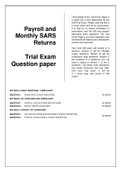
The purpose of the Trial Exam Paper is
to assist you in your preparation for the
ICB Final Exam. Please note that this is
a ‘mock’ exam and not an actual exam.
Payroll and It is also by no means exhaustive or
prescriptive, and the ICB may present
alternative exam questions. The Trial
Monthly SARS Exam Paper is an exam preparation tool
and should not replace your studying the
Returns content and outcomes.
Your final ICB exam will consist of 3
sections. Section A will be Multiple
choice questions. Section B will be
Trial Exam compulsory long questions. Section C
will comprise of 2 questions; you will
have a choice to answer 1 of the 2
Question paper questions. The below mark allocations
are merely illustrative and may differ
from your final exam. It will be
3 ½ hours long, and consist of 180
marks.
SECTION A: SHORT QUESTIONS - COMPULSORY
QUESTION 1: 20 MULTIPLE CHOICE QUESTIONS 40 MARKS
SECTION B: ALL QUESTIONS ARE COMPULSORY
QUESTION 1: PAYROLL CALCULATIONS AND RETURNS 40 MARKS
QUESTION 2: SHORT THEORY QUESTIONS 40 MARKS
SECTION C: CHOOSE 1 OF 2 QUESTIONS
QUESTION 1: VAT CALCULATIONS AND RETURNS & THEORY QUESTIONS
60 MARKS
QUESTION 2: PAYROLL ACCOUNTING & THEORY QUESTIONS
, Section A: Short questions – Compulsory
QUESTION 1 MULTIPLE CHOICE QUESTIONS
Choose the correct answer from the options provided at each of the following questions. Write down only the
letter of your choice next to the corresponding number; e.g. 1.1 D.
1.1 Which of the following is an uncontrollable cost?
A Taking sick leave when it is not really necessary
B Rates to the local government
C Taking extended breaks over lunch or tea
D Being late for work
1.2. Any manager of a business, whether it is an international organisation or an informal business, will
perform basic tasks. Which of the following is not a main function of management?
A Control
B Co-ordinating
C Directing
D Planning
1.3. Issues relating to business ethics and corporate governance can be incorporated into almost every
aspect of accounting. Which of the following does not apply to accounting?
A One partner makes excessive drawings from the business
B Failure to pay over VAT
C Unauthorised use of non-current assets
D Use of inferior raw materials
1.4. Internal controls are intended to ensure that . . .
A fraud is prevented and detected at all costs.
B the business maintains a high level of professional competency.
C personal integrity of all employers and employees is maintained.
D sensitive matters are treated with confidentiality.
1.5. Which of the following is not an advantage for the regulation of tax practitioners?
A Protection of the public
B Increased administrative efficiency of SARS
C Restriction of competition
D Improved integrity of the tax system
to assist you in your preparation for the
ICB Final Exam. Please note that this is
a ‘mock’ exam and not an actual exam.
Payroll and It is also by no means exhaustive or
prescriptive, and the ICB may present
alternative exam questions. The Trial
Monthly SARS Exam Paper is an exam preparation tool
and should not replace your studying the
Returns content and outcomes.
Your final ICB exam will consist of 3
sections. Section A will be Multiple
choice questions. Section B will be
Trial Exam compulsory long questions. Section C
will comprise of 2 questions; you will
have a choice to answer 1 of the 2
Question paper questions. The below mark allocations
are merely illustrative and may differ
from your final exam. It will be
3 ½ hours long, and consist of 180
marks.
SECTION A: SHORT QUESTIONS - COMPULSORY
QUESTION 1: 20 MULTIPLE CHOICE QUESTIONS 40 MARKS
SECTION B: ALL QUESTIONS ARE COMPULSORY
QUESTION 1: PAYROLL CALCULATIONS AND RETURNS 40 MARKS
QUESTION 2: SHORT THEORY QUESTIONS 40 MARKS
SECTION C: CHOOSE 1 OF 2 QUESTIONS
QUESTION 1: VAT CALCULATIONS AND RETURNS & THEORY QUESTIONS
60 MARKS
QUESTION 2: PAYROLL ACCOUNTING & THEORY QUESTIONS
, Section A: Short questions – Compulsory
QUESTION 1 MULTIPLE CHOICE QUESTIONS
Choose the correct answer from the options provided at each of the following questions. Write down only the
letter of your choice next to the corresponding number; e.g. 1.1 D.
1.1 Which of the following is an uncontrollable cost?
A Taking sick leave when it is not really necessary
B Rates to the local government
C Taking extended breaks over lunch or tea
D Being late for work
1.2. Any manager of a business, whether it is an international organisation or an informal business, will
perform basic tasks. Which of the following is not a main function of management?
A Control
B Co-ordinating
C Directing
D Planning
1.3. Issues relating to business ethics and corporate governance can be incorporated into almost every
aspect of accounting. Which of the following does not apply to accounting?
A One partner makes excessive drawings from the business
B Failure to pay over VAT
C Unauthorised use of non-current assets
D Use of inferior raw materials
1.4. Internal controls are intended to ensure that . . .
A fraud is prevented and detected at all costs.
B the business maintains a high level of professional competency.
C personal integrity of all employers and employees is maintained.
D sensitive matters are treated with confidentiality.
1.5. Which of the following is not an advantage for the regulation of tax practitioners?
A Protection of the public
B Increased administrative efficiency of SARS
C Restriction of competition
D Improved integrity of the tax system