Lecture 2 (Chapters 4 & 7)
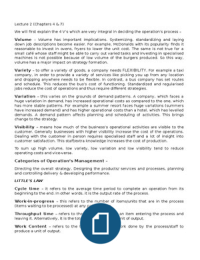
We will first explain the 4 V’s which are very integral in deciding the operation’s process –
Volume – Volume has important implications. Systemizing, standardizing and laying
down job descriptions become easier. For example, McDonalds with its popularity finds it
reasonable to invest in ovens, fryers to lower the unit cost. The same is not true for a
small café whose staff might be able to carry out varied tasks and investing in specialised
machines is not possible because of low volume of the burgers produced. So this way,
volume has a major impact on strategy formation.
Variety – to offer a variety of goods, a company needs FLEXIBILITY. For example a taxi
company, in order to provide a variety of services like picking you up from any location
and dropping anywhere needs to be flexible. In contrast, a bus company has set routes
and schedule. This reduces the bus’s cost of functioning. Standardized and regularised
jobs reduce the cost of operations and thus require different strategies.
Variation – this varies on the grounds of demand patterns. A company, which faces a
huge variation in demand, has increased operational costs as compared to the one, which
has more stable patterns. For example a summer resort faces huge variations (summers
have increased demand) and has higher operational costs than a hotel, which has levelled
demands. A demand pattern affects planning and scheduling of activities. This brings
change to the strategy.
Visibility – means how much of the business’s operational activities are visible to the
customer. Generally businesses with higher visibility increase the cost of the operations.
Dealing with the customer in person requires specialised staff and a lot of insight into
customer satisfaction. This staff/extra knowledge increases the cost of production.
To sum up high volume, low variety, low variation and low visibility tend to reduce
operating costs and vice-versa.
Categories of Operation’s Management –
Directing the overall strategy, Designing the products/ services and processes, planning
and controlling delivery & developing performance.
LITTLE’S LAW
Cycle time – it refers to the average time period to complete an operation from its
beginning to the end. In other words, it is the output rate of the process.
Work-in-progress – this refers to the number of items/units that are in the process
(items waiting to be processed) at any point of time.
Throughput time – refers to the duration between an item entering the process and
leaving it. Alternatively, it is the total time to process a unit of output.
Work Content – refers to the total time required/work done by the process/staff to
produce a unit of output.
We will first explain the 4 V’s which are very integral in deciding the operation’s process –
Volume – Volume has important implications. Systemizing, standardizing and laying
down job descriptions become easier. For example, McDonalds with its popularity finds it
reasonable to invest in ovens, fryers to lower the unit cost. The same is not true for a
small café whose staff might be able to carry out varied tasks and investing in specialised
machines is not possible because of low volume of the burgers produced. So this way,
volume has a major impact on strategy formation.
Variety – to offer a variety of goods, a company needs FLEXIBILITY. For example a taxi
company, in order to provide a variety of services like picking you up from any location
and dropping anywhere needs to be flexible. In contrast, a bus company has set routes
and schedule. This reduces the bus’s cost of functioning. Standardized and regularised
jobs reduce the cost of operations and thus require different strategies.
Variation – this varies on the grounds of demand patterns. A company, which faces a
huge variation in demand, has increased operational costs as compared to the one, which
has more stable patterns. For example a summer resort faces huge variations (summers
have increased demand) and has higher operational costs than a hotel, which has levelled
demands. A demand pattern affects planning and scheduling of activities. This brings
change to the strategy.
Visibility – means how much of the business’s operational activities are visible to the
customer. Generally businesses with higher visibility increase the cost of the operations.
Dealing with the customer in person requires specialised staff and a lot of insight into
customer satisfaction. This staff/extra knowledge increases the cost of production.
To sum up high volume, low variety, low variation and low visibility tend to reduce
operating costs and vice-versa.
Categories of Operation’s Management –
Directing the overall strategy, Designing the products/ services and processes, planning
and controlling delivery & developing performance.
LITTLE’S LAW
Cycle time – it refers to the average time period to complete an operation from its
beginning to the end. In other words, it is the output rate of the process.
Work-in-progress – this refers to the number of items/units that are in the process
(items waiting to be processed) at any point of time.
Throughput time – refers to the duration between an item entering the process and
leaving it. Alternatively, it is the total time to process a unit of output.
Work Content – refers to the total time required/work done by the process/staff to
produce a unit of output.