

🛷
L6 - The endosymbiotic theory
and introduction to
phylogenetics
This block will move on to how we use extranuclear DNA as an evolutionary
molecular marker.
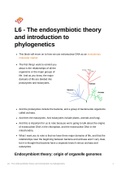
The first thing I want to remind you
about is the relationships of all the
organisms or the major groups of
life. And as you know, the major
domains of life are divided into
prokaryotes and eukaryotes.
And the prokaryotes include the bacteria, and a group of bacteria-like organisms
called archaea.
And then the eukaryotes. And eukaryotes include plants, animals and fungi.
And this is important for us to note because we’re going to talk about the origins
of extranuclear DNA in the chloroplast, and the extranuclear DNA in the
mitochondria.
What I want you to note is that we have three major domains of life, and that the
relationships near the beginning between bacteria and archaea aren’t very clear,
but it is thought that bacteria have a separate branch versus archaea and
eukaryotes.
Endosymbiont theory: origin of organelle genomes
L6 - The endosymbiotic theory and introduction to phylogenetics 1
, So what we’re now going to discuss is the endosymbiotic theory that explains
the origins of organelle genomes.
The endosymbiont theory was first proposed in the 1970s by a scientist called
Lynn Margulis, and what she proposed, and we have lots of evidence for this, as
I’ll show you in the subsequent slides, is that mitochondria and chloroplasts were
originally free-living bacteria that originated more than one billion years ago.
And the idea is that ancient cells, also bacteria-like cells, engulfed the bacteria
which subsequently became mitochondria or chloroplasts, millions of years ago,
and these two bacteria then established a symbiotic relationship.
Symbiotic means mutually beneficial.
That ancient cells in one event engulfed mitochondria, and the mitochondria
came from bacteria, and that chloroplasts were engulfed by these ancient cells
as a secondary event, after mitochondria were enveloped.
And the chloroplast came from a special group of bacteria called cyanobacteria.
And the ancient cells proposed to be the host for this engulfing are cells, single
cells from the domain of life called archaea.
So archaea are good candidates for the primitive hosts of the endosymbionts
that eventually came eukaryotes.
On the right-hand
side of this slide
there is a diagram
that depicts some
of the events of the
endosymbiosis that
supports the
endosymbiont
theory of the origin
of organelles.
L6 - The endosymbiotic theory and introduction to phylogenetics 2
L6 - The endosymbiotic theory
and introduction to
phylogenetics
This block will move on to how we use extranuclear DNA as an evolutionary
molecular marker.
The first thing I want to remind you
about is the relationships of all the
organisms or the major groups of
life. And as you know, the major
domains of life are divided into
prokaryotes and eukaryotes.
And the prokaryotes include the bacteria, and a group of bacteria-like organisms
called archaea.
And then the eukaryotes. And eukaryotes include plants, animals and fungi.
And this is important for us to note because we’re going to talk about the origins
of extranuclear DNA in the chloroplast, and the extranuclear DNA in the
mitochondria.
What I want you to note is that we have three major domains of life, and that the
relationships near the beginning between bacteria and archaea aren’t very clear,
but it is thought that bacteria have a separate branch versus archaea and
eukaryotes.
Endosymbiont theory: origin of organelle genomes
L6 - The endosymbiotic theory and introduction to phylogenetics 1
, So what we’re now going to discuss is the endosymbiotic theory that explains
the origins of organelle genomes.
The endosymbiont theory was first proposed in the 1970s by a scientist called
Lynn Margulis, and what she proposed, and we have lots of evidence for this, as
I’ll show you in the subsequent slides, is that mitochondria and chloroplasts were
originally free-living bacteria that originated more than one billion years ago.
And the idea is that ancient cells, also bacteria-like cells, engulfed the bacteria
which subsequently became mitochondria or chloroplasts, millions of years ago,
and these two bacteria then established a symbiotic relationship.
Symbiotic means mutually beneficial.
That ancient cells in one event engulfed mitochondria, and the mitochondria
came from bacteria, and that chloroplasts were engulfed by these ancient cells
as a secondary event, after mitochondria were enveloped.
And the chloroplast came from a special group of bacteria called cyanobacteria.
And the ancient cells proposed to be the host for this engulfing are cells, single
cells from the domain of life called archaea.
So archaea are good candidates for the primitive hosts of the endosymbionts
that eventually came eukaryotes.
On the right-hand
side of this slide
there is a diagram
that depicts some
of the events of the
endosymbiosis that
supports the
endosymbiont
theory of the origin
of organelles.
L6 - The endosymbiotic theory and introduction to phylogenetics 2


