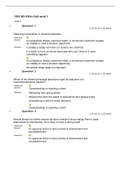
CEFS 501-Ethics Quiz week 1
Week 1
• Question 1
2.25 out of 2.25 points
Obtaining consultation is important because:
Selected
Answer:
our prejudices, biases, personal needs, or emotional investment creates
an inability to view a situation objectively.
Answers: it creates a safety net when our actions are unethical.
it is better to have someone else know who your client is in case
something happens.
our prejudices, biases, personal needs, or emotional investment creates
an inability to view a situation objectively.
the ethical codes state it is important.
• Question 2
2.25 out of 2.25 points
Which of the following therapist behaviors might be indicative of a
countertransference reaction?
Selected
Answer:
Overprotecting or rejecting a client
Answers: Refraining from giving advice
Allowing the client the space to experience and release anger
Empowering a client to make decisions
Overprotecting or rejecting a client
• Question 3
2.25 out of 2.25 points
Ronald directs his clients toward solutions instead of encouraging them to seek
alternatives for themselves. He is likely to have a strong need:
Selected
Answer:
for approval and/or to feel a sense of achievement and
accomplishment.
Answers:
for approval and/or to feel a sense of achievement and
accomplishment.
, to allow the client to come up with solutions.
to empower his client.
to nurture his client.
• Question 4
2.25 out of 2.25 points
An ethical issue arises when:
Selected
Answer:
counselors encourage and promote dependence on the part of their
clients.
Answers: a new client temporarily experiences a period of dependence on the
counselor.
counselors encourage clients to come up with solutions to problems with
minimal help from the counselor.
a client develops an unhealthy dependence on their counselor and the
counselor deals with it therapeutically, without blaming the client.
counselors encourage and promote dependence on the part of their
clients.
• Question 5
2.25 out of 2.25 points
When counselors become overly concerned with meeting their own needs or pushing
their own personal agendas, their behavior becomes:
Selected
Answer:
unethical.
Answers: annoying to the client.
unethical.
illegal.
helpful to the client.
• Question 6
2.25 out of 2.25 points
The first essential step towards ethical decision making is:
Selected
Answer:
identifying the problem or dilemma.
Answers:
identifying the problem or dilemma.
Week 1
• Question 1
2.25 out of 2.25 points
Obtaining consultation is important because:
Selected
Answer:
our prejudices, biases, personal needs, or emotional investment creates
an inability to view a situation objectively.
Answers: it creates a safety net when our actions are unethical.
it is better to have someone else know who your client is in case
something happens.
our prejudices, biases, personal needs, or emotional investment creates
an inability to view a situation objectively.
the ethical codes state it is important.
• Question 2
2.25 out of 2.25 points
Which of the following therapist behaviors might be indicative of a
countertransference reaction?
Selected
Answer:
Overprotecting or rejecting a client
Answers: Refraining from giving advice
Allowing the client the space to experience and release anger
Empowering a client to make decisions
Overprotecting or rejecting a client
• Question 3
2.25 out of 2.25 points
Ronald directs his clients toward solutions instead of encouraging them to seek
alternatives for themselves. He is likely to have a strong need:
Selected
Answer:
for approval and/or to feel a sense of achievement and
accomplishment.
Answers:
for approval and/or to feel a sense of achievement and
accomplishment.
, to allow the client to come up with solutions.
to empower his client.
to nurture his client.
• Question 4
2.25 out of 2.25 points
An ethical issue arises when:
Selected
Answer:
counselors encourage and promote dependence on the part of their
clients.
Answers: a new client temporarily experiences a period of dependence on the
counselor.
counselors encourage clients to come up with solutions to problems with
minimal help from the counselor.
a client develops an unhealthy dependence on their counselor and the
counselor deals with it therapeutically, without blaming the client.
counselors encourage and promote dependence on the part of their
clients.
• Question 5
2.25 out of 2.25 points
When counselors become overly concerned with meeting their own needs or pushing
their own personal agendas, their behavior becomes:
Selected
Answer:
unethical.
Answers: annoying to the client.
unethical.
illegal.
helpful to the client.
• Question 6
2.25 out of 2.25 points
The first essential step towards ethical decision making is:
Selected
Answer:
identifying the problem or dilemma.
Answers:
identifying the problem or dilemma.