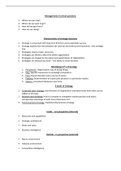
Managements 4 critical questions
1. Where are we now?
2. Where do we want to go?
3. How will we get there?
4. How are we doing?
Characteristics of strategic decisions
1. Strategy is concerned with long term direction and sustainable success.
2. Strategy exploits the links between the internal and external environments – the strategic
link.
3. Strategies require major resources.
4. Strategies are likely to affect the whole organisation.
5. Strategies are shaped by the values and expectations of stakeholders.
6. Strategies are directed by vision – the ability to move forward.
Mintzbergs 5 P’s of strategy
1. Perspective: Organisations way of doing things.
2. Ploy: Specific manoeuvre to outweigh competitors
3. Plan: Overall direction and a course of action.
4. Position: Determination of a particular product in a particular market.
5. Pattern: Consistent behaviour over time.
3 levels of strategy:
1. Corporate level strategy: Sets direction of organisation and determines how value can be
added at all levels.
2. Business level strategy: How to compete to strengthen market position and attain
comparative advantage of each area of business unit.
3. Functional level strategy: Implementing business strategy.
Inside – out perspective (Internal)
• Resources and capabilities
• Strategic architecture
• Goals and value
• Business intelligence
Outside – in perspective (external)
• Macro environment
• Industry environment
• Competitive Intelligence
1. Where are we now?
2. Where do we want to go?
3. How will we get there?
4. How are we doing?
Characteristics of strategic decisions
1. Strategy is concerned with long term direction and sustainable success.
2. Strategy exploits the links between the internal and external environments – the strategic
link.
3. Strategies require major resources.
4. Strategies are likely to affect the whole organisation.
5. Strategies are shaped by the values and expectations of stakeholders.
6. Strategies are directed by vision – the ability to move forward.
Mintzbergs 5 P’s of strategy
1. Perspective: Organisations way of doing things.
2. Ploy: Specific manoeuvre to outweigh competitors
3. Plan: Overall direction and a course of action.
4. Position: Determination of a particular product in a particular market.
5. Pattern: Consistent behaviour over time.
3 levels of strategy:
1. Corporate level strategy: Sets direction of organisation and determines how value can be
added at all levels.
2. Business level strategy: How to compete to strengthen market position and attain
comparative advantage of each area of business unit.
3. Functional level strategy: Implementing business strategy.
Inside – out perspective (Internal)
• Resources and capabilities
• Strategic architecture
• Goals and value
• Business intelligence
Outside – in perspective (external)
• Macro environment
• Industry environment
• Competitive Intelligence