NURS 223L - INTERPERSONAL PROCESS ANALYSIS 1.
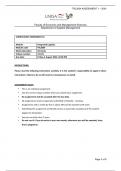
NURS 223L - INTERPERSONAL PROCESS ANALYSIS 1. Student: NAME HERE Date: 05/01/20 Clinical Instructor: Name (initials only): VR Unit: secure psych unit Current Legal Status (Vol., 5150, 5250, 30-day, T-Con, LPS-Conservatorship): Family still care for patient. “Grandson and niece that is her support system and Power of Attorney” Multiaxial Diagnostic System: Axis I (Clinical Disorder): ANXIETY, DEMENTIA, DEPRESSION Axis II (Personality Disorder / Mental Retardation): Alter mental statue Axis III (General Medical Conditions): CHF, DVT, Stage IV ovarian cancer. Axis IV (Psychosocial and Environmental Problems): Lack of education, only attended high school. Refused to attend group activities. Axis V (Global Assessment of Functioning Scale): Level 31. Pt possesses some danger of hurting self or others. 1. Description of the patient: Age? Sex? Ethnicity? Marital Status? What precipitated hospitalization? Number of days in the hospital? Mental Status, etc. Client is 57 years old Caucasian female, divorced some couple of years ago, but has a grandson and a niece, who is her support and also her power of Attorney. Patient was in the memory care about two years ago. Patients wanders to other patients’ rooms and slap them in the face, go around stealing medication cups. Before her admission to the hospital, she was admitted to the hospice, due her terminal illness, that have metastasized to her brain causing her alter mental statue. Patient was admitted to Millwood hospital for an attempted elopement from her memory care unit. Patient was admitted on the 04/24/20, and has been in the hospital for one week now. She is alert and oriented x 1. Patient has a wander guard on her ankle so she does not attempt to elope. Patient has been uncooperative with care, has a poor judgment, ambulates independently, she has a low tone and soft speech, and thinks that everyone is trying to hold her hostage. When asked the reason for admission, patient was tearful without eye contact states “I don’t know”. Pt is so anxious that she couldn’t sit down during the interaction process, she was just pacing all forth and back the room, but could still answer some questions. 2. Description of environmental setting where interaction took place. Explain the reasons for a supportive or non-supportive environment. (e.g. noise, distractions, light, temperature, etc.) The discussion with the patient, was in patient room, and the discussion lasted about 45 minutes. The patient was pacing back and forth in the room as the discussion was going on, which may be due to room condition, although the room was quiet, it had a bright light, as the curtain to the room were open, the temperature of the room was cold. As I went closed to give patient some therapeutic words to let her know she is in good hand and she going to be taking good care of, Patient still continue pacing rapidly back and forth. She denies homicidal, suicidal, visual or auditory hallucination. Pt mood could still be due to the condition of the room that has the too much bright light, couple with the cold in the room. INTERPERSONAL PROCESS ANALYSIS NAME: TAIWO ANIYEDE DATE: 05/01/20 Student: • Verbal (quotes) and Nonverbal Communication (behavior, tone of voice, eye Patient: Verbal (quotes) and Nonverbal Communication (behavior, Communication Techniques • Identify communication technique used then define your communication techniques Critique and Analysis (effective or not effective? Could have said…) Document your thoughts and feelings Goal: My goal was to have initial conversation with the patient to know what Verbal: “I don’t know” Nonverbal : No eye contact, pacing forth and back in the room. Started the conversation to allow the patient take the lead on the discussion. It wasn’t real an effective technique because the patient never relaxed to communicate with me, although was answering questions but no eye contact and was pacing back and forth in room as the discussion was going on. brough her to the hospital. Verbal: So, tell me what brought you to the hospital today Nonverbal: Sitting calm facing the patient. Therapeutic. Defense: Denial saying she does not know why she was brought to the hospital. Coping: By pacing for and back in the room to help his anxiety. Goal: To initiate an open conversation with the patient to get to know her Page 4 of 7 dy source was downloaded by from Co Verbal: None urseH on :39:12 GM Trying to establish nurse patient relationship. T -05:00 My goal wasn’t really effective as patient was not in the mood for the INTERPERSONAL PROCESS ANALYSIS SUMMARY 1. Evaluation: After analyzing the interaction, provide a description on how the interaction progressed. Identify the reasons for successful process or unsuccessful process. What did you learn from the interaction with your patient? I felt that my interaction was fruitful due to the therapeutic nature of our association, . Despite the fact that her graph may have expressed she was some of the time forceful and regularly on edge, our discussion was neither forceful nor on edge. I recalled my therapeutic correspondence and never ask for what good reason question. I am ready to perceive that my therapeutic correspondence despite everything needs more work, and I should attempt to pose the correct kind of inquiry, or I won't get the reaction I am looking for. I was additionally effectively ready to divert my inquiries during the discussion so it would stay therapeutic. 2. How did you personally feel about the interaction? What would you change if you had to redo the interaction? I for one feel that my discussion with this patient worked out positively and remained therapeutic in any event, when she got tragic. It was somewhat hard for me to pose a portion of the harder inquiries and I was somewhat terrified of how she may respond realizing her diagnosis, expressed she has some animosity; however, I am happy with the consequence of the discussion. I would change the way I expressed my reaction to her memory. Subsequent to posing the inquiry I realized I couldn't find a solution since she was unable to recall, and also very anxious. STUDENT SIGNATURE: Taiwo Aniyede DATE: 05/01/20 INSTRUCTOR SIGNATURE: DATE: COMMENTS: REFRENCES: Halter, M. J. (2018). Varcarolis foundations of psychiatric-mental health nursing: A clinical approach. St. Louis, MO: Elsevier.
Written for
- Institution
- NURS 223L - INTERPERSONAL PROCESS ANALYSIS 1.
- Course
- NURS 223L - INTERPERSONAL PROCESS ANALYSIS 1.
Document information
- Uploaded on
- June 11, 2022
- Number of pages
- 9
- Written in
- 2021/2022
- Type
- Exam (elaborations)
- Contains
- Questions & answers
Subjects
-
nurs 223l interpersonal process analysis 1
-
nurs 223l interpersonal process analysis 1 student name here date 050120 clinical instructor name initials only vr unit secure psyc