UNIT 7: THE FIRM AND ITS CUSTOMERS
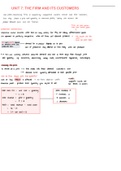
How profit maximizing firms
-
in
imperfectly competitive markets interact with their customers ;
how
they choose price and quantity to profits taking into the
'
a maximize account
,
product demand curve and cost function .
•
firms are price -
setters
firms have market
power
◦
IMPERFECT COMPETITION : ^
competitive market situation where there are
many sellers
,
but they are
selling differentiated goods
( as opposed to
perfectly competitive : when all firms sell identical products ) > •
the market sets the
price
•
firms are price
-
takers
price and
quantity depend
on demand ( Wtp ) and
demand for a product depends on its price
production costs
how
cost of
production may depend on
many units are produced
.
* A firm can actively influence consumer demand and cost in more
ways than through price
and environmental technologies
quantity . . .
e.g .
innovation
, advertising , wage, taxes,
regulation ,
choosing the price
to decide on a price > firm needs info about demand : customer 's WTP
>
demand curve :
quantity demanded at each possible price
How do firms choose price and quantity ?
* Note :
Look at how PROFIT is affected .
> the firm 's objective =
profit
ISO profit curves are
maximize profit :
produce exact
quantity you expect to sell
not tested in c- cos 114
Total profit increases if :
costs ITC ) unit cost ×
quantity
=
=
C ✗ Q •
P increases or
total revenue =
price ×
quantity • Q increases or
= P x Q •
c decreases
Profit = total revenue -
total costs
=
TR TC
-
=
( P -
unit cost) ✗ Q
, Price -
setting firms
differentiated
sell
goods
•
•
have some market power
•
e.
g. monopolies or
oligopolies
with market
monopoly :
single firm produces goods no close substitutes (have a LOT of
power)
oligopoly : small number of large firms produce similar
,
but slightly different goods . u
only one seller
price -
taking firms
•
these firms sell homogenous / identical goods
•
have no market power
total revenue :
PRODUCT DIFFERENTIATION full amount of total
sales of and services
goods
Homogenous goods
.
TR = total amount of goods
•
good sold in the market are
completely and services ✗
price
identical in
every aspect
•
impossible to sell at higher price than sellers
•
firms are price -
takers
provide 2 different models
for analysing firms and
Differentiated goods markets
•
products differ by characteristics ( quality ,
style ,
location ) value
and consumers
variety Uniqueness
+
profit =
revenue -
costs
IT = TR -
TC
•
different firms compete for buyers on multiple
price and
TR =
quantity
fronts price and
:
quantity demand curve
firms each firm its
TC =
quantity
price
°
are -
setters so sets
, cost curves
own price
•
a higher price may cause some customers to
move to competitors
, Monopolistic competitors and monopolies
Firms selling differentiated products compete against other firms selling their varieties
•
own
of the same
type of product .
Even though such firms have market power , they still face a degree of competition for
market share to their competitors
Natural monopoly :
a
production process in which the long -
run
average cost curve is
sufficiently downward -
sloping to make it impossible to sustain competition among firms in this market.
•
monopolies face no
competition at all :
a
single firm controls the entire
supply in a market
there are no close substitutes for its products
Firms selling differentiated products and monopolies both price
*
are -
setters .
demand
* Both are constrained
by downwards -
sloping curves .
Monopoly 's demand
= Market demand
downwards -
sloping demand curve * refers to whole market
not all P Q combinations are feasible
,
monopolies
Barriers to
entry :
•
Exclusive ownership of a resource ( De Beers)
Legal ( Telkom)
patents copyright
•
:
,
Cost of production [ economies of scale ] ( Eskom ) natural monopoly
•
:
monopoly 's demand =
market demand
How profit maximizing firms
-
in
imperfectly competitive markets interact with their customers ;
how
they choose price and quantity to profits taking into the
'
a maximize account
,
product demand curve and cost function .
•
firms are price -
setters
firms have market
power
◦
IMPERFECT COMPETITION : ^
competitive market situation where there are
many sellers
,
but they are
selling differentiated goods
( as opposed to
perfectly competitive : when all firms sell identical products ) > •
the market sets the
price
•
firms are price
-
takers
price and
quantity depend
on demand ( Wtp ) and
demand for a product depends on its price
production costs
how
cost of
production may depend on
many units are produced
.
* A firm can actively influence consumer demand and cost in more
ways than through price
and environmental technologies
quantity . . .
e.g .
innovation
, advertising , wage, taxes,
regulation ,
choosing the price
to decide on a price > firm needs info about demand : customer 's WTP
>
demand curve :
quantity demanded at each possible price
How do firms choose price and quantity ?
* Note :
Look at how PROFIT is affected .
> the firm 's objective =
profit
ISO profit curves are
maximize profit :
produce exact
quantity you expect to sell
not tested in c- cos 114
Total profit increases if :
costs ITC ) unit cost ×
quantity
=
=
C ✗ Q •
P increases or
total revenue =
price ×
quantity • Q increases or
= P x Q •
c decreases
Profit = total revenue -
total costs
=
TR TC
-
=
( P -
unit cost) ✗ Q
, Price -
setting firms
differentiated
sell
goods
•
•
have some market power
•
e.
g. monopolies or
oligopolies
with market
monopoly :
single firm produces goods no close substitutes (have a LOT of
power)
oligopoly : small number of large firms produce similar
,
but slightly different goods . u
only one seller
price -
taking firms
•
these firms sell homogenous / identical goods
•
have no market power
total revenue :
PRODUCT DIFFERENTIATION full amount of total
sales of and services
goods
Homogenous goods
.
TR = total amount of goods
•
good sold in the market are
completely and services ✗
price
identical in
every aspect
•
impossible to sell at higher price than sellers
•
firms are price -
takers
provide 2 different models
for analysing firms and
Differentiated goods markets
•
products differ by characteristics ( quality ,
style ,
location ) value
and consumers
variety Uniqueness
+
profit =
revenue -
costs
IT = TR -
TC
•
different firms compete for buyers on multiple
price and
TR =
quantity
fronts price and
:
quantity demand curve
firms each firm its
TC =
quantity
price
°
are -
setters so sets
, cost curves
own price
•
a higher price may cause some customers to
move to competitors
, Monopolistic competitors and monopolies
Firms selling differentiated products compete against other firms selling their varieties
•
own
of the same
type of product .
Even though such firms have market power , they still face a degree of competition for
market share to their competitors
Natural monopoly :
a
production process in which the long -
run
average cost curve is
sufficiently downward -
sloping to make it impossible to sustain competition among firms in this market.
•
monopolies face no
competition at all :
a
single firm controls the entire
supply in a market
there are no close substitutes for its products
Firms selling differentiated products and monopolies both price
*
are -
setters .
demand
* Both are constrained
by downwards -
sloping curves .
Monopoly 's demand
= Market demand
downwards -
sloping demand curve * refers to whole market
not all P Q combinations are feasible
,
monopolies
Barriers to
entry :
•
Exclusive ownership of a resource ( De Beers)
Legal ( Telkom)
patents copyright
•
:
,
Cost of production [ economies of scale ] ( Eskom ) natural monopoly
•
:
monopoly 's demand =
market demand