UNIT 2 “ANALYZING NARRATIVE TEXTS”. NOTES
1. WHAT IS PROSE FICTION?
(falta completar con lo de la Study Guide 2)
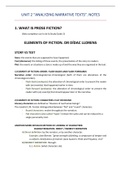
ELEMENTS OF FICTION. DR DÍDAC LLORENS
STORY VS TEXT
Story: the events that are supposed to have happened.
Text (discourse): the telling of these events, the presentation of the story to readers.
Plot: the events or situations a story is made up of and the way they are organised in the text.
1) ELEMENT OF FICTION: ORDER. FLASH-BACKS AND FLASH-FORWARDS
Narrative order: chronological/non-chronological (both of them are alterations of the
chronological order).
- Flash-back (analepsis): the alteration of chronological order to present the reader
with (an) event(s) that happened earlier in time.
- Flash-forward (prolepsis): the alteration of chronological order to present the
reader with (an) event(s) that should appear later in the narrative.
2) ELEMENT OF FICTION: CHARACTERS: FLAT OR ROUND
Literary characters are defined as “illusions of real human beings”
The novelist E.M. Forster distinguished between “flat” and “round” characters.
- Round characters: evolve throughout the narration.
- Flat characters (also called “types”) remain the same and can be reduced to a
single personality trait.
ANOTHER MORE DETAILED METHOD OF LOOKING AT CHARACTERS:
CHARACTERISATION. DIRECT / INDIRECT DEFINITION
A) Direct definition: by the narrator, or by another character.
Example: Jane Bennet: “great strength of feeling, a composure of temper and
a uniform cheerfulness of manner (Jane Austen’s Pride and Prejudice, ch.6”
B) INDIRECT DEFINITION: through:
b.1. Action: (what characters do).
, Example: going on foot to places rather than taking a carriage because this
character is not too concerned about appearances.
b.2. Speech: the kind of language used (ideolectal, sociolectal, dialectal
features).
Example: Mary Bennet who uses pedantic language and the other sisters Lydia
and Kitty that by contrast use a language that is childish and frivolous, in
accordance with their personalities.
b.3. External/Physical appearance: which may reinforce psychological traits.
Example: In Charles Dickens’s “Hard Times” Mr.Boudady is described as
“having a big head and a very prominent forehead”.
b.4. Analogy , typically, between a character’s name, the place where they live,
and their personality or between the place where they live and their
personality.
CHARACTERISATION
1) Do we have access to their minds / their thoughts?
2) Are they verisimilar (believable) as human beings?
3) Do they represent a concept or idea? Are they allegorical? (Very common in medieval
texts).
4) Are they prototypical of a genre?
5) What parts of their lives show through more clearly?
3) ELEMENT OF FICTION: POINT OF VIEW. PERSONAL / IMPERSONAL NARRATION
Point of view: WHO narrates and HOW. It has nothing to do with the narrator’s ideology or
opinions.
Personal/impersonal narration: in personal narration there’s a presence of a narator
mediating between the events told and the reader who reads about these events.
PERSONAL NARRATION
Narrator: the immediate communicator of the fiction
Two types of narrators:
o INTERNAL: characters in the story, either main characters or secondary
characters who are not involved in the events.
o EXTERNAL: only exist in the text (they are not characters in the story): also
called authorial narrators or third-person narrators.
IMPERSONAL NARRATION
There is an attempt to erase the narrator so that the story progresses in dialoge, as in drama
or as in cinema. “Camera-eye view,” “fly-on-the-wall”.
ANOTHER CONCEPTS RELATED TO POINT OF VIEW
OMNISCIENCE
It is associated with personal narration. There are several degrees of omniscience.
2
, - Having access to characters’ minds (mental access or inner view).
- Knowing/witnessing/seeing things that the characters cannot know/witnes/see.
- Being able to interpret characters’ actions and knowing their motives.
- Judging or criticising characters (typycal of XIX century fiction).
- Commenting on aspects not directly related with the narration.
Omniscience can be:
SELECTIVE OMNISCIENCE: the narrator has access to characters’ thoughts but the story is
filtered through the point of view of this character. Selective omniscience can move from one
character to another in the same narration. The character chosen for the narration can be the
“filter character”.
THOUGHT PRESENTATION
Characters can express their thoughts on fiction and narrators can have access to their minds.
The concepts of stream of consciousness and interior monologue are used when characters’
thoughts are conveyed.
Characters’ speech can appear in direct speech (dialogues) or what they say can be reported
by the narrator or by another character.
- Direct speech. Example: “The end is near”, she thought.
- Reported speech. Example: she thought that the end was near.
- Free indirect speech/style: a modality of thought presentation in which the
character’s direct speech is combined with the narrator’s indirect report. Example:
the end was near. We have neither quotation marks nor reporting verb. The
sentence has the same structure as in direct speech but the tense has changed as
in reported speech. We are having access to the character’s mind through the
narrator.
NARRATEE, FRAME NARRATION AND UNRELIABLE NARRATOR
Narratee: the receiver of the story told by a narrator who is typically internal.
Frame narrative: a narrative in which the narrator communicates with a narratee.
Example: “The Canterbury Tales” where the pilgrims travelled together to Canterbury (FRAME
NARRATIVE) and each of the tales that the pilgrims tell are the FRAMED NARRATIVES. The
other pilgrims become the NARRATEES when they listen to the tale told by the pilgrim.
Unreliable narrator: one whose version of the events is suspect, distorted, and is therefore
put into question by readers. There is a discrepancy between what the narrator says and what
would readers could deduce from the text.
As a rule, readers consider true what the narrators tell them. They have signed a “contract”
(PACTO DE FICCIÓN) that if it was broken we would consider the narrator unreliable.
3
1. WHAT IS PROSE FICTION?
(falta completar con lo de la Study Guide 2)
ELEMENTS OF FICTION. DR DÍDAC LLORENS
STORY VS TEXT
Story: the events that are supposed to have happened.
Text (discourse): the telling of these events, the presentation of the story to readers.
Plot: the events or situations a story is made up of and the way they are organised in the text.
1) ELEMENT OF FICTION: ORDER. FLASH-BACKS AND FLASH-FORWARDS
Narrative order: chronological/non-chronological (both of them are alterations of the
chronological order).
- Flash-back (analepsis): the alteration of chronological order to present the reader
with (an) event(s) that happened earlier in time.
- Flash-forward (prolepsis): the alteration of chronological order to present the
reader with (an) event(s) that should appear later in the narrative.
2) ELEMENT OF FICTION: CHARACTERS: FLAT OR ROUND
Literary characters are defined as “illusions of real human beings”
The novelist E.M. Forster distinguished between “flat” and “round” characters.
- Round characters: evolve throughout the narration.
- Flat characters (also called “types”) remain the same and can be reduced to a
single personality trait.
ANOTHER MORE DETAILED METHOD OF LOOKING AT CHARACTERS:
CHARACTERISATION. DIRECT / INDIRECT DEFINITION
A) Direct definition: by the narrator, or by another character.
Example: Jane Bennet: “great strength of feeling, a composure of temper and
a uniform cheerfulness of manner (Jane Austen’s Pride and Prejudice, ch.6”
B) INDIRECT DEFINITION: through:
b.1. Action: (what characters do).
, Example: going on foot to places rather than taking a carriage because this
character is not too concerned about appearances.
b.2. Speech: the kind of language used (ideolectal, sociolectal, dialectal
features).
Example: Mary Bennet who uses pedantic language and the other sisters Lydia
and Kitty that by contrast use a language that is childish and frivolous, in
accordance with their personalities.
b.3. External/Physical appearance: which may reinforce psychological traits.
Example: In Charles Dickens’s “Hard Times” Mr.Boudady is described as
“having a big head and a very prominent forehead”.
b.4. Analogy , typically, between a character’s name, the place where they live,
and their personality or between the place where they live and their
personality.
CHARACTERISATION
1) Do we have access to their minds / their thoughts?
2) Are they verisimilar (believable) as human beings?
3) Do they represent a concept or idea? Are they allegorical? (Very common in medieval
texts).
4) Are they prototypical of a genre?
5) What parts of their lives show through more clearly?
3) ELEMENT OF FICTION: POINT OF VIEW. PERSONAL / IMPERSONAL NARRATION
Point of view: WHO narrates and HOW. It has nothing to do with the narrator’s ideology or
opinions.
Personal/impersonal narration: in personal narration there’s a presence of a narator
mediating between the events told and the reader who reads about these events.
PERSONAL NARRATION
Narrator: the immediate communicator of the fiction
Two types of narrators:
o INTERNAL: characters in the story, either main characters or secondary
characters who are not involved in the events.
o EXTERNAL: only exist in the text (they are not characters in the story): also
called authorial narrators or third-person narrators.
IMPERSONAL NARRATION
There is an attempt to erase the narrator so that the story progresses in dialoge, as in drama
or as in cinema. “Camera-eye view,” “fly-on-the-wall”.
ANOTHER CONCEPTS RELATED TO POINT OF VIEW
OMNISCIENCE
It is associated with personal narration. There are several degrees of omniscience.
2
, - Having access to characters’ minds (mental access or inner view).
- Knowing/witnessing/seeing things that the characters cannot know/witnes/see.
- Being able to interpret characters’ actions and knowing their motives.
- Judging or criticising characters (typycal of XIX century fiction).
- Commenting on aspects not directly related with the narration.
Omniscience can be:
SELECTIVE OMNISCIENCE: the narrator has access to characters’ thoughts but the story is
filtered through the point of view of this character. Selective omniscience can move from one
character to another in the same narration. The character chosen for the narration can be the
“filter character”.
THOUGHT PRESENTATION
Characters can express their thoughts on fiction and narrators can have access to their minds.
The concepts of stream of consciousness and interior monologue are used when characters’
thoughts are conveyed.
Characters’ speech can appear in direct speech (dialogues) or what they say can be reported
by the narrator or by another character.
- Direct speech. Example: “The end is near”, she thought.
- Reported speech. Example: she thought that the end was near.
- Free indirect speech/style: a modality of thought presentation in which the
character’s direct speech is combined with the narrator’s indirect report. Example:
the end was near. We have neither quotation marks nor reporting verb. The
sentence has the same structure as in direct speech but the tense has changed as
in reported speech. We are having access to the character’s mind through the
narrator.
NARRATEE, FRAME NARRATION AND UNRELIABLE NARRATOR
Narratee: the receiver of the story told by a narrator who is typically internal.
Frame narrative: a narrative in which the narrator communicates with a narratee.
Example: “The Canterbury Tales” where the pilgrims travelled together to Canterbury (FRAME
NARRATIVE) and each of the tales that the pilgrims tell are the FRAMED NARRATIVES. The
other pilgrims become the NARRATEES when they listen to the tale told by the pilgrim.
Unreliable narrator: one whose version of the events is suspect, distorted, and is therefore
put into question by readers. There is a discrepancy between what the narrator says and what
would readers could deduce from the text.
As a rule, readers consider true what the narrators tell them. They have signed a “contract”
(PACTO DE FICCIÓN) that if it was broken we would consider the narrator unreliable.
3