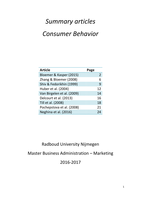
Summary MCB articles
VAN ROEST
Influence of quality cues and typicality cues on restaurant purchase intention.
Product cues: brand name/price etc.
Hypotheses
1. The better a cue performs on signaling product quality, the better it performs on
signaling category membership
2. Cue-driven typicality perceptions are more strongly related to purchase intention
compared to cue-driven quality perceptions.
3. The better a cue performs on signaling category membership, the better it performs
on signaling perceptions of multiple equality dimensions.
Methods
Conjoint task + people in a mall + 16 videotaped
VAELE
Intrinsic cues: cannot be changed without changing the product itself
Extrinsic cues: can be changed without changing the product itself
Consumers think that extrinsic cues indicate value and quality. When we have little
knowledge about a product, extrinsic cues are used.
RATNESHWAR
Personal goals: this has to do with character traits.
Situational goals: dependent on the context the consumer is in. these goals are states and
can be manipulated.
Goal-derived categories: do not coincide with normal product categories for which
consumers and marketers have labels or names.
CUNNINGHAM
Consumer perceptions differ due to cultural influences and variations. Therefore, in cross-
cultural research it is very important to ensure equivalence across the studies.
PARASURAMAN
Quality is important for lowering manufacturing costs, improving productivity.
Characteristics of services: intangible, heterogeneity, and inseparability of production and
consumption.
Services are harder to evaluate than goods.
KILIWINGER
Food choices and everyday behavior are based on routine actions with little emotional
involvement or importance.
KIRCHHOFF
Over groente en fruit eten, vrouwen eten mee ren 50+ers ook.
, BOTSCHEN
Consumer behavior is driven by benefits a consumer seeks in products.
Services and products have meaning structures which are stored in people’s memory.
Attributes are the means by which the product provides the desired values. The values drive
consumer behavior.
Attributes are product characteristics. Benefits are reasons why people look for attributes.
The same attribute can lead to different benefits, which makes segmenting difficult.
Means-end chain theory suggests that values are the ultimate goal when purchasing a
product, more important than benefits.
CHREA
Price and region are important attributes for wine customers.
VAN ROEST
Influence of quality cues and typicality cues on restaurant purchase intention.
Product cues: brand name/price etc.
Hypotheses
1. The better a cue performs on signaling product quality, the better it performs on
signaling category membership
2. Cue-driven typicality perceptions are more strongly related to purchase intention
compared to cue-driven quality perceptions.
3. The better a cue performs on signaling category membership, the better it performs
on signaling perceptions of multiple equality dimensions.
Methods
Conjoint task + people in a mall + 16 videotaped
VAELE
Intrinsic cues: cannot be changed without changing the product itself
Extrinsic cues: can be changed without changing the product itself
Consumers think that extrinsic cues indicate value and quality. When we have little
knowledge about a product, extrinsic cues are used.
RATNESHWAR
Personal goals: this has to do with character traits.
Situational goals: dependent on the context the consumer is in. these goals are states and
can be manipulated.
Goal-derived categories: do not coincide with normal product categories for which
consumers and marketers have labels or names.
CUNNINGHAM
Consumer perceptions differ due to cultural influences and variations. Therefore, in cross-
cultural research it is very important to ensure equivalence across the studies.
PARASURAMAN
Quality is important for lowering manufacturing costs, improving productivity.
Characteristics of services: intangible, heterogeneity, and inseparability of production and
consumption.
Services are harder to evaluate than goods.
KILIWINGER
Food choices and everyday behavior are based on routine actions with little emotional
involvement or importance.
KIRCHHOFF
Over groente en fruit eten, vrouwen eten mee ren 50+ers ook.
, BOTSCHEN
Consumer behavior is driven by benefits a consumer seeks in products.
Services and products have meaning structures which are stored in people’s memory.
Attributes are the means by which the product provides the desired values. The values drive
consumer behavior.
Attributes are product characteristics. Benefits are reasons why people look for attributes.
The same attribute can lead to different benefits, which makes segmenting difficult.
Means-end chain theory suggests that values are the ultimate goal when purchasing a
product, more important than benefits.
CHREA
Price and region are important attributes for wine customers.