Aantekeningen Perception to Consciousness
Lecture 9&10: Attention
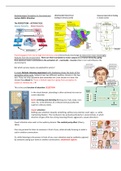
The PERCEPTION – ACTION CYCLE
Processing goes from low to high level sensory cortex (hierarchical processing) to extract ever more meaningful
features from the environment. These are then translated to motor outputs in a reverse hierarchy, going
from abstract motor commands to the activation of – eventually - muscles (that in turn will influence the
environment).
But which sensory inputs are selected for action?
A simple Dichotic Listening experiment with shadowing shows the limits of the
perception action cycle. Subjects hear two different auditory streams in the two
ears. They can only reproduce (and remember etc.) one stream at a time: the
stream they attend to. There is limited capacity in going from perception to
action (or memory etc.) →
This is the core function of attention: SELECTION
In the visual domain, attending is either achieved via overt or
covert attention
Overt orienting and attending Moving your eyes, body, ears,
nose, etc. in the direction of a relevant stimulus (what the
superior colliculus does).
Covert attention
Shifting your attention towards something, without any external, overt signs, i.e. while
maintaining fixation. This mechanism has evolved particularly in social animals, in which
direction of gaze often has strong meaning (threat, aggression, sexual attraction)
Covert attention also exists in the auditory domain: The cocktail party effect (Cherry,
1953).
One may pretend to listen to someone in front of you, while actually focusing on what is
said in another conversation.
Or, while listening to the person in front of you, your attention may be suddenly captured
by someone saying your name in another conversation: attentional capture
,Attention overview
• Different types of attention
• What is the effect of attention on processing?
• What happens to unattended stimuli
• Who ‘controls’ attention?
• Disorders of attention
Types of attention
• Top-down attention / voluntary attention (spatial attention)
• Capture / bottom-up attention (spatial attention)
• Object based attention
• Feature based attention
Top-Down attention: when subjects are instructed to focus their attention on some location of the visual field
(such as in the Posner cueing task). The behavioral effect typically is that reaction times to presented targets
are faster at the attended location.
Bottom-Up attention: a suddenly appearing stimulus will automatically
‘capture’ attention. Shorter reaction time to primed location. This
happens even when subjects know the cue (prime) is mostly invalid
(which shows capture is ‘automatic’ and not top down).
Attentional capture transforms into ‘inhibition of return’ when the
temporal interval between prime and target > 300 ms. Now, reaction time
is longer for the cued location. The subject starts to actively suppress
attention to the location of the (mostly invalid) cue.
Object based attention
(John Driver)
Instead of focusing on a particular location, attention can also focus on a particular object.
How to show the difference: cueing C leads to faster detection of S than of D (even when
there is an occluder overlying the bars)
Attention can be directed towards objects that overlap in space
(Issue: are these really non-spatial forms of attention? Or is spatial attention simply
spreading faster along objects, and can spatial attention also work in 3D?)
, Another clever experiment to show the existence of object-based attention:
one of two white lines was cued, and then targets where shown on either
the same location (valid), on the same white line (invalid within) or the other
white line (invalid between).
A difference in reaction time between invalid targets on the two lines was only
observed when they were perceived as different objects, not when perceived
as a single background surface, proving the existence of object-based
attention.
Feature based attention
Focus your attention on a specific feature,
e.g.: finding a Lego piece you are specifically
looking for.
Attention overview
• Different types of attention
• What is the effect of attention on processing?
• What happens to unattended stimuli?
• Who ‘controls’ attention?
• Disorders of attention
In top-down attention, the effect is an enhanced response to stimuli that
appear at the attended location. The Posner cueing task increases the
amplitude of visual evoked potentials recorded from the human scalp (P1
component).
→
, This enhanced response is specific for the attended location (so it is not a
general or overall increase in neural responsiveness). The P1 attention effect is
topographically distributed over the visual cortex in accordance with the
location of the visual field where attention is directed at.
Attentional capture has a similar effect on neural processing: an
increased response for stimuli at the cued (or rather captured)
location. Inhibition of return results in a decreased response at the
cued location, in accordance with the now decreased attention at
that site (less activation).
These effect of capture (and inhibition of return) again
show spatial specificity, in that they occur only at the
cortical locations where the attention is directed to
(drawn away from)
In monkey area V4, there is an increased response when
attention is directed towards the preferred stimulus
(Desimone). Spatial attention causes increased signals.
→
Attention to a feature (direction of
motion) enhances responses to that
feature all over the visual field: Feature
based attention causes increased signals
of attended features.
Lecture 9&10: Attention
The PERCEPTION – ACTION CYCLE
Processing goes from low to high level sensory cortex (hierarchical processing) to extract ever more meaningful
features from the environment. These are then translated to motor outputs in a reverse hierarchy, going
from abstract motor commands to the activation of – eventually - muscles (that in turn will influence the
environment).
But which sensory inputs are selected for action?
A simple Dichotic Listening experiment with shadowing shows the limits of the
perception action cycle. Subjects hear two different auditory streams in the two
ears. They can only reproduce (and remember etc.) one stream at a time: the
stream they attend to. There is limited capacity in going from perception to
action (or memory etc.) →
This is the core function of attention: SELECTION
In the visual domain, attending is either achieved via overt or
covert attention
Overt orienting and attending Moving your eyes, body, ears,
nose, etc. in the direction of a relevant stimulus (what the
superior colliculus does).
Covert attention
Shifting your attention towards something, without any external, overt signs, i.e. while
maintaining fixation. This mechanism has evolved particularly in social animals, in which
direction of gaze often has strong meaning (threat, aggression, sexual attraction)
Covert attention also exists in the auditory domain: The cocktail party effect (Cherry,
1953).
One may pretend to listen to someone in front of you, while actually focusing on what is
said in another conversation.
Or, while listening to the person in front of you, your attention may be suddenly captured
by someone saying your name in another conversation: attentional capture
,Attention overview
• Different types of attention
• What is the effect of attention on processing?
• What happens to unattended stimuli
• Who ‘controls’ attention?
• Disorders of attention
Types of attention
• Top-down attention / voluntary attention (spatial attention)
• Capture / bottom-up attention (spatial attention)
• Object based attention
• Feature based attention
Top-Down attention: when subjects are instructed to focus their attention on some location of the visual field
(such as in the Posner cueing task). The behavioral effect typically is that reaction times to presented targets
are faster at the attended location.
Bottom-Up attention: a suddenly appearing stimulus will automatically
‘capture’ attention. Shorter reaction time to primed location. This
happens even when subjects know the cue (prime) is mostly invalid
(which shows capture is ‘automatic’ and not top down).
Attentional capture transforms into ‘inhibition of return’ when the
temporal interval between prime and target > 300 ms. Now, reaction time
is longer for the cued location. The subject starts to actively suppress
attention to the location of the (mostly invalid) cue.
Object based attention
(John Driver)
Instead of focusing on a particular location, attention can also focus on a particular object.
How to show the difference: cueing C leads to faster detection of S than of D (even when
there is an occluder overlying the bars)
Attention can be directed towards objects that overlap in space
(Issue: are these really non-spatial forms of attention? Or is spatial attention simply
spreading faster along objects, and can spatial attention also work in 3D?)
, Another clever experiment to show the existence of object-based attention:
one of two white lines was cued, and then targets where shown on either
the same location (valid), on the same white line (invalid within) or the other
white line (invalid between).
A difference in reaction time between invalid targets on the two lines was only
observed when they were perceived as different objects, not when perceived
as a single background surface, proving the existence of object-based
attention.
Feature based attention
Focus your attention on a specific feature,
e.g.: finding a Lego piece you are specifically
looking for.
Attention overview
• Different types of attention
• What is the effect of attention on processing?
• What happens to unattended stimuli?
• Who ‘controls’ attention?
• Disorders of attention
In top-down attention, the effect is an enhanced response to stimuli that
appear at the attended location. The Posner cueing task increases the
amplitude of visual evoked potentials recorded from the human scalp (P1
component).
→
, This enhanced response is specific for the attended location (so it is not a
general or overall increase in neural responsiveness). The P1 attention effect is
topographically distributed over the visual cortex in accordance with the
location of the visual field where attention is directed at.
Attentional capture has a similar effect on neural processing: an
increased response for stimuli at the cued (or rather captured)
location. Inhibition of return results in a decreased response at the
cued location, in accordance with the now decreased attention at
that site (less activation).
These effect of capture (and inhibition of return) again
show spatial specificity, in that they occur only at the
cortical locations where the attention is directed to
(drawn away from)
In monkey area V4, there is an increased response when
attention is directed towards the preferred stimulus
(Desimone). Spatial attention causes increased signals.
→
Attention to a feature (direction of
motion) enhances responses to that
feature all over the visual field: Feature
based attention causes increased signals
of attended features.