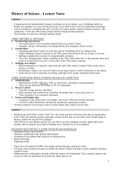
History of Science - Lecture Notes
Lecture 1
- Computing did not fundamentally change everything, not every culture, way of thinking, habits etc.
- People saw machines as a way of being deceived, as you didn’t know what was behind the technology.
- Trust in machines is something that grew overtime. Not many people wanted machines, because “why
would they”. In the late 19th century people started to begin trusting machines.
- The Pascaline was the first calculator machine made.
THREE HISTORICAL MISTAKES
1. Not knowing your sources
- You need to know a lot to actually interpret what was actually written.
- Example: Turing’s AM machine was interpreted the first computer, while it wasn’t.
2. Anachronism
- Something that doesn’t really fit in the time period. Something out of its ordinary time.
- Charles Babbage created a machine in the 19th century that seemed a bit out of place in its time.
- Babbage originated the concept of a programmable computer.
- The word “programming” meant something in the 19th century then now, so the meaning when used
needs to be specified if you use it in the sense of the 19th century meaning.
3. Defining your subject
- Efficient programs in a business stems from the early 20th century. Frederik Taylor turnt it into a
science, a system.
- By defining a subject, you can erase history by giving no space to earlier definitions of the subject.
- Taylor did not want to automate everything, although it how people remembered him today.
THREE TRADITIONS WHICH STARTED THE IDEA OF COMPUTING
1. Administration
- Optimization of office efficiency with e.g. typewriters, calculators, sorting machines
- There was an efficiency movement in 1911 in Amsterdam
2. Process Control
- Typically in huge factories like Shell
- Huge machines that needed to be controlled, but people didn’t want to get close to it
- These machinery was eventually automated
3. Science and Engineering
- Computers in the earlier sense were people, only in the 1950s they became machines
- Used for weather predictions, mechanical calculations, predicting economy
- All three traditions were trying to achieve similar things, their outline was the same.
Lecture 2
- Machines like the ENIAC would “work” for a few hours and then will need a few days of maintenance.
- In the 1960’s the machine became important, whereas before that, no one really cared. People began to
discuss “which one was the first computer”.
- After WWII, not only Britain and the US were able to get into computer research. Japan built such a
machine. Most countries succeeded in building such a machine by its own standards.
REASONS FOR STARTING A COMPUTER RESEARCH PROGRAM
- Manhattan Project (atom bombs)
- Machines could break codes quicker than humans.
- Aeronautical calculations that needed to be tiptop precise.
- Radar technology
- Supplying troups
- These were all needed for WWII, thus people realized that they needed all of this.
- In Europe, there needed to be plans to rebuild the nations. Which with help of some computer machines
would be easier.
- Mathematicians would gather and help rebuild the nation, the Netherlands. They wanted to improve the
society as well, not going back to the previous ideals before war.
1
Lecture 1
- Computing did not fundamentally change everything, not every culture, way of thinking, habits etc.
- People saw machines as a way of being deceived, as you didn’t know what was behind the technology.
- Trust in machines is something that grew overtime. Not many people wanted machines, because “why
would they”. In the late 19th century people started to begin trusting machines.
- The Pascaline was the first calculator machine made.
THREE HISTORICAL MISTAKES
1. Not knowing your sources
- You need to know a lot to actually interpret what was actually written.
- Example: Turing’s AM machine was interpreted the first computer, while it wasn’t.
2. Anachronism
- Something that doesn’t really fit in the time period. Something out of its ordinary time.
- Charles Babbage created a machine in the 19th century that seemed a bit out of place in its time.
- Babbage originated the concept of a programmable computer.
- The word “programming” meant something in the 19th century then now, so the meaning when used
needs to be specified if you use it in the sense of the 19th century meaning.
3. Defining your subject
- Efficient programs in a business stems from the early 20th century. Frederik Taylor turnt it into a
science, a system.
- By defining a subject, you can erase history by giving no space to earlier definitions of the subject.
- Taylor did not want to automate everything, although it how people remembered him today.
THREE TRADITIONS WHICH STARTED THE IDEA OF COMPUTING
1. Administration
- Optimization of office efficiency with e.g. typewriters, calculators, sorting machines
- There was an efficiency movement in 1911 in Amsterdam
2. Process Control
- Typically in huge factories like Shell
- Huge machines that needed to be controlled, but people didn’t want to get close to it
- These machinery was eventually automated
3. Science and Engineering
- Computers in the earlier sense were people, only in the 1950s they became machines
- Used for weather predictions, mechanical calculations, predicting economy
- All three traditions were trying to achieve similar things, their outline was the same.
Lecture 2
- Machines like the ENIAC would “work” for a few hours and then will need a few days of maintenance.
- In the 1960’s the machine became important, whereas before that, no one really cared. People began to
discuss “which one was the first computer”.
- After WWII, not only Britain and the US were able to get into computer research. Japan built such a
machine. Most countries succeeded in building such a machine by its own standards.
REASONS FOR STARTING A COMPUTER RESEARCH PROGRAM
- Manhattan Project (atom bombs)
- Machines could break codes quicker than humans.
- Aeronautical calculations that needed to be tiptop precise.
- Radar technology
- Supplying troups
- These were all needed for WWII, thus people realized that they needed all of this.
- In Europe, there needed to be plans to rebuild the nations. Which with help of some computer machines
would be easier.
- Mathematicians would gather and help rebuild the nation, the Netherlands. They wanted to improve the
society as well, not going back to the previous ideals before war.
1