Psychology: Attachments
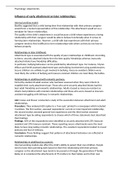
Influence of early attachment on later relationships:
Internal working model:
Bowlby suggested that a child having their first relationship with their primary caregiver
would form a mental representation of this relationship. This attachment would act as a
template for future relationships.
The quality of the child’s attachment is crucial because a child whose experiences a loving
relationship with their caregiver would be able to behave functionally when it comes to
forming later relationships. However, a child with bad experiences with their primary
caregiver tends to find it difficult to form relationships with others as they do not how to
behave properly.
Relationships in later childhood:
Attachment type is associated with the quality of peer relationships in childhood. According
to Kerns, securely attached infants form the best quality friendships whereas insecurely
attached infants have friendship difficulties.
In particular, bullying behaviour can be predicted by attachment type. For instance, Myron-
Wilson and Smith assessed attachment type and bullying involvement using questionnaires.
Secure children are unlikely to get involved in bullying. Insecure-avoidant children were
most likely the victims of bullying and insecure-resistant children are most likely the bullies.
Relationships in adulthood with romantic partners:
McCarthy studied 40 adult women who had been assessed when they were infants to
establish their early attachment type. Those who were securely attached infants had the
best adult friendship and romantic relationships. Adults classed as insecure-resistant as
infants had problems with maintain relationships and those who were classed as insecure-
avoidant struggling with intimacy in romantic relationships.
Aim: Hazan and Shaver conducted a study of the association between attachment and adult
relationships.
Procedure: They analysed 620 replies to a ‘love quiz’ printed in a newspaper which included
3 sections. The first section, assessed respondents’ current or most important relationship,
the second section assessed general love experiences and the third section assessed
attachment type by asking respondents to choose which of three statements best described
their feelings.
Findings: 56% of the respondents were identified as securely attached with 25% insecure-
avoidant and 19% insecure-resistant. Those reporting secure attachments were the most
likely to have long lasting romantic relationships. The avoidant respondents tended to reveal
jealousy and fear of intimacy.
Conclusion: These findings suggest that patterns of attachment behaviour are reflected in
romantic relationships.
Relationships in adulthood as a parent:
Internal working models also affect the child’s ability to parent their own children. People
tend to base their parenting style based on their first relationship with their primary
caregiver so the attachment type tends to be passed on through the generations if family.
Bailey et al considered the attachments of 99 mothers to their babies and to their own
Influence of early attachment on later relationships:
Internal working model:
Bowlby suggested that a child having their first relationship with their primary caregiver
would form a mental representation of this relationship. This attachment would act as a
template for future relationships.
The quality of the child’s attachment is crucial because a child whose experiences a loving
relationship with their caregiver would be able to behave functionally when it comes to
forming later relationships. However, a child with bad experiences with their primary
caregiver tends to find it difficult to form relationships with others as they do not how to
behave properly.
Relationships in later childhood:
Attachment type is associated with the quality of peer relationships in childhood. According
to Kerns, securely attached infants form the best quality friendships whereas insecurely
attached infants have friendship difficulties.
In particular, bullying behaviour can be predicted by attachment type. For instance, Myron-
Wilson and Smith assessed attachment type and bullying involvement using questionnaires.
Secure children are unlikely to get involved in bullying. Insecure-avoidant children were
most likely the victims of bullying and insecure-resistant children are most likely the bullies.
Relationships in adulthood with romantic partners:
McCarthy studied 40 adult women who had been assessed when they were infants to
establish their early attachment type. Those who were securely attached infants had the
best adult friendship and romantic relationships. Adults classed as insecure-resistant as
infants had problems with maintain relationships and those who were classed as insecure-
avoidant struggling with intimacy in romantic relationships.
Aim: Hazan and Shaver conducted a study of the association between attachment and adult
relationships.
Procedure: They analysed 620 replies to a ‘love quiz’ printed in a newspaper which included
3 sections. The first section, assessed respondents’ current or most important relationship,
the second section assessed general love experiences and the third section assessed
attachment type by asking respondents to choose which of three statements best described
their feelings.
Findings: 56% of the respondents were identified as securely attached with 25% insecure-
avoidant and 19% insecure-resistant. Those reporting secure attachments were the most
likely to have long lasting romantic relationships. The avoidant respondents tended to reveal
jealousy and fear of intimacy.
Conclusion: These findings suggest that patterns of attachment behaviour are reflected in
romantic relationships.
Relationships in adulthood as a parent:
Internal working models also affect the child’s ability to parent their own children. People
tend to base their parenting style based on their first relationship with their primary
caregiver so the attachment type tends to be passed on through the generations if family.
Bailey et al considered the attachments of 99 mothers to their babies and to their own