Summary Part 3 Evolutionary Developmental Biology
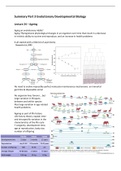
Lecture 24 – Ageing
Aging an evolutionary riddle?
Aging →progressive physiological changes in an organism over time that result in a decrease
in intrinsic ability to survive and reproduce, and an increase in health problems
It all started with a little bit of asymmetry
No need to evolve impossibly perfect molecular maintenance mechanisms: an immortal
germline & disposable soma!
No organism lives forever....but
large variation in lifespans
between and within species
Also large variation in age-related
health problems
Ageing as part of life history
Life history theory: explain inter-
and intraspecific variation in the
characteristics of the life cycle
• Longevity, development time,
age at reproduction, body size,
number of offspring
,Principles of life-history evolution
- Internal & external mortality
• Cancer; metabolic, cardiovascular, neurodegenerative
diseases
• Predation, infection, starvation, dehydration, freezing
- High extrinsic mortality:
Early maturation, increased fecundity, less investment in
maintenance, shorter intrinsic lifespan
- Changes in extrinsic mortality in human history
• Hominin evolution: superior social structure & defenses, and parental care
• Transition from hunter-gatherer to agriculture
• Industrial revolution & demographic transition
Resource acquisition & allocation
• Y-model (De Jong & van Noordwijk, 1992)
• Different strategies on how to divide limited resources in space and time
• Correlated responses
• Trade-offs
Experimental evolution of longevity
Selection on postponed reproduction in Drosophila results in
the evolution of a longer lifespan
,Evolutionary theories of ageing
Haldane & Medawar, 1940s: Selection shadow
• Selection acts on (early) reproduction and its force
reduces with age
Medawar, 1952: Mutation accumulation theory
• Weak selection at increased ages insufficient to
remove deleterious mutations from the population
• Late-onset diseases, e.g. Huntington’s disease
Williams, 1957: Antagonistic pleiotropy
• When a genetic or physiological mechanism has a positive
effect on one trait, but a negative effect on another trait
• Result of evolutionary tinkering
• Endocrine system regulates most physiological functions:
IIS/TOR, testosterone, leptin
• Trade-off between lifespan and reproduction
• BRCA1: enhanced fertility in humans, but excess post-
reproductive mortality
Pleiotropy of nutrient signalling pathways
Mutant analyses in model organisms
Mutation accumulation
• purely deleterious late-life effects, maintained due
to reduced selective pressure
Antagonistic pleiotropy
• beneficial early-life effects, but deleterious late-life
effects
, Disposable soma theory
• Organisms have to balance energy invested in reproduction with
DNA repair mechanisms (ageing)
• Cellular processes involved in growth and reproduction cause
cellular damage
• Somatic cells are only maintained to ensure reproduction,
afterwards the soma is disposable
• Optimal fitness achieved at a level of repair lower than needed for
immortality
The developmental theory of ageing
• Gene expression optimized for development and
early-life reproduction
• Senescence caused by suboptimal gene expression
in adulthood
• Age-specific optimization of gene expression can
increase lifespan without reproduction costs
• Age-specific RNAi knockdown in C. elegans
An evolutionary medicine approach
Do early versus late-life history studies suggest treatments for ageing?
- Target of rapamycin (TOR) signalling
• Nutrient signalling & metabolism
• Life history trade-offs
- Rapamycin supplements extend lifespan in mice; mixed effect on
ageing phenotypes
• Positive effect on cancer incidence, memory, body composition
• No effect on muscle function, vision, heart pathology, DNA
damage, a.o.
Lecture 24 – Ageing
Aging an evolutionary riddle?
Aging →progressive physiological changes in an organism over time that result in a decrease
in intrinsic ability to survive and reproduce, and an increase in health problems
It all started with a little bit of asymmetry
No need to evolve impossibly perfect molecular maintenance mechanisms: an immortal
germline & disposable soma!
No organism lives forever....but
large variation in lifespans
between and within species
Also large variation in age-related
health problems
Ageing as part of life history
Life history theory: explain inter-
and intraspecific variation in the
characteristics of the life cycle
• Longevity, development time,
age at reproduction, body size,
number of offspring
,Principles of life-history evolution
- Internal & external mortality
• Cancer; metabolic, cardiovascular, neurodegenerative
diseases
• Predation, infection, starvation, dehydration, freezing
- High extrinsic mortality:
Early maturation, increased fecundity, less investment in
maintenance, shorter intrinsic lifespan
- Changes in extrinsic mortality in human history
• Hominin evolution: superior social structure & defenses, and parental care
• Transition from hunter-gatherer to agriculture
• Industrial revolution & demographic transition
Resource acquisition & allocation
• Y-model (De Jong & van Noordwijk, 1992)
• Different strategies on how to divide limited resources in space and time
• Correlated responses
• Trade-offs
Experimental evolution of longevity
Selection on postponed reproduction in Drosophila results in
the evolution of a longer lifespan
,Evolutionary theories of ageing
Haldane & Medawar, 1940s: Selection shadow
• Selection acts on (early) reproduction and its force
reduces with age
Medawar, 1952: Mutation accumulation theory
• Weak selection at increased ages insufficient to
remove deleterious mutations from the population
• Late-onset diseases, e.g. Huntington’s disease
Williams, 1957: Antagonistic pleiotropy
• When a genetic or physiological mechanism has a positive
effect on one trait, but a negative effect on another trait
• Result of evolutionary tinkering
• Endocrine system regulates most physiological functions:
IIS/TOR, testosterone, leptin
• Trade-off between lifespan and reproduction
• BRCA1: enhanced fertility in humans, but excess post-
reproductive mortality
Pleiotropy of nutrient signalling pathways
Mutant analyses in model organisms
Mutation accumulation
• purely deleterious late-life effects, maintained due
to reduced selective pressure
Antagonistic pleiotropy
• beneficial early-life effects, but deleterious late-life
effects
, Disposable soma theory
• Organisms have to balance energy invested in reproduction with
DNA repair mechanisms (ageing)
• Cellular processes involved in growth and reproduction cause
cellular damage
• Somatic cells are only maintained to ensure reproduction,
afterwards the soma is disposable
• Optimal fitness achieved at a level of repair lower than needed for
immortality
The developmental theory of ageing
• Gene expression optimized for development and
early-life reproduction
• Senescence caused by suboptimal gene expression
in adulthood
• Age-specific optimization of gene expression can
increase lifespan without reproduction costs
• Age-specific RNAi knockdown in C. elegans
An evolutionary medicine approach
Do early versus late-life history studies suggest treatments for ageing?
- Target of rapamycin (TOR) signalling
• Nutrient signalling & metabolism
• Life history trade-offs
- Rapamycin supplements extend lifespan in mice; mixed effect on
ageing phenotypes
• Positive effect on cancer incidence, memory, body composition
• No effect on muscle function, vision, heart pathology, DNA
damage, a.o.