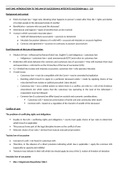
UNIT ONE: INTRODUCTION TO THE LAW OF SUCCESSION & INTESTATE SUCCESSION (pg 1 – 23)
Background and context
Field of private law + legal rules dictating what happens to person’s estate after they die + rights and duties
of certain people in the deceased estate of another
Beneficiaries = persons who succeed the deceased
Inheritances and legacies = types of benefits that can be received
3 ways in which succession may take place:
o Valid will (testamentary succession) = successio ex testament
o Intestate Succession (absence of a valid will) = successio ab intestate or successio legitima
o Contract and agreement = successio ex contractu or pactum successorium
Dual Character of the Law of Succession
Modern SA law = influenced by Roman-Dutch law, English CL and indigenous / customary law
o Indigenous / customary law = used synonymously BUT Const refers to customary law
Distinction still exists between the common and customary law of succession + they still maintain their dual
and equal status + referred to as the 2 branches of the law of succession (LOS)
CL = divided into testate and intestate succession; customary law = only operates intestate
4 main issues:
o Customary law = must be compatible with the Const + may be amended by legislation
o Deciding which branch to apply to a particular deceased estate = made by applying choice of law
rules derived from statute or judicial precedent (stare decisis)
o Customary law = not a unified system so where there is a conflict, we refer to s 1(3) of the Evidence
Amendment Act which states that the customary law operating in the land of the defendant /
respondent must be followed
o Common law & customary law differ based on societal and economic considerations:
Customary LOS = based on preservation of family unit and community after death
Common LOS = based on a regulation of the transfer of wealth of the deceased
Conflict of Laws
The problem of conflicting rights and obligations
Duality in the LOS = conflicting rights and obligations + courts must apply choice of law rules to determine
which branch is applicable
This process forms part of the legal discipline known as the conflict of laws
Relevant choice of law rules = derived from statute and judicial precedent
Testate law of succession
Concept of a will = not found in customary LOS
Therefore, in the absence of a direct provision indicating which law is applicable = apply the common LOS
(especially to capacity and validity)
Testators may indicate in their will which law should apply by way of the CL notion of freedom of testation
Intestate law of succession
Bhe v Magistrate Khayelitsha (‘Bhe’)
, o CC made major changes to the choice of law rules applied to the intestate estates of persons living
under a system of customary law
o 15 October 2004 onwards = Intestate Succession Act (‘ISA’) applies to all intestate estates,
irrespective of the cultural affiliation of the deceased
o Result = customary LOS can now only be applied if chosen through freedom of testation i.e. valid
clause in a will
Reform of Customary Law of Succession Act = modified choice of law rules + was assented to in 2009 but its
date of operation has not been published
o Major provision = any estate of a person who is subject to customary law that does not devolve in
terms of a will must devolve according to the ISA
Administration of estates
Pre-2000 = separate systems for administration of intestate estates
Post-2000 = any legislation creating different systems of administration based on race is unconstitutional
(Moseneke)
All new estates must be administered under the Master’s supervision according to the Administration of
Estates Cat (‘AOEA’)
Terminology (see pg 7 – 12 for full list – ONLY COMMON TERMS PROVIDED BELOW)
Ademption = tacit revocation of a legacy whereby a testator voluntarily alienates the object of the legacy
during their lifetime, causing the legacy to fail
Adiation = acceptance of a benefit from the estate of the testator
Administration of estates = the process, including all administrative actions, to initiate and complete the
liquidation and division of an estate by an executor under the supervision of the Master of the HC
Amendment = deletion, addition, alteration or interlineations by the testator (do not confuse with
rectification)
Animus testandi = intention of the testator to make a will
Ascendants = ancestors of the deceased (upward line of relationship)
Attestation clause = appears at the end of the will and declares that all the parties were present and signed
in each other’s presence + includes place and date of signature
Beneficiary = person to whom a testator’s estate is transferred + heirs receive an inheritance + legatees
receive a legacy
Bequeath = dispose of assets by means of a will
Compos mentis = of sound mind
Conditional bequest = a bequest which depends the occurrence of a future, uncertain event
Curator = person legally appointed to take care of the interests of someone who is unable to manage their
affairs on account of mental illness or incapacity
Deceased estate = comprises the assets and liabilities of a deceased person at the time of their death +
residue of the estate refers to what is left over after payment of the testator’s debts, legacies, funeral
expenses, administration costs and tax
Descendants = lineal descendents or persons in the downward line of the deceased
Dies cedit = “the day will come” i.e. time when a beneficiary obtains a vested right to claim delivery of
bequeathed property unconditionally (regardless of whether or not the exercise of the right is delayed until
some future date which is certain to arrive)
Dies venit = “the day has come” i.e. time at which the beneficiary’s right to claim delivery of the bequeathed
property becomes enforceable or the day when delivery of the property has to take place
Background and context
Field of private law + legal rules dictating what happens to person’s estate after they die + rights and duties
of certain people in the deceased estate of another
Beneficiaries = persons who succeed the deceased
Inheritances and legacies = types of benefits that can be received
3 ways in which succession may take place:
o Valid will (testamentary succession) = successio ex testament
o Intestate Succession (absence of a valid will) = successio ab intestate or successio legitima
o Contract and agreement = successio ex contractu or pactum successorium
Dual Character of the Law of Succession
Modern SA law = influenced by Roman-Dutch law, English CL and indigenous / customary law
o Indigenous / customary law = used synonymously BUT Const refers to customary law
Distinction still exists between the common and customary law of succession + they still maintain their dual
and equal status + referred to as the 2 branches of the law of succession (LOS)
CL = divided into testate and intestate succession; customary law = only operates intestate
4 main issues:
o Customary law = must be compatible with the Const + may be amended by legislation
o Deciding which branch to apply to a particular deceased estate = made by applying choice of law
rules derived from statute or judicial precedent (stare decisis)
o Customary law = not a unified system so where there is a conflict, we refer to s 1(3) of the Evidence
Amendment Act which states that the customary law operating in the land of the defendant /
respondent must be followed
o Common law & customary law differ based on societal and economic considerations:
Customary LOS = based on preservation of family unit and community after death
Common LOS = based on a regulation of the transfer of wealth of the deceased
Conflict of Laws
The problem of conflicting rights and obligations
Duality in the LOS = conflicting rights and obligations + courts must apply choice of law rules to determine
which branch is applicable
This process forms part of the legal discipline known as the conflict of laws
Relevant choice of law rules = derived from statute and judicial precedent
Testate law of succession
Concept of a will = not found in customary LOS
Therefore, in the absence of a direct provision indicating which law is applicable = apply the common LOS
(especially to capacity and validity)
Testators may indicate in their will which law should apply by way of the CL notion of freedom of testation
Intestate law of succession
Bhe v Magistrate Khayelitsha (‘Bhe’)
, o CC made major changes to the choice of law rules applied to the intestate estates of persons living
under a system of customary law
o 15 October 2004 onwards = Intestate Succession Act (‘ISA’) applies to all intestate estates,
irrespective of the cultural affiliation of the deceased
o Result = customary LOS can now only be applied if chosen through freedom of testation i.e. valid
clause in a will
Reform of Customary Law of Succession Act = modified choice of law rules + was assented to in 2009 but its
date of operation has not been published
o Major provision = any estate of a person who is subject to customary law that does not devolve in
terms of a will must devolve according to the ISA
Administration of estates
Pre-2000 = separate systems for administration of intestate estates
Post-2000 = any legislation creating different systems of administration based on race is unconstitutional
(Moseneke)
All new estates must be administered under the Master’s supervision according to the Administration of
Estates Cat (‘AOEA’)
Terminology (see pg 7 – 12 for full list – ONLY COMMON TERMS PROVIDED BELOW)
Ademption = tacit revocation of a legacy whereby a testator voluntarily alienates the object of the legacy
during their lifetime, causing the legacy to fail
Adiation = acceptance of a benefit from the estate of the testator
Administration of estates = the process, including all administrative actions, to initiate and complete the
liquidation and division of an estate by an executor under the supervision of the Master of the HC
Amendment = deletion, addition, alteration or interlineations by the testator (do not confuse with
rectification)
Animus testandi = intention of the testator to make a will
Ascendants = ancestors of the deceased (upward line of relationship)
Attestation clause = appears at the end of the will and declares that all the parties were present and signed
in each other’s presence + includes place and date of signature
Beneficiary = person to whom a testator’s estate is transferred + heirs receive an inheritance + legatees
receive a legacy
Bequeath = dispose of assets by means of a will
Compos mentis = of sound mind
Conditional bequest = a bequest which depends the occurrence of a future, uncertain event
Curator = person legally appointed to take care of the interests of someone who is unable to manage their
affairs on account of mental illness or incapacity
Deceased estate = comprises the assets and liabilities of a deceased person at the time of their death +
residue of the estate refers to what is left over after payment of the testator’s debts, legacies, funeral
expenses, administration costs and tax
Descendants = lineal descendents or persons in the downward line of the deceased
Dies cedit = “the day will come” i.e. time when a beneficiary obtains a vested right to claim delivery of
bequeathed property unconditionally (regardless of whether or not the exercise of the right is delayed until
some future date which is certain to arrive)
Dies venit = “the day has come” i.e. time at which the beneficiary’s right to claim delivery of the bequeathed
property becomes enforceable or the day when delivery of the property has to take place