MATTER
SOLIDS → compact & have a definitive shape
LIQUIDS → definitive volume and take shape of their container
GASES → have neither a shape nor a volume
All forms of matter are made of building blocks → chemical elements
Elements → a substance which cannot be split into a simpler substance by using basic
chemical procedures
o 118 elements & 92 occur naturally on earth
CHEMICAL ELEMENTS
26 different elements in human body
Major elements → oxygen(O), carbon( C), hydrogen(H) & nitrogen(N)
o 96% of body mass
Lesser elements → Calcium(Ca), Phosphorus(P), Potassium(K), Sulphur(S), Sodium(Na),
Chlorine(Cl), Magnesium(Mg), Iron(Fe)
o 3.6% of body mass
Trace elements → make up 0.4% of body mass
o Iodine needed to make thyroid hormones
All have important function in the body
ATOM
Smallest chemical unit of a molecule
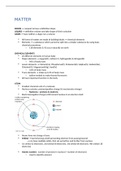
Nucleus contains: protons(positive charge) & neutrons(no charge)
o Nucleons = protons & neutrons
Electrons(negative charge) orbit around nucleus in an electron shell
Atoms have net charge of zero
Orbital → barrier(energy shell) preventing electron from passing beyond
→ can have multiple orbits, that set up further and further from nucleus
o 1st orbital (2 electrons), 2nd orbital (8 electrons), 3rd orbital (8 electrons), 4th orbital (18
electrons)
Atomic number: number of protons in nucleus (= number of electrons)
o Used to identify element
, Mass number: number of protons + neutrons (mass of nucleus)
Atomic mass: average mass of all its naturally occurring isotopes
Isotopes
When an atom exists as one or more species (same atomic number but differ in atomic
mass)
o Therefore different number of neutrons
Ion → formed when an element gains or loses an electron (positive or negative)
o Ionisation - process of losing or gaining electrons (e.g. Ca 2+)
Molecule → formed when > 2 atoms share electrons (e.g. H 2O)
Compound → substance that contains atoms of two or more different elements (e.g. H 2O)
CHEMICAL BONDS
→ forces that hold together the atoms of a molecule or a compound
o Dependent on valence electrons (electrons found in the other most orbital of the atom)
Ionic bonds
Results when valence electrons from one atom are completely transferred to 2nd atom
(NOT sharing)
o Ions are formed
o Cations → positively charged & move towards negative pole (cathode)
o Anions → negatively charged and move towards positive pole (anode)
Form ionic compounds
Example: Na + Cl → Na+(cation) Cl- (anion)
Easily dissociate(separate) & ions attracted to polar water molecules & hydration spheres
are formed
o These polar molecules are soluble
In body → found in teeth & bones - give strength
Electrolyte → an ionic compound which breaks apart in solution
o Most ions in body are dissolved in fluid as electrolytes
Covalent bonds
Occur when atoms share valence electrons
Found between identical atoms (e.g. O 2) - strongest because electrons are equally shared
> No. of electron pairs shared, stronger the bond
Most common chemical bond in body
Non-polar molecules → electrons equally distributed between atoms
Single (H2) , double (O2) or triple (N2) bonds can form between two atoms
Polar molecules → when covalent bonds are formed between two different atoms
(electrons pulled towards atom with larger nucleus)
o Positive & negative side(end to which electron is pulled)
o Water is polar & serves as a solvent
o Polar covalent bonds are weaker & can ionise(unstable & breakdown)
HYDROGEN BONDS
Found between polar molecules
Usually form between slightly positive hydrogen with second electronegative atom (oxygen
or nitrogen)
Weaker than covalent bonds
SOLIDS → compact & have a definitive shape
LIQUIDS → definitive volume and take shape of their container
GASES → have neither a shape nor a volume
All forms of matter are made of building blocks → chemical elements
Elements → a substance which cannot be split into a simpler substance by using basic
chemical procedures
o 118 elements & 92 occur naturally on earth
CHEMICAL ELEMENTS
26 different elements in human body
Major elements → oxygen(O), carbon( C), hydrogen(H) & nitrogen(N)
o 96% of body mass
Lesser elements → Calcium(Ca), Phosphorus(P), Potassium(K), Sulphur(S), Sodium(Na),
Chlorine(Cl), Magnesium(Mg), Iron(Fe)
o 3.6% of body mass
Trace elements → make up 0.4% of body mass
o Iodine needed to make thyroid hormones
All have important function in the body
ATOM
Smallest chemical unit of a molecule
Nucleus contains: protons(positive charge) & neutrons(no charge)
o Nucleons = protons & neutrons
Electrons(negative charge) orbit around nucleus in an electron shell
Atoms have net charge of zero
Orbital → barrier(energy shell) preventing electron from passing beyond
→ can have multiple orbits, that set up further and further from nucleus
o 1st orbital (2 electrons), 2nd orbital (8 electrons), 3rd orbital (8 electrons), 4th orbital (18
electrons)
Atomic number: number of protons in nucleus (= number of electrons)
o Used to identify element
, Mass number: number of protons + neutrons (mass of nucleus)
Atomic mass: average mass of all its naturally occurring isotopes
Isotopes
When an atom exists as one or more species (same atomic number but differ in atomic
mass)
o Therefore different number of neutrons
Ion → formed when an element gains or loses an electron (positive or negative)
o Ionisation - process of losing or gaining electrons (e.g. Ca 2+)
Molecule → formed when > 2 atoms share electrons (e.g. H 2O)
Compound → substance that contains atoms of two or more different elements (e.g. H 2O)
CHEMICAL BONDS
→ forces that hold together the atoms of a molecule or a compound
o Dependent on valence electrons (electrons found in the other most orbital of the atom)
Ionic bonds
Results when valence electrons from one atom are completely transferred to 2nd atom
(NOT sharing)
o Ions are formed
o Cations → positively charged & move towards negative pole (cathode)
o Anions → negatively charged and move towards positive pole (anode)
Form ionic compounds
Example: Na + Cl → Na+(cation) Cl- (anion)
Easily dissociate(separate) & ions attracted to polar water molecules & hydration spheres
are formed
o These polar molecules are soluble
In body → found in teeth & bones - give strength
Electrolyte → an ionic compound which breaks apart in solution
o Most ions in body are dissolved in fluid as electrolytes
Covalent bonds
Occur when atoms share valence electrons
Found between identical atoms (e.g. O 2) - strongest because electrons are equally shared
> No. of electron pairs shared, stronger the bond
Most common chemical bond in body
Non-polar molecules → electrons equally distributed between atoms
Single (H2) , double (O2) or triple (N2) bonds can form between two atoms
Polar molecules → when covalent bonds are formed between two different atoms
(electrons pulled towards atom with larger nucleus)
o Positive & negative side(end to which electron is pulled)
o Water is polar & serves as a solvent
o Polar covalent bonds are weaker & can ionise(unstable & breakdown)
HYDROGEN BONDS
Found between polar molecules
Usually form between slightly positive hydrogen with second electronegative atom (oxygen
or nitrogen)
Weaker than covalent bonds