HESI EXIT EXAM 1
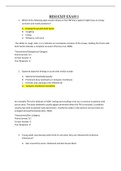
HESI EXIT EXAM 1 1. Which of the following signs would indicate to the FNP that a patient might have an airway occlusion and needs assistance? A. Holding throat with both hands B. Coughing C. Crying D. Whispery, soft voice The ability to cough, talk, or cry indicates an incomplete occlusion of the airway. Holding the throat with both hands indicates a complete occlusion (Thomas et al, 2006). *Assessment/Emergencies Category Points Earned: 1/1 Correct Answer: A Your Response: A 2. Expected objective findings in acute otitis media include: A. Submental lymphadenopathy B. Prominent bony landmarks on tympanic membrane C. Itchiness and cracking in the affected ear D. Tympanic membrane immobility An immobile TM is the hallmark of AOM. Itching and crackling in the ear is common in patients with serous otitis. The bony landmarks usually appear prominent when the TM is retracted, a condition usually seen with eustachian tube dysfunction. Usually the nodes in the anterior cervical chain are enlarged and painful (Ruckenstein, 2004). *Assessment/Ears Category Points Earned: 1/1 Correct Answer: D Your Response: D 3. Young adults may develop which kind of rash when they are infected with erythema infectiosum? A. Skin around the neck is thickened and dark brown-black B. Erythematous rash in a butterfly distribution on the face C. 2 mm to 5 mm red macules on the trunk and proximal extremities D. Reddened exanthema on hands and feet with distinct margins at wrist and ankle joints Young adults may have papular-pruritic “gloves and socks” syndrome (Cunningham, 2005). *Assessment/Infectious Disease Category Points Earned: 0/1 Correct Answer: D Your Response: C 4. Which factor in a patient’s history places him at high risk for skin cancer? A. Job-related exposure to coal tar B. Repairman for x-ray equipment C. Work on a crew that paves highways D. Janitorial service The factor that places a patient at greatest risk for skin cancer is exposure to ultraviolet light; because of sun exposure, the man who works on a highway crew would be at greatest risk (Fitzpatrick et al, 2001). *Assessment/Dermatology Category Points Earned: 1/1 Correct Answer: C Your Response: C 5. Which of the following physical findings would be expected in a patient with peritoneal irritation? A. Abdominal guarding B. Liver 2 cm below the costal margin C. Increased bowel sounds D. Engorged veins around the umbilicus Peritoneal irritation would lead to guarding and possible rebound tenderness. The Iliopsoas sign is an indicator of peritoneal irritation. A liver below the costal margin may indicate hepatic inflammation, as seen in hepatitis. Increased bowel sounds might be seen in gastroenteritis. In many cases, bowel sounds would decrease in the presence of peritoneal irritation. Engorged veins around the umbilicus are seen with ascites (Kidd et al, 2003). *Assessment/Gastrointestinal Category Points Earned: 1/1 Correct Answer: A Your Response: A 6. At what age would the FNP expect to see a child use his or her pincher grasp? A. 11 months B. 6 months C. 9 months D. 3 months A child normally uses a pincher grasp around the age of 9 months (Bright Futures, 2001). *Assessment/Wellness-Health Promotion Category Points Earned: 1/1 Correct Answer: C Your Response: C 7. An adolescent presents for a sports physical examination. He has a family history of premature cardiac death. He is nonsymptomatic and appears in good health. The FNP should use which technique during the examination to help determine the presence of abnormal heart sounds? A. Have the patient lie on his left side. B. Have the patient perform the Valsalva maneuver. C. Have the patient lean forward. D. Have the patient hold his breath. In hypertrophic cardiomyopathy a murmur may not be detected, but performing the Valsalva maneuver will accentuate the murmur if it is present (Kidd et al, 2003). *Assessment/Wellness-Health Promotion Category Points Earned: 1/1 Correct Answer: B Your Response: B 8. An FNP reviews both the patient log of a patient with type 2 diabetes and current lab results. Which findings indicate that the target value of the particular test is being met? A. Fasting glucose 125 mg/dL B. HS glucose levels between 100 and 140 mg/dL C. Glycosylated glucose 8% on a random sample D. Glucose levels between 140 and 180 mg/dL 2 hours after heavy meal The HS blood glucose matches a target level. The target levels for type 2 diabetes are FBS 80 to 120 mg/dL (Funnel and Kruger, 2004). *Assessment/Endocrine Category Points Earned: 1/1 Correct Answer: B Your Response: B 9. Which of the following actions best demonstrates that a 31-year-old woman has achieved the appropriate developmental task for her age group? A. Changing careers three times since graduating high school B. Living at home with her parents and working part time C. Living alone and spending lots of time shopping online D. Married with two sons and an active social life The appropriate developmental task for this age is Intimacy versus Isolation. This refers not only to physical intimacy but also to friendships, work colleagues, and parenting relationships. Marriage, family, and social activity is most reflective of the Intimacy task being met (Kidd et al, 2003). *Assessment/Wellness-Health Promotion Category Points Earned: 1/1 Correct Answer: D Your Response: D 10. Which of the following comments by a patient with Osgood-Schlatter disease is consistent with the diagnosis? A. “My knee hurts all the time, even when I am not moving.” B. “My knee hurts when I run or jump.” C. “My knee only hurts when I twist it.” D. “My knee only hurts when I try to straighten it.” OS is an overuse syndrome; the pain occurs with running, jumping, going up steps, and kneeling (Calmback et al, 2003). *Assessment/Musculoskeletal Category Points Earned: 1/1 Correct Answer: B Your Response: B 11. In a patient with Bell’s palsy, which of the following physical exam findings is consistent with the diagnosis? A. Decreased RAMs B. Inability to puff out cheek C. Decreased ability to smell D. Positive straight leg raise In Bell’s palsy, unilateral paresis or paralysis of the facial nerve occurs. Bell’s palsy symptoms include facial weakness accompanied by change in taste sensation, hyperacusis, and decreased lacrimation (Bromley, 2000). *Assessment/Neurological Category Points Earned: 1/1 Correct Answer: B Your Response: B 12. Which factor in the patient’s history should cause the FNP to suspect deep vein thrombosis? A. Low fluid intake B. Regular exercise C. Occupation cashier D. Oral contraceptive pill use DVT should be suspected in the following circumstances: pregnancy, smoking, oral contraceptive use, older age, or clotting disorders (Fitzmaurice, Hobbs, and McManus, 2002; *Assessment/Cardiovascular Category Points Earned: 1/1 Correct Answer: D Your Response: D 13. Which of the following is not a trait found in a person suffering from PTSD? A. Hypersomnia B. Hyperarousal C. Reexperiencing D. Avoidance The DSM IV identifies PTSD as consisting of three clusters of symptoms: reexperiencing, avoidance, and hyperarousal. Hypersomnia is not a trait of PTSD (Miller, 2000). *Assessment/Psychosocial or Infectious Category Points Earned: 1/1 Correct Answer: A Your Response: A 14. Besides abdominal or flank pain, what would the best indicator be in a patient with a kidney stone? A. Hematuria B. Urinary frequency/urgency C. pH of urine D. Fever Hematuria is generally seen in all patients with kidney stones. The other findings may not be seen in all patients with kidney stones (Portis and Sundaram, 2001). *Assessment/Genitourinary Category Points Earned: 1/1 Correct Answer: A Your Response: A 15. Which of the following objective findings is pathognomonic for infectious mononucleosis? A. Throat erythematous, no exudate B. Facial edema C. Maculopapular rash D. Lymphadenopathy The localized inflammatory response produces the lymphadenopathy that is almost always present in infectious mononucleosis. If lymphadenopathy is not present, the diagnosis of mononucleosis should be questioned. Although usually present in infectious mononucleosis, the rash, facial edema, and sore throat could also occur with other illnesses (Robinson, 2000). *Assessment/Immune Category Points Earned: 1/1 Correct Answer: D Your Response: D 16. What is the primary difference between tender points and trigger points as objective findings in a physical examination? A. Eliciting trigger points requires use of the reflex hammer; evaluating tender points does not. B. The amount of pressure required to elicit them is different. C. Palpation of trigger points causes radiation of pain; palpation of tender points does not. D. Tender points cause radiating pain, whereas trigger points do not. On physical examination, palpation of trigger points causes radiation of pain; palpation of tender points does not. The other options are false (Dunphry and Winland-Brown, 2001).
Written for
- Institution
- Hesi exit
- Course
- Hesi exit
Document information
- Uploaded on
- February 22, 2022
- Number of pages
- 74
- Written in
- 2022/2023
- Type
- Exam (elaborations)
- Contains
- Questions & answers
Subjects
-
hesi exit exam 1 1 which of the following signs would indicate to the fnp that a patient might have an airway occlusion and needs assistance a holding throat with both hands b coughing c crying d

Document also available in package deal