Station Response Sheet Name: ________
Model 1:
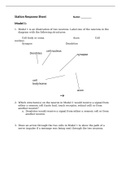
1. Model 1 is an illustration of two neurons. Label one of the neurons in the
diagram with the following structures:
Cell body or soma Axon Cell
nucleus
Synapse Dendrites
cell nucleus
Dendrites synapse
cell
body/soma
axon
→
2. Which structure(s) on the neuron in Model 1 would receive a signal from
either a sensory cell (taste bud, touch receptor, retinal cell) or from
another neuron?
a. Dendrites would receive a signal from either a sensory cell or from
another neuron.
3. Draw an arrow through the two cells in Model 1 to show the path of a
nerve impulse if a message was being sent through the two neurons.
, Model 2:
1. Describe the cellular structure shown in detail in Model 2.
a. The sodium-potassium pump moves the sodium and potassium ions
across the cell membrane so that it can provide energy for the
signal in the neuron. The sodium and potassium ions are balanced
and it allows for action potential to be produced by nerve cells.
2. Identify each of these symbols in Model 2.
+¿ +¿
phospholipid NA ❑¿ K ❑¿ sodium-
potassium pumps
3. Consider Model 2.
a. Which side of the membrane has more sodium ions when the neuron
is at rest?
i. outside of cell
b. Briefly explain why sodium ions cannot cross the membrane without
the use of a protein channel.
i. Sodium ions cannot cross the membrane without the use of a
protein channel because the sodium ions themselves can’t
diffuse through the membrane since it’s electrically charged.
c. Which direction should sodium ions flow naturally if a channel is
provided?
i. They would go into the cell
4. Consider Model 2.
a. Which side of the membrane has more potassium ions when the
neuron is at rest?
i. Inside of the cell.
Model 1:
1. Model 1 is an illustration of two neurons. Label one of the neurons in the
diagram with the following structures:
Cell body or soma Axon Cell
nucleus
Synapse Dendrites
cell nucleus
Dendrites synapse
cell
body/soma
axon
→
2. Which structure(s) on the neuron in Model 1 would receive a signal from
either a sensory cell (taste bud, touch receptor, retinal cell) or from
another neuron?
a. Dendrites would receive a signal from either a sensory cell or from
another neuron.
3. Draw an arrow through the two cells in Model 1 to show the path of a
nerve impulse if a message was being sent through the two neurons.
, Model 2:
1. Describe the cellular structure shown in detail in Model 2.
a. The sodium-potassium pump moves the sodium and potassium ions
across the cell membrane so that it can provide energy for the
signal in the neuron. The sodium and potassium ions are balanced
and it allows for action potential to be produced by nerve cells.
2. Identify each of these symbols in Model 2.
+¿ +¿
phospholipid NA ❑¿ K ❑¿ sodium-
potassium pumps
3. Consider Model 2.
a. Which side of the membrane has more sodium ions when the neuron
is at rest?
i. outside of cell
b. Briefly explain why sodium ions cannot cross the membrane without
the use of a protein channel.
i. Sodium ions cannot cross the membrane without the use of a
protein channel because the sodium ions themselves can’t
diffuse through the membrane since it’s electrically charged.
c. Which direction should sodium ions flow naturally if a channel is
provided?
i. They would go into the cell
4. Consider Model 2.
a. Which side of the membrane has more potassium ions when the
neuron is at rest?
i. Inside of the cell.