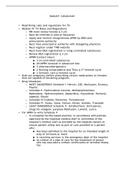
Module1 Collaborate
• Read Rxing rules and regulations for TX.
• Module #1 TX Rules and Regulations
o RN must renew license q 2 yrs
o Must be certified in area of education
o Apply and receive recognitionas APRN by BON and
prescriptive authority
o Must have prescriptive authority with delegating physician
o Must register under TNB website
o Must have DEA registration is rxing controlled substances.
o Renew DEA registration q 3 yrs
o APRN Contact Hours
▪ 3 on controlled substances
▪ 20 APRN renewal in advanced role
▪ 5 pharmacotherapeutics
▪ 2 Nursing Jurisprudence and Thics q 3rd renewal cycle
▪ 2 Geriatric care q renewal cycle
• Rule out pregnancy before prescribing certain medications to females
that are capable of becoming pregnant.
• Drug Schedules
o MOST DANGEROUS Schedule I- Heroin, LSD, Marijuans, Ecstacy,
Peyote
o Schedule II- Hydrocodone Cocaine, Methamphetamine,
Methadone, Hydromorphone, Meperidine, Oxycodone, Fentanyl,
Adderall, Ritalin
o Schedule III-Codeine, Ketamine, Testosterone
o Schedule IV- Xanax, Soma, Valium, Ativan, Ambien, Tramadol
o LEAST DANGEROUS Schedule V- Antidiarrheal, Antitussives,
drugs for analgesic purposes Robitussin, Lomotil, Lyrica
• For APRN to write Schedule II
o In a hospital facility based practice, in accordance with policies
approved by the hospitals medical staff or committee of the
hospital’s medical staff as provided by the hospitals bylaws to
ensure patient safety and as part of care provided to a patient
who:
▪ Has been admitted to the hospital for an intended length of
stay of 24 hours or more
▪ Is receiving services in the emergency dept of the hospital
▪ As written of a plan of care for the treatment of person
who has executed a written certification of terminal illness,
has
, elected to receive hospice care, and is receiving hospice
treatment from a qualified hospice provider.
• Therapeutic Range- between the minimum effective concentration and
toxic concentration. The wider the range the safer it is to Rx.
o As more narrow the harder to control
▪ Ex: warafin, less safe.
• Half Life-Time require for the amount of a drug in the body to
decline by 50%.
o Drugs with shorter ½ life must be administered frequently.
o Drugs with long ½ life must be administered less frequently.
▪ 4-5.5 hrs half life to get to steady state.
▪ 4-5.5 half life to eliminate from the body.
• A drug with a ½ life of 4hrs would take 16-22 hrs to
rach steady state and to be eliminated from the
body.
o 4x4=16
o 5.5x4=22
• Protein Binding
o Only part not bound crosses membrane.
▪ When two highly bound drugs are given it increases the
level of both drugs.
• Ex.-coumadin, thyroid both competing for plasma
proteins which increase level of free circulating drug.
• Elderly, keketic, decrease plasma albumin, MUST decrease dosage.
• PY450
o Substrate-an agent that is metabolized by an enzyme into a
metabolite and product and eventually excreted.
o Inhibitors-compete w/other drugs for a particular enzyme
affecting the metabolism (decreases) of the substrate and
decreases the excretion of the substrate and increases the
circulating drug.
o Inducers-competes w/other drugs for a particular enzyme
affecting metabolism of the substrate (increases) decreasing the
efficacy of the drug.
▪ Inhibitors Increase
▪ Inducers Decrease
• If a pt is on medication X and you administer
medication Y, that is an inducer or an inhibitor, you
know how it will affect substrate. You will have to
decrease the amount of drug given of inhibitor and
increase drug given of inducer
o Excretion (Need to know GFR)
• Read Rxing rules and regulations for TX.
• Module #1 TX Rules and Regulations
o RN must renew license q 2 yrs
o Must be certified in area of education
o Apply and receive recognitionas APRN by BON and
prescriptive authority
o Must have prescriptive authority with delegating physician
o Must register under TNB website
o Must have DEA registration is rxing controlled substances.
o Renew DEA registration q 3 yrs
o APRN Contact Hours
▪ 3 on controlled substances
▪ 20 APRN renewal in advanced role
▪ 5 pharmacotherapeutics
▪ 2 Nursing Jurisprudence and Thics q 3rd renewal cycle
▪ 2 Geriatric care q renewal cycle
• Rule out pregnancy before prescribing certain medications to females
that are capable of becoming pregnant.
• Drug Schedules
o MOST DANGEROUS Schedule I- Heroin, LSD, Marijuans, Ecstacy,
Peyote
o Schedule II- Hydrocodone Cocaine, Methamphetamine,
Methadone, Hydromorphone, Meperidine, Oxycodone, Fentanyl,
Adderall, Ritalin
o Schedule III-Codeine, Ketamine, Testosterone
o Schedule IV- Xanax, Soma, Valium, Ativan, Ambien, Tramadol
o LEAST DANGEROUS Schedule V- Antidiarrheal, Antitussives,
drugs for analgesic purposes Robitussin, Lomotil, Lyrica
• For APRN to write Schedule II
o In a hospital facility based practice, in accordance with policies
approved by the hospitals medical staff or committee of the
hospital’s medical staff as provided by the hospitals bylaws to
ensure patient safety and as part of care provided to a patient
who:
▪ Has been admitted to the hospital for an intended length of
stay of 24 hours or more
▪ Is receiving services in the emergency dept of the hospital
▪ As written of a plan of care for the treatment of person
who has executed a written certification of terminal illness,
has
, elected to receive hospice care, and is receiving hospice
treatment from a qualified hospice provider.
• Therapeutic Range- between the minimum effective concentration and
toxic concentration. The wider the range the safer it is to Rx.
o As more narrow the harder to control
▪ Ex: warafin, less safe.
• Half Life-Time require for the amount of a drug in the body to
decline by 50%.
o Drugs with shorter ½ life must be administered frequently.
o Drugs with long ½ life must be administered less frequently.
▪ 4-5.5 hrs half life to get to steady state.
▪ 4-5.5 half life to eliminate from the body.
• A drug with a ½ life of 4hrs would take 16-22 hrs to
rach steady state and to be eliminated from the
body.
o 4x4=16
o 5.5x4=22
• Protein Binding
o Only part not bound crosses membrane.
▪ When two highly bound drugs are given it increases the
level of both drugs.
• Ex.-coumadin, thyroid both competing for plasma
proteins which increase level of free circulating drug.
• Elderly, keketic, decrease plasma albumin, MUST decrease dosage.
• PY450
o Substrate-an agent that is metabolized by an enzyme into a
metabolite and product and eventually excreted.
o Inhibitors-compete w/other drugs for a particular enzyme
affecting the metabolism (decreases) of the substrate and
decreases the excretion of the substrate and increases the
circulating drug.
o Inducers-competes w/other drugs for a particular enzyme
affecting metabolism of the substrate (increases) decreasing the
efficacy of the drug.
▪ Inhibitors Increase
▪ Inducers Decrease
• If a pt is on medication X and you administer
medication Y, that is an inducer or an inhibitor, you
know how it will affect substrate. You will have to
decrease the amount of drug given of inhibitor and
increase drug given of inducer
o Excretion (Need to know GFR)