
ZOL 3702 LEARNING UNIT 8
THE POPULATION DYNAMICS OF PREDATION
Textbook reference: pg 297 - 325
Learning outcomes:
List the different patterns of predator-prey abundance and give examples.
Give the derivation of and explain the Lotka-Volterra model for predation.
Demonstrate predator-prey cycles in nature.
Demonstrate the importance of density dependence.
Discuss the effect of density/crowding on predator-prey interactions.
Identify functional responses and apply them to population models.
Explain population fluctuations using predator-prey models.
PATTERNS IN PREDATOR-PREY ABUNDANCE pg 297 - 298
There are a variety of patterns of abundance.
They range from a very damaging effect such as the vedalia ladybird beetle (Rodolia cardinalis) is famous
for having virtually eradicated the cottony cushion-scale insect (Icerya purchasi), a pest that threatened
the California citrus industry in the late 1880s.
There are many cases where predators and herbivores have no apparent effect on their prey’s dynamics
or abundance. Eg. the weevil Apion ulicis has been introduced into many parts of the world in an attempt
to control the abundance of gorse bushes (Ulex europaeus), and it has often become well established.
There are also examples that appear to show predator and prey populations linked together by couples
oscillations in abundance, but there are more examples in which predator and prey populations fluctuate
in abundance apparently independently of each other.
It is a major task for ecologists to develop and understanding of the patterns of predator-prey abundance,
and to account for the differences from one example to the next.
It is difficult to explain these patterns in isolation, but rather as parts of multispecies systems, and that all
these species are affected by environmental conditions.
The approach is to use simple models of the components must be tested against reality and explanations
found for the differences.
, THE LOTKA-VOLTERRA MODEL FOR PREDATOR-PREY INTERACTION AND POPULATION CYCLES pg 298 -
303
THE LOTKA-VOLTERRA MODEL:
PREDATOR-PREY CYCLES:
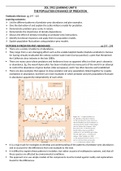
The tendency for predator-prey interactions to generate coupled oscillation in abundance might suggest
an expectation of such oscillations in real populations.
However, there are many important aspects of predator and prey ecology that have not been considered
in the models derived so far, and these can greatly modify our expectations.
THE POPULATION DYNAMICS OF PREDATION
Textbook reference: pg 297 - 325
Learning outcomes:
List the different patterns of predator-prey abundance and give examples.
Give the derivation of and explain the Lotka-Volterra model for predation.
Demonstrate predator-prey cycles in nature.
Demonstrate the importance of density dependence.
Discuss the effect of density/crowding on predator-prey interactions.
Identify functional responses and apply them to population models.
Explain population fluctuations using predator-prey models.
PATTERNS IN PREDATOR-PREY ABUNDANCE pg 297 - 298
There are a variety of patterns of abundance.
They range from a very damaging effect such as the vedalia ladybird beetle (Rodolia cardinalis) is famous
for having virtually eradicated the cottony cushion-scale insect (Icerya purchasi), a pest that threatened
the California citrus industry in the late 1880s.
There are many cases where predators and herbivores have no apparent effect on their prey’s dynamics
or abundance. Eg. the weevil Apion ulicis has been introduced into many parts of the world in an attempt
to control the abundance of gorse bushes (Ulex europaeus), and it has often become well established.
There are also examples that appear to show predator and prey populations linked together by couples
oscillations in abundance, but there are more examples in which predator and prey populations fluctuate
in abundance apparently independently of each other.
It is a major task for ecologists to develop and understanding of the patterns of predator-prey abundance,
and to account for the differences from one example to the next.
It is difficult to explain these patterns in isolation, but rather as parts of multispecies systems, and that all
these species are affected by environmental conditions.
The approach is to use simple models of the components must be tested against reality and explanations
found for the differences.
, THE LOTKA-VOLTERRA MODEL FOR PREDATOR-PREY INTERACTION AND POPULATION CYCLES pg 298 -
303
THE LOTKA-VOLTERRA MODEL:
PREDATOR-PREY CYCLES:
The tendency for predator-prey interactions to generate coupled oscillation in abundance might suggest
an expectation of such oscillations in real populations.
However, there are many important aspects of predator and prey ecology that have not been considered
in the models derived so far, and these can greatly modify our expectations.


