Topic 3 – Self affirmation
[Lecture notes]
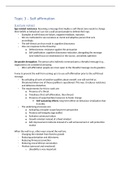
Ego-related resistance: Receiving a message that implies a self-threat (one needs to change
their beliefs or behaviour) can rise a wall around people to defend their ego.
- Examples of self-threat are failure, negative feedback, rejection.
- We are motivated to see ourselves as moral and adaptive person that acts
accordingly.
- The self-threat can thus result in cognitive dissonance
- One can response to the threat by:
o Defensiveness: resistance against the persuasion
o Self-justification: cognitive dissonance-reduction, derogating the message
(one-sided focus on weaknesses) or the source, unrealistic optimism
Do-gooder derogation: The person who indirectly communicates a threatful message (e.g.,
vegetarians) are considered annoying
- After self-affirmation people are more open to the threatful message via do-gooders.
A way to prevent the wall from coming up is to use self-affirmation prior to the self-threat
message.
- By activating all sorts of positive qualities about oneself, one will not feel as
threatened when one of those qualities is questioned. This way, it reduces resistance
and defensive distortion.
- The requirements for this to work are:
o Presence of a threat
o Timeliness (first self-affirmation, then threat)
o Presence of opportunities/resources to foster change
Self-sustaining effects: long-term effect on behaviour (realization that
it works).
- The underlying processes are:
o Activating a broader scope/long-term perspective
o Protects self-integrity (ego buffer)
o Activates communal values
o Growth mindset instead of a fixed mindset
o Self-improvement motivate instead of a self-enhancement or self-protection
motive
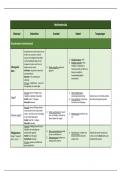
When the wall is up, other ways around the wall are:
- Changing the mindset from fixed to growth
- Reducing polarisation and dichotomy
- Reducing firmness/conviction
- Reducing moral/ethical connotation
- Motives (personal and emotional)
o Likeability is very important
[Lecture notes]
Ego-related resistance: Receiving a message that implies a self-threat (one needs to change
their beliefs or behaviour) can rise a wall around people to defend their ego.
- Examples of self-threat are failure, negative feedback, rejection.
- We are motivated to see ourselves as moral and adaptive person that acts
accordingly.
- The self-threat can thus result in cognitive dissonance
- One can response to the threat by:
o Defensiveness: resistance against the persuasion
o Self-justification: cognitive dissonance-reduction, derogating the message
(one-sided focus on weaknesses) or the source, unrealistic optimism
Do-gooder derogation: The person who indirectly communicates a threatful message (e.g.,
vegetarians) are considered annoying
- After self-affirmation people are more open to the threatful message via do-gooders.
A way to prevent the wall from coming up is to use self-affirmation prior to the self-threat
message.
- By activating all sorts of positive qualities about oneself, one will not feel as
threatened when one of those qualities is questioned. This way, it reduces resistance
and defensive distortion.
- The requirements for this to work are:
o Presence of a threat
o Timeliness (first self-affirmation, then threat)
o Presence of opportunities/resources to foster change
Self-sustaining effects: long-term effect on behaviour (realization that
it works).
- The underlying processes are:
o Activating a broader scope/long-term perspective
o Protects self-integrity (ego buffer)
o Activates communal values
o Growth mindset instead of a fixed mindset
o Self-improvement motivate instead of a self-enhancement or self-protection
motive
When the wall is up, other ways around the wall are:
- Changing the mindset from fixed to growth
- Reducing polarisation and dichotomy
- Reducing firmness/conviction
- Reducing moral/ethical connotation
- Motives (personal and emotional)
o Likeability is very important