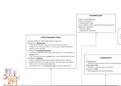
Ascending Limb:
- Simple cuboidal epithelium
- Absence of aquaporins
- Impermeable to water
- Large quantities of the Na+/K+ ATPase pump (lets move
against conc.gradients)
- Hypotonic filtrate
- Hyperosmotic interstitium
- S
- P
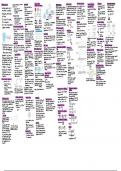
Distal Convoluted Tubule:
A
-
- Recover another 10?15 % water before forming urine
- Receptors for aldosterone
- Increases the amount of Na+/K+ATPase in basal membrane
- Conserve Na+- more Na in blood, so more water moves into blood to
balance osmotic gradient
- Receptors for parathyroid hormone
- PTH binds to interstitial surface and stims insertion of Ca2+channels in
luminal surface
- Ca2+ recovery from urine in lumen which can be reabsorbed into blood
- Receptors for calcitriol Collecting Ducts
- Binds to interstitial surface and facilitates release of Ca2+ binding
proteins which bind to vesicles that have calcium in them which allows - Principal cells
them to ?dock?on to the basal membrane. - Channels for the recovery or loss of sodium and pota
- Exocytosis of Ca2+ from inside DCT wall across basal membrane - Intercalated cells
- Secretes or absorbs acid or bicarbonate
- Receptors forADH
- Insert aquaporins into apical membrane
, Urinary System
pH Regulation
- Intercalated cells most often at the interface
between DCT and Collecting Duct; but also in PCT
and DCT
- H+ in blood further lowers pH Factors that Factors that
Acid/Base Bas
- Bicarb (HCO3-) increases it decrease H+ increase H+
- If blood pH is low; H+ will be excreted into lumen Homeostasis
secretion secretion
then into urea, and bicarbonate will be reabsorbed
into interstitium then into bloodstream
- And Vice Versa
- Alkalizing foods (fruits & ve
seeds, nuts)
- Metabolism of anionic (-) am
- Metabolism of organic anio
- These alkali help buffer H+
- Simple cuboidal epithelium
- Absence of aquaporins
- Impermeable to water
- Large quantities of the Na+/K+ ATPase pump (lets move
against conc.gradients)
- Hypotonic filtrate
- Hyperosmotic interstitium
- S
- P
Distal Convoluted Tubule:
A
-
- Recover another 10?15 % water before forming urine
- Receptors for aldosterone
- Increases the amount of Na+/K+ATPase in basal membrane
- Conserve Na+- more Na in blood, so more water moves into blood to
balance osmotic gradient
- Receptors for parathyroid hormone
- PTH binds to interstitial surface and stims insertion of Ca2+channels in
luminal surface
- Ca2+ recovery from urine in lumen which can be reabsorbed into blood
- Receptors for calcitriol Collecting Ducts
- Binds to interstitial surface and facilitates release of Ca2+ binding
proteins which bind to vesicles that have calcium in them which allows - Principal cells
them to ?dock?on to the basal membrane. - Channels for the recovery or loss of sodium and pota
- Exocytosis of Ca2+ from inside DCT wall across basal membrane - Intercalated cells
- Secretes or absorbs acid or bicarbonate
- Receptors forADH
- Insert aquaporins into apical membrane
, Urinary System
pH Regulation
- Intercalated cells most often at the interface
between DCT and Collecting Duct; but also in PCT
and DCT
- H+ in blood further lowers pH Factors that Factors that
Acid/Base Bas
- Bicarb (HCO3-) increases it decrease H+ increase H+
- If blood pH is low; H+ will be excreted into lumen Homeostasis
secretion secretion
then into urea, and bicarbonate will be reabsorbed
into interstitium then into bloodstream
- And Vice Versa
- Alkalizing foods (fruits & ve
seeds, nuts)
- Metabolism of anionic (-) am
- Metabolism of organic anio
- These alkali help buffer H+