Nursing science
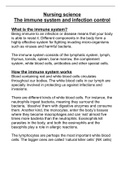
The immune system and infection control
What is the immune system?
Being immune to an infection or disease means that your body
is able to resist it. Different components in the body form a
highly effective system for fighting invading micro-organisms
such as viruses and harmful bacteria.
The immune system consists of the lymphatic system, lymph,
thymus, tonsils, spleen, bone marrow, the complement
system, white blood cells, antibodies and other special cells.
How the immune system works
Blood containing red and white blood cells circulates
throughout our bodies. The white blood cells in our lymph are
specially involved in protecting us against infections and
invasions.
There are different kinds of white blood cells. For instance, the
neutrophils ingest bacteria, meaning they surround the
bacteria, ‘dissolve’ them with digestive enzymes and consume
them. Another kind, the monocytes, enter the body’s tissues
where they become macrophages and can ‘eat’ almost five
times more bacteria than the neutrophils. Eosinophils kill
parasites in the body, and both the eosinophils and the
basophils play a role in allergic reactions.
The lymphocytes are perhaps the most important white blood
cells. The bigger ones are called ‘natural killer cells’ (NK cells)
The immune system and infection control
What is the immune system?
Being immune to an infection or disease means that your body
is able to resist it. Different components in the body form a
highly effective system for fighting invading micro-organisms
such as viruses and harmful bacteria.
The immune system consists of the lymphatic system, lymph,
thymus, tonsils, spleen, bone marrow, the complement
system, white blood cells, antibodies and other special cells.
How the immune system works
Blood containing red and white blood cells circulates
throughout our bodies. The white blood cells in our lymph are
specially involved in protecting us against infections and
invasions.
There are different kinds of white blood cells. For instance, the
neutrophils ingest bacteria, meaning they surround the
bacteria, ‘dissolve’ them with digestive enzymes and consume
them. Another kind, the monocytes, enter the body’s tissues
where they become macrophages and can ‘eat’ almost five
times more bacteria than the neutrophils. Eosinophils kill
parasites in the body, and both the eosinophils and the
basophils play a role in allergic reactions.
The lymphocytes are perhaps the most important white blood
cells. The bigger ones are called ‘natural killer cells’ (NK cells)