¥-0②atÉoqaaqgGpz
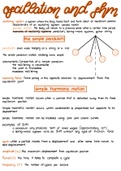
oscillating systemsystem where the body moves back and forth about
:
a an equilibrium position .
Characteristic of an oscillating system periodic motion :
periodic motion : the body will return to a previous state after a certain time period .
examples of oscillating systems pendulum spring
:
.
-
mass system .
guitar string
|
the simple pendulum
pendulum : small mass
hanging on a
string or a rod .
+ne simple pendulum makes modeling more simple
assumptions / properties of a simple pendulum :
the rod /
string is inextensible
the pivot is frictionless
massless rod / string
restoring force : force acting in the opposite direction to displacement from the
equilibrium point .
simple harmonic motion
simple harmonic motion occurs when a particle that is disturbed away from its fixed
equilibrium position .
Simple harmonic motion occurs when acceleration is proportional but opposite to its
displacement
simple harmonic motion can be modeled using sine and cosine curves .
examples of SHM
a only produces SHM at small angles (approximately 20° )
pendulum .
a
spring mass system acts as SHH without any type of friction force
-
cycle : when a particle moves from a displacement and after some time return to
said displacement .
amplitude ( Xo) the : maximum displacement from equilibrium position .
Period ( T ) the time:
it takes to complete a
cycle
frequency (f ) : the number of cycles per second .
, so
] :
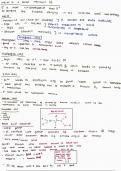
graphing simple harmonic motion
•A
mass spring system
:÷¥÷y
-
displacement time -
graph :
F- 21T FF at point A :
maximum positive xo
displacement
simple pendulum at point B :
maximum negative
F- 21T 1g displacement ✗o
at point 0 : zero displacement
¥3
velocity -
time graph negative :
sine curve
"" """ "
any Point is the •""" " " """"cement
time graph (first derivative )
µ
A
point A at Max positive displacement there is
:
,
zero velocity
point B at Max negative displacement there is
:
,
zero velocity
point 0 depending :
on direction
acceleration time -
graph negative cosine curve
:
at point A :
the negative maximum acceleration
at point B :
the positive maximum acceleration
at point 0 :
there is zero acceleration
These graphs show the proportional and opposite relationship .
between displacement and acceleration .
Kinetic potential energy
energy and
"
"
%
✗
since
velocity is maximum at equilibrium , "
" " "" " "" ""° " "+ "" " " " " " " " " "+
velocity and kinetic
energy is zero .
KE = É MWZ (✗ of ✗ 2) -
Potential energy is zero at equilibrium and
maximum at maximum displacement .
PE = É MW2×2
conservations of energy applies meaning total
energy is constant
?⃝
oscillating systemsystem where the body moves back and forth about
:
a an equilibrium position .
Characteristic of an oscillating system periodic motion :
periodic motion : the body will return to a previous state after a certain time period .
examples of oscillating systems pendulum spring
:
.
-
mass system .
guitar string
|
the simple pendulum
pendulum : small mass
hanging on a
string or a rod .
+ne simple pendulum makes modeling more simple
assumptions / properties of a simple pendulum :
the rod /
string is inextensible
the pivot is frictionless
massless rod / string
restoring force : force acting in the opposite direction to displacement from the
equilibrium point .
simple harmonic motion
simple harmonic motion occurs when a particle that is disturbed away from its fixed
equilibrium position .
Simple harmonic motion occurs when acceleration is proportional but opposite to its
displacement
simple harmonic motion can be modeled using sine and cosine curves .
examples of SHM
a only produces SHM at small angles (approximately 20° )
pendulum .
a
spring mass system acts as SHH without any type of friction force
-
cycle : when a particle moves from a displacement and after some time return to
said displacement .
amplitude ( Xo) the : maximum displacement from equilibrium position .
Period ( T ) the time:
it takes to complete a
cycle
frequency (f ) : the number of cycles per second .
, so
] :
graphing simple harmonic motion
•A
mass spring system
:÷¥÷y
-
displacement time -
graph :
F- 21T FF at point A :
maximum positive xo
displacement
simple pendulum at point B :
maximum negative
F- 21T 1g displacement ✗o
at point 0 : zero displacement
¥3
velocity -
time graph negative :
sine curve
"" """ "
any Point is the •""" " " """"cement
time graph (first derivative )
µ
A
point A at Max positive displacement there is
:
,
zero velocity
point B at Max negative displacement there is
:
,
zero velocity
point 0 depending :
on direction
acceleration time -
graph negative cosine curve
:
at point A :
the negative maximum acceleration
at point B :
the positive maximum acceleration
at point 0 :
there is zero acceleration
These graphs show the proportional and opposite relationship .
between displacement and acceleration .
Kinetic potential energy
energy and
"
"
%
✗
since
velocity is maximum at equilibrium , "
" " "" " "" ""° " "+ "" " " " " " " " " "+
velocity and kinetic
energy is zero .
KE = É MWZ (✗ of ✗ 2) -
Potential energy is zero at equilibrium and
maximum at maximum displacement .
PE = É MW2×2
conservations of energy applies meaning total
energy is constant
?⃝