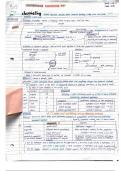
Periodicity – Week 6 notes
History of the periodic table
• 1800’s à elements categorised by their physical and chemical properties and their relative atomic mass.
• 1817 à Döbereiner attempted to group similar elements (chemical properties - triads.
• 1863 à John Newlands arranged elements in order of mass. (Law of octaves)
à DMITRI MENDELEEV – 1869 – arranged elements by atomic mass and left gaps where elements didn’t seem to fit.
à he also predicted the properties of undiscovered elements.
à Henry Moseley – 1914 – periodic table arranged by increasing proton number.
Periodicity = the repeating trends in the physical and chemical properties across each period of the periodic table.
S-block P-block D-block
Groups 1 and 2 (s1 or s2) Groups 13 to 18 (p1 to p6) Transition metals
Ionisation energies
First ionisation energy = the energy needed to remove 1 mole of electrons from one mole of atoms which are in
their gaseous state to form one mole of 1+ ions.
• First ionisation energy is ENDOTHERMIC, as energy is needed to ionise.
• The lower the ionisation energy, the easier it is to form an ion.
e.g. à O(g) à O+(g) + e-
factors affecting ionisation energy:
n NUCLEAR CHARGE à more protons in the nucleus, the more positively charged the nucleus is, so the
stronger the attraction to the electrons.
n ATOMIC RADIUS à as distance from the nucleus increases, the attraction of the electrons to the nucleus
decreases, so as atomic radius increases ionisation energy decreases.
n SHIELDING à as electrons between outer electrons and the nucleus increases, outer electrons feel less
attraction towards the nucleus.
Trend of ionisation energy down a group Trend of ionisation energy across a period
- Ionisation decreases down the group!! – refer - Ionisation energy increases across a period.
to the 3 scenarios above. - Nuclear charge increases
- Nuclear charge increases - Electrons pulled closer to the nucleus
- Atomic radius increases - Hence atomic radius decreases
- Electron shielding increases - There is no extra shielding.
Drop between group 2 and 3 Drop between group 5 and 6
• Outer electron in group 3 elements is P rather • In group 5 elements electron removed from a
than S. single occupied orbital.
• P orbital has slightly higher energy, so found • In group 6, electron removed from full orbital.
further from the nucleus. • Repulsion between two electrons in an orbital
• P orbital also has more shielding means electrons are easier to remove.
• Override the effect of nuclear charge so the
ionisation energy drops slightly.
, Successive ionisation energies
• Within a shell successive ionisation energies increase.
• Because the ion becomes more positive, so electrons held more strongly by the nucleus
• Big jumps happen when a new shell is broken into.
Structure, bonding and properties.
Diamond, Graphite and Graphene à giant covalent lattices
Diamond Graphite Graphene
• Giant covalent • Giant covalent • Sheet of graphite
• Each carbon has 4Cbonds • Made up of layers of • Each carbon has 3 Cbonds
• Very hard graphene • Very light
• Good thermal conductor • Each carbon has 3 CBonds • Transparent
• Can’t conduct electricity • Delocalised electrons •
• Wont dissolve in any between the layers
solvent. • Can conduct electricity
• Very high melting point • Softer than diamond
• Insoluble in any solvent
• Very high melting point
• Lubricant as layers can slide
Allotropes = different forms of the same element in the same state.
Metallic bonding
Metal Cations are held together by a sea of delocalised electrons. (Held together by the electrostatic attraction)
• The more the delocalised electrons, the higher the melting point as the stronger the bonding will be.
• If ionic radius is smaller, electrons will be attracted closer to the nuclei.
• Metals are malleable as the ions can slide over each other
• Good electrical conductors due to the delocalised electrons
• Insoluble due to the strength of the metallic bonds
Simple molecular covalent
• Covalent bonds between the atoms are very strong
• Melting and boiling point depend on the strength of IDDIs.
Sulphur (S8) Phosphorus (P4)
• 8 atoms covalently bonded • 4 atoms covalently bonded
• More electrons • Less electrons than sulphur
• SO IDDIs will be stronger • So IDDIs will be weaker than sulphur
• Higher MP/BP than Phosphorus. • Lower MP/BP than sulphur.
Noble gases à Monatomic, so very weak IDDIs between atoms.
History of the periodic table
• 1800’s à elements categorised by their physical and chemical properties and their relative atomic mass.
• 1817 à Döbereiner attempted to group similar elements (chemical properties - triads.
• 1863 à John Newlands arranged elements in order of mass. (Law of octaves)
à DMITRI MENDELEEV – 1869 – arranged elements by atomic mass and left gaps where elements didn’t seem to fit.
à he also predicted the properties of undiscovered elements.
à Henry Moseley – 1914 – periodic table arranged by increasing proton number.
Periodicity = the repeating trends in the physical and chemical properties across each period of the periodic table.
S-block P-block D-block
Groups 1 and 2 (s1 or s2) Groups 13 to 18 (p1 to p6) Transition metals
Ionisation energies
First ionisation energy = the energy needed to remove 1 mole of electrons from one mole of atoms which are in
their gaseous state to form one mole of 1+ ions.
• First ionisation energy is ENDOTHERMIC, as energy is needed to ionise.
• The lower the ionisation energy, the easier it is to form an ion.
e.g. à O(g) à O+(g) + e-
factors affecting ionisation energy:
n NUCLEAR CHARGE à more protons in the nucleus, the more positively charged the nucleus is, so the
stronger the attraction to the electrons.
n ATOMIC RADIUS à as distance from the nucleus increases, the attraction of the electrons to the nucleus
decreases, so as atomic radius increases ionisation energy decreases.
n SHIELDING à as electrons between outer electrons and the nucleus increases, outer electrons feel less
attraction towards the nucleus.
Trend of ionisation energy down a group Trend of ionisation energy across a period
- Ionisation decreases down the group!! – refer - Ionisation energy increases across a period.
to the 3 scenarios above. - Nuclear charge increases
- Nuclear charge increases - Electrons pulled closer to the nucleus
- Atomic radius increases - Hence atomic radius decreases
- Electron shielding increases - There is no extra shielding.
Drop between group 2 and 3 Drop between group 5 and 6
• Outer electron in group 3 elements is P rather • In group 5 elements electron removed from a
than S. single occupied orbital.
• P orbital has slightly higher energy, so found • In group 6, electron removed from full orbital.
further from the nucleus. • Repulsion between two electrons in an orbital
• P orbital also has more shielding means electrons are easier to remove.
• Override the effect of nuclear charge so the
ionisation energy drops slightly.
, Successive ionisation energies
• Within a shell successive ionisation energies increase.
• Because the ion becomes more positive, so electrons held more strongly by the nucleus
• Big jumps happen when a new shell is broken into.
Structure, bonding and properties.
Diamond, Graphite and Graphene à giant covalent lattices
Diamond Graphite Graphene
• Giant covalent • Giant covalent • Sheet of graphite
• Each carbon has 4Cbonds • Made up of layers of • Each carbon has 3 Cbonds
• Very hard graphene • Very light
• Good thermal conductor • Each carbon has 3 CBonds • Transparent
• Can’t conduct electricity • Delocalised electrons •
• Wont dissolve in any between the layers
solvent. • Can conduct electricity
• Very high melting point • Softer than diamond
• Insoluble in any solvent
• Very high melting point
• Lubricant as layers can slide
Allotropes = different forms of the same element in the same state.
Metallic bonding
Metal Cations are held together by a sea of delocalised electrons. (Held together by the electrostatic attraction)
• The more the delocalised electrons, the higher the melting point as the stronger the bonding will be.
• If ionic radius is smaller, electrons will be attracted closer to the nuclei.
• Metals are malleable as the ions can slide over each other
• Good electrical conductors due to the delocalised electrons
• Insoluble due to the strength of the metallic bonds
Simple molecular covalent
• Covalent bonds between the atoms are very strong
• Melting and boiling point depend on the strength of IDDIs.
Sulphur (S8) Phosphorus (P4)
• 8 atoms covalently bonded • 4 atoms covalently bonded
• More electrons • Less electrons than sulphur
• SO IDDIs will be stronger • So IDDIs will be weaker than sulphur
• Higher MP/BP than Phosphorus. • Lower MP/BP than sulphur.
Noble gases à Monatomic, so very weak IDDIs between atoms.