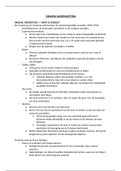
Brain mechanisms mediating vocal emotional processing – Schirmer & Kotz (2006)
Introduction
- Right hemisphere specialised for emotional processing of voice
o Largely research does support but there are findings that show acoustic cues (e.g
frequency and temporal information) are differently lateralised
- Vocal emotional comprehension multi-step process
o Analysis of vocalisation acoustic cues
o Is there emotional significance in acoustic cues
o Applying this emotional significance to higher order cognition
Sound
- Physiological parameters change according to emotional state, modulating vocal production
E.g increased emotional arousal links with greater laryngal tension and
increased subglottal pressure which increases vocal intensity
- Amplitude, timing and f0 (i.e pitch) are the acoustic cues conveying emotions
E.g happiness = fast speech rate, high intensity, mean f0 and f0 variability
sounding melodic and energetic whereas sad = slow, low intensity, f0 high in
spectral noise resulting in sounding ‘broken’
Sensory processing
- Cue mediated in pathways from ear to stations in brain stem, then thalamus then ipsilateral
and contralateral hemispheres
Input larger to contralateral thalamus
which continues at auditory cortex in Model of emotional processing
the superior temporal lobe prosody
Auditory cortex – primary region is
1 – acoustic analysis mediated
tonotopically organised and
bilaterally
surrounding secondary region
represent input from primary – both 2 – ‘what’ pathway integrates
modulated by sound intensity emotionally significant acoustic
(increased neuron firing) information and projects from superior
- Measure ERP by looking at differences in frequency or temporal gyrus to anterior superior
sound intensity, peaks 100ms after stimulus (N1) temporal sulcus
N1 generated in bilateral secondary
3 – emotional information taken from
auditory cortex suggesting areas
STS allows for higher cognitive
encodes extremely fast
processes
Increased N1 amplitudes and activity
in auditory cortex (inferior frontal
activity) when attending suggests
attention modulates early acoustic processing
- fMRI/PET studies show left and right differ in temporal resolution
o the left operates on a finer temporal scale so better at rapid changing information
and right specialising in pitch perception
o recently proposed that processing occurs on 2 time scales 25-30ms and 200-300ms
and though bilateral superior temporal gyrus is on both the superior temporal sulcus
differs
, right more stronger reliance on 200-300ms scale
Integration of emotionally significant acoustic cues
- processing pathway
o ‘what’ stream processes speech and non-speech vocalisations and reaches from
auditory cortex to lateral STG and STS where it becomes more complex and feeds
higher cognitions
Both intelligible and unintelligible speech activate left STG but STS only
responds to intelligible speech – but failure to modulate in right suggests
mediation of identifying linguistic auditory objects is lateralised to the left
But lateralisation to right of paralinguistic aspects, activating middle and
anterior STS
Cognition
- Once evaluation of emotions conveyed in speaker’s voice, information is integrated into co-
occurring processes e.g utterances in social interactions relies on vocal and verbal
information
o ‘you moron’ or ‘greater jobs’ must be interpreted as banter or sarcasm if tone
contradicts meaning – requires additional processing shown by increased activity in
left IFG for words spoken with incongruous compared to congruous emotional
prosody
o This then impacts semantic processing as IFG activation correlates with effort of
semantic selection, retrieval and integration
- Emotional prosody modulating semantic processing is shown in ERP measures, specifically
N400 – negatively peaking around 400ms following word onset shows semantic processing
effort
o Negativity larger for incongruent contexts and emotional prosody
Sex differences in vocal emotional processing
- Women more accurate in recognising emotions in faces, gestures and voices
- Neurophysiological correlates showing vocal emotional processing differences
o women show larger mismatch negativity to emotional vocalisations compared to
neutral, N400 effect and activity in left IFG to words incongruent to emotional
prosody
Conclusion
- right hemisphere lateralisation for spectral processing and left for temporal processing
- vocal emotional expressions recruit areas along auditory ‘what’ pathway which encodes
emotional significance
o acoustic cues convey information and integrated in anterior STS which seems
lateralised to right with latency of 200ms and then emotional significance is
available for higher cognition
- vocal emotional processing is modulated by attentional focus
- Primacy effects may be induced by top-down mechanisms increasing attention so
intentionally direct emotional prosody and also bottom-up mechanisms trigged due to
unexpected emotional expressions (change in speakers tone) or have intrinsic relevance (e.g
signals of threat)
Introduction
- Right hemisphere specialised for emotional processing of voice
o Largely research does support but there are findings that show acoustic cues (e.g
frequency and temporal information) are differently lateralised
- Vocal emotional comprehension multi-step process
o Analysis of vocalisation acoustic cues
o Is there emotional significance in acoustic cues
o Applying this emotional significance to higher order cognition
Sound
- Physiological parameters change according to emotional state, modulating vocal production
E.g increased emotional arousal links with greater laryngal tension and
increased subglottal pressure which increases vocal intensity
- Amplitude, timing and f0 (i.e pitch) are the acoustic cues conveying emotions
E.g happiness = fast speech rate, high intensity, mean f0 and f0 variability
sounding melodic and energetic whereas sad = slow, low intensity, f0 high in
spectral noise resulting in sounding ‘broken’
Sensory processing
- Cue mediated in pathways from ear to stations in brain stem, then thalamus then ipsilateral
and contralateral hemispheres
Input larger to contralateral thalamus
which continues at auditory cortex in Model of emotional processing
the superior temporal lobe prosody
Auditory cortex – primary region is
1 – acoustic analysis mediated
tonotopically organised and
bilaterally
surrounding secondary region
represent input from primary – both 2 – ‘what’ pathway integrates
modulated by sound intensity emotionally significant acoustic
(increased neuron firing) information and projects from superior
- Measure ERP by looking at differences in frequency or temporal gyrus to anterior superior
sound intensity, peaks 100ms after stimulus (N1) temporal sulcus
N1 generated in bilateral secondary
3 – emotional information taken from
auditory cortex suggesting areas
STS allows for higher cognitive
encodes extremely fast
processes
Increased N1 amplitudes and activity
in auditory cortex (inferior frontal
activity) when attending suggests
attention modulates early acoustic processing
- fMRI/PET studies show left and right differ in temporal resolution
o the left operates on a finer temporal scale so better at rapid changing information
and right specialising in pitch perception
o recently proposed that processing occurs on 2 time scales 25-30ms and 200-300ms
and though bilateral superior temporal gyrus is on both the superior temporal sulcus
differs
, right more stronger reliance on 200-300ms scale
Integration of emotionally significant acoustic cues
- processing pathway
o ‘what’ stream processes speech and non-speech vocalisations and reaches from
auditory cortex to lateral STG and STS where it becomes more complex and feeds
higher cognitions
Both intelligible and unintelligible speech activate left STG but STS only
responds to intelligible speech – but failure to modulate in right suggests
mediation of identifying linguistic auditory objects is lateralised to the left
But lateralisation to right of paralinguistic aspects, activating middle and
anterior STS
Cognition
- Once evaluation of emotions conveyed in speaker’s voice, information is integrated into co-
occurring processes e.g utterances in social interactions relies on vocal and verbal
information
o ‘you moron’ or ‘greater jobs’ must be interpreted as banter or sarcasm if tone
contradicts meaning – requires additional processing shown by increased activity in
left IFG for words spoken with incongruous compared to congruous emotional
prosody
o This then impacts semantic processing as IFG activation correlates with effort of
semantic selection, retrieval and integration
- Emotional prosody modulating semantic processing is shown in ERP measures, specifically
N400 – negatively peaking around 400ms following word onset shows semantic processing
effort
o Negativity larger for incongruent contexts and emotional prosody
Sex differences in vocal emotional processing
- Women more accurate in recognising emotions in faces, gestures and voices
- Neurophysiological correlates showing vocal emotional processing differences
o women show larger mismatch negativity to emotional vocalisations compared to
neutral, N400 effect and activity in left IFG to words incongruent to emotional
prosody
Conclusion
- right hemisphere lateralisation for spectral processing and left for temporal processing
- vocal emotional expressions recruit areas along auditory ‘what’ pathway which encodes
emotional significance
o acoustic cues convey information and integrated in anterior STS which seems
lateralised to right with latency of 200ms and then emotional significance is
available for higher cognition
- vocal emotional processing is modulated by attentional focus
- Primacy effects may be induced by top-down mechanisms increasing attention so
intentionally direct emotional prosody and also bottom-up mechanisms trigged due to
unexpected emotional expressions (change in speakers tone) or have intrinsic relevance (e.g
signals of threat)