

1
Question 8
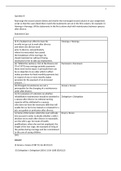
Rearrange the second column below and rewrite the rearranged second column in your assignment
script so that the cases listed there match the statements set out in the first column, for example: (i)
Havenga v Havenga. All the statements in the first column deal with maintenance between spouses
after divorce.
Statement Case
(i) If a husband can afford to have his Havenga v Havenga
ex-wife not go out to work after divorce
and where she did not work
prior to divorce, and particularly
where his misconduct has caused
the breakdown of the marriage, he
should maintain her without it being
necessary for her to take up employment.
(ii) “Whilst the section [s 7(2) of the Divorce Act Pommerel v Pommerel
70 of 1979] may envisage periodic payments
these need not be equal. In principle there can
be no objection to an order which in effect
makes provision for fixed monthly payments but
in respect of one or more months makes
provision for the payment of an increased
amount ...”.
(iii) Changed circumstances are not a Grasso v Grasso
prerequisite for the changing of a maintenance
order after divorce.
(iv) For purposes of a decision on whether
rehabilitative maintenance should be awarded to Zwiegelaar v Zwiegelaar
a spouse after divorce no notional earning
capacity will be attributed to a spouse
who does not have the necessary skills that will
enable him or her to be trained or retrained for a
job, occupation or profession after divorce.
(v) Some of the factors which the court will take Kroon v Kroon
into account in order to decide whether a wife’s
decision not to work after divorce is reasonable,
are the wife’s age, her state of health,
qualifications, when she was last employed, the
length of the mar riage, the standard of living of
the parties during marriage and her commitment
to the care of young children.
[10]
Answer
(i) Grasso v Grasso (1987 (1) SA 48 (C)).(2)
(ii) Zwiegelaar v Zwiegelaar (2001 (1) SA 1208 (SCA)).(2)
, 2
(iii) Havenga v Havenga (1988 (2) SA 438 (T)).(2)
(iv) Kroon v Kroon (1986 (4) SA 616 (E)).(2)
(v) Pommerel v Pommerel (1990 (1) SA 998 (E)).(2)
Question 7
Rearrange the second column below and rewrite the rearranged second column in your assignment
script so that the cases listed there match the statements set out in the first column, for example: (i)
Jooste v Botha. The statements in the first column all deal with the legal relationship between
children and their parents/grandparents.
Statement Case
(i) As the quality of a parent’s role is not simply Jooste v Botha
determined by gender, a father can be just as
good a “mother” as the child’s biological mother,
and conversely, the mother can be just as good a
“father” as the child’s biological father.
(ii) The father of an illegitimate child has no legal Mentz v Simpson
duty to afford the child love,
attention and affection if he does not have
custody of the child.
(iii) The obligation parents have to support their Barnard v Miller
children includes the obligation to provide the
child with a suitable education.
(iv) There is no duty on the deceased estate of a Van Rooyen v Van Rooyen
grandparent to support his or her grandchildren
after his or her (the grandparent’s) death.
(v) Although the mother has the freedom to Van der Linde v Van der Linde
choose her own lifestyle, her children’s best
interests cannot be served by allowing them to
be exposed to the sexual relationship she is
having with another woman. [10]
Question 9
Question 8
Rearrange the second column below and rewrite the rearranged second column in your assignment
script so that the cases listed there match the statements set out in the first column, for example: (i)
Havenga v Havenga. All the statements in the first column deal with maintenance between spouses
after divorce.
Statement Case
(i) If a husband can afford to have his Havenga v Havenga
ex-wife not go out to work after divorce
and where she did not work
prior to divorce, and particularly
where his misconduct has caused
the breakdown of the marriage, he
should maintain her without it being
necessary for her to take up employment.
(ii) “Whilst the section [s 7(2) of the Divorce Act Pommerel v Pommerel
70 of 1979] may envisage periodic payments
these need not be equal. In principle there can
be no objection to an order which in effect
makes provision for fixed monthly payments but
in respect of one or more months makes
provision for the payment of an increased
amount ...”.
(iii) Changed circumstances are not a Grasso v Grasso
prerequisite for the changing of a maintenance
order after divorce.
(iv) For purposes of a decision on whether
rehabilitative maintenance should be awarded to Zwiegelaar v Zwiegelaar
a spouse after divorce no notional earning
capacity will be attributed to a spouse
who does not have the necessary skills that will
enable him or her to be trained or retrained for a
job, occupation or profession after divorce.
(v) Some of the factors which the court will take Kroon v Kroon
into account in order to decide whether a wife’s
decision not to work after divorce is reasonable,
are the wife’s age, her state of health,
qualifications, when she was last employed, the
length of the mar riage, the standard of living of
the parties during marriage and her commitment
to the care of young children.
[10]
Answer
(i) Grasso v Grasso (1987 (1) SA 48 (C)).(2)
(ii) Zwiegelaar v Zwiegelaar (2001 (1) SA 1208 (SCA)).(2)
, 2
(iii) Havenga v Havenga (1988 (2) SA 438 (T)).(2)
(iv) Kroon v Kroon (1986 (4) SA 616 (E)).(2)
(v) Pommerel v Pommerel (1990 (1) SA 998 (E)).(2)
Question 7
Rearrange the second column below and rewrite the rearranged second column in your assignment
script so that the cases listed there match the statements set out in the first column, for example: (i)
Jooste v Botha. The statements in the first column all deal with the legal relationship between
children and their parents/grandparents.
Statement Case
(i) As the quality of a parent’s role is not simply Jooste v Botha
determined by gender, a father can be just as
good a “mother” as the child’s biological mother,
and conversely, the mother can be just as good a
“father” as the child’s biological father.
(ii) The father of an illegitimate child has no legal Mentz v Simpson
duty to afford the child love,
attention and affection if he does not have
custody of the child.
(iii) The obligation parents have to support their Barnard v Miller
children includes the obligation to provide the
child with a suitable education.
(iv) There is no duty on the deceased estate of a Van Rooyen v Van Rooyen
grandparent to support his or her grandchildren
after his or her (the grandparent’s) death.
(v) Although the mother has the freedom to Van der Linde v Van der Linde
choose her own lifestyle, her children’s best
interests cannot be served by allowing them to
be exposed to the sexual relationship she is
having with another woman. [10]
Question 9


