English Grammar Notes for Beginners
Nouns
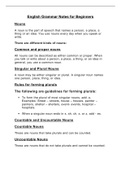
A noun is the part of speech that names a person, a place, a
thing or an idea. You use nouns every day when you speak or
write.
There are different kinds of nouns:
Common and proper nouns
All nouns can be described as either common or proper. When
you talk or write about a person, a place, a thing, or an idea in
general, you use a common noun.
Singular and Plural Nouns
A noun may be either singular or plural. A singular noun names
one person, place, thing, or idea.
Rules for forming plurals
The following are guidelines for forming plurals:
To form the plural of most singular nouns, add -s.
Examples: Street – streets, house – houses, painter –
painters, shelter – shelters, event- events, hospital –
hospitals.
When a singular noun ends in s, sh, ch, x, or z, add - es.
Countable and Uncountable Nouns
Countable Nouns
These are nouns that take plurals and can be counted.
Uncountable Nouns
These are nouns that do not take plurals and cannot be counted.
Nouns
A noun is the part of speech that names a person, a place, a
thing or an idea. You use nouns every day when you speak or
write.
There are different kinds of nouns:
Common and proper nouns
All nouns can be described as either common or proper. When
you talk or write about a person, a place, a thing, or an idea in
general, you use a common noun.
Singular and Plural Nouns
A noun may be either singular or plural. A singular noun names
one person, place, thing, or idea.
Rules for forming plurals
The following are guidelines for forming plurals:
To form the plural of most singular nouns, add -s.
Examples: Street – streets, house – houses, painter –
painters, shelter – shelters, event- events, hospital –
hospitals.
When a singular noun ends in s, sh, ch, x, or z, add - es.
Countable and Uncountable Nouns
Countable Nouns
These are nouns that take plurals and can be counted.
Uncountable Nouns
These are nouns that do not take plurals and cannot be counted.