MODULE 11: INVERTORY SYSTEMS
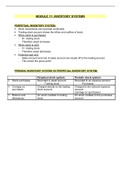
PERPETUAL INVENTORY SYSTEM:
Stock movements are recorded continually.
Trading stock account shows the inflow and outflow of stock.
When stock is purchased:
- Dr: trading stock
- Therefore asset increases
When stock is sold:
- Cr: trading stock
- Therefore asset decreases
Financial year end:
- Sales account and cost of sales account are closed off to the trading account.
- This shows the gross profit.
PERIODIC INVENTORY SYSTEM VS PERPETUAL INVENTORY SYSTEM:
Perpetual stock system: Periodic stock system:
Stock purchases Recorded in asset account Recorded in an expense account
- Trading stock - Purchases
Carriage on Charged directly to the trading Charged to the relevant expense
purchases stock account. account.
(carriage on purchases)
Returns and On stock credited to trading On stock credited to the purchases
allowances stock. account.
, Donations and stock Credited to the trading stock Credited to the purchase account.
withdrawals by the account.
owner
Sales of stock /cost Recorded immediately by Not recorded immediately. You need
of sales means of debiting cost of sales to do a calculation to determine the
and crediting trading stock cost of the sale.
Cost of goods sold is always
known.
Balance of stock Trading stock account is the Stock take in conducted
amount of stock which should (periodically) to determine the
be on hand. amount of stock on hand to
Stock take done for verification determine stock losses / deficit.
purposes – see losses / deficits
COST OF SALES & GREOSS PROFIT CALCULATIONS:
Opening stock + purchases + carriage on purchases = cost of stock available for
sales.
Cost of stock available for sale – closing stock = cost of sales.
Opening stock xxx
Purchases + Carriages + xxx
Cost of sales available for sale = xxx
Closing stock (xxx)
Cost of sales = COS
Gross profit = sales – cost of sales
Sales xxx
Cost of sales (xxx)
= GP
EXAMPLES OF EXPENSES INCURRED IN PURCHASING STOCK:
Carriage is transport costs.
Customs duty is paid in imported stock.
Freight is transported by air or ship.
Import duties are paid on special stock that is imported.
Harbour dues / doc charges are fees to use these facilities when importing stock.
MAIN FEATURES OF THE PERPETUAL SYSTEM:
There is better control of stock.
PERPETUAL INVENTORY SYSTEM:
Stock movements are recorded continually.
Trading stock account shows the inflow and outflow of stock.
When stock is purchased:
- Dr: trading stock
- Therefore asset increases
When stock is sold:
- Cr: trading stock
- Therefore asset decreases
Financial year end:
- Sales account and cost of sales account are closed off to the trading account.
- This shows the gross profit.
PERIODIC INVENTORY SYSTEM VS PERPETUAL INVENTORY SYSTEM:
Perpetual stock system: Periodic stock system:
Stock purchases Recorded in asset account Recorded in an expense account
- Trading stock - Purchases
Carriage on Charged directly to the trading Charged to the relevant expense
purchases stock account. account.
(carriage on purchases)
Returns and On stock credited to trading On stock credited to the purchases
allowances stock. account.
, Donations and stock Credited to the trading stock Credited to the purchase account.
withdrawals by the account.
owner
Sales of stock /cost Recorded immediately by Not recorded immediately. You need
of sales means of debiting cost of sales to do a calculation to determine the
and crediting trading stock cost of the sale.
Cost of goods sold is always
known.
Balance of stock Trading stock account is the Stock take in conducted
amount of stock which should (periodically) to determine the
be on hand. amount of stock on hand to
Stock take done for verification determine stock losses / deficit.
purposes – see losses / deficits
COST OF SALES & GREOSS PROFIT CALCULATIONS:
Opening stock + purchases + carriage on purchases = cost of stock available for
sales.
Cost of stock available for sale – closing stock = cost of sales.
Opening stock xxx
Purchases + Carriages + xxx
Cost of sales available for sale = xxx
Closing stock (xxx)
Cost of sales = COS
Gross profit = sales – cost of sales
Sales xxx
Cost of sales (xxx)
= GP
EXAMPLES OF EXPENSES INCURRED IN PURCHASING STOCK:
Carriage is transport costs.
Customs duty is paid in imported stock.
Freight is transported by air or ship.
Import duties are paid on special stock that is imported.
Harbour dues / doc charges are fees to use these facilities when importing stock.
MAIN FEATURES OF THE PERPETUAL SYSTEM:
There is better control of stock.