PROTEIN SYNTHESIS:
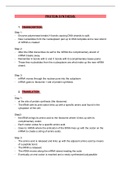
1. TRANSCRIPTION:
Step 1:
- Enzyme polymerase breaks H bonds causing DNA strands to split.
- New nucleotides form the nucleoplasm pair up to DNA template and a new strand
of mRNA is created
Step 2:
- After the DNA transcribes its self to the mRNA the complimentary strand of
mRNA breaks away
- Remember A bonds with U and C bonds with G (complimentary bases pairs)
- These free nucleotides from the nucleoplasm are what make up the new mRNA
strand.
Step 3:
- mRNA moves through the nuclear pore into the cytoplasm
- mRNA goes to ribosome = site of protein synthesis
2. TRANSLATION:
Step 1:
- at the site of protein synthesis (the ribosome)
- The tRNA with its anti-codon links up with a specific amino acid found in the
cytoplasm of the cell.
Step2:
- the tRNA brings its amino acid to the ribosome where it links up with its
complimentary codon
- Each codon codes for a specific amino acid.
- Goes to mRNA where the anticodon of the tRNA lines up with the codon on the
mRNA to create a string of amino acids.
Step 3:
- The amino acid is released and links up with the adjacent amino acid by means
of a peptide bond.
- The tRNA is released.
- The rRNA moves along the mRNA strand reading the code
- Eventually an end codon is reached and a newly synthesised polypeptide
1. TRANSCRIPTION:
Step 1:
- Enzyme polymerase breaks H bonds causing DNA strands to split.
- New nucleotides form the nucleoplasm pair up to DNA template and a new strand
of mRNA is created
Step 2:
- After the DNA transcribes its self to the mRNA the complimentary strand of
mRNA breaks away
- Remember A bonds with U and C bonds with G (complimentary bases pairs)
- These free nucleotides from the nucleoplasm are what make up the new mRNA
strand.
Step 3:
- mRNA moves through the nuclear pore into the cytoplasm
- mRNA goes to ribosome = site of protein synthesis
2. TRANSLATION:
Step 1:
- at the site of protein synthesis (the ribosome)
- The tRNA with its anti-codon links up with a specific amino acid found in the
cytoplasm of the cell.
Step2:
- the tRNA brings its amino acid to the ribosome where it links up with its
complimentary codon
- Each codon codes for a specific amino acid.
- Goes to mRNA where the anticodon of the tRNA lines up with the codon on the
mRNA to create a string of amino acids.
Step 3:
- The amino acid is released and links up with the adjacent amino acid by means
of a peptide bond.
- The tRNA is released.
- The rRNA moves along the mRNA strand reading the code
- Eventually an end codon is reached and a newly synthesised polypeptide