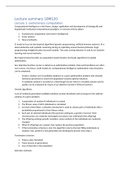
Lecture summary 1BM120
Lecture 1: evolutionary computation
Computational intelligence is the theory, design, application and development of biologically and
linguistically motivated computational paradigms. CI consists of three pillars:
1. Evolutionary computation (and swarm intelligence)
2. Fuzzy systems
3. Neural networks
CI tends to focus on bio-inspired algorithms (genetic programming, artificial immune systems). AI is
about deductive and symbolic reasoning aiming at replicating animal (human) behavior (logic
programming, Hodgkin-Huxley neuronal models). The main overlap between CI and AI are machine
learning and neural networks.
Bio-inspired meta-heuristic are population-based iterative stochastic algorithms for global
optimization.
Any objective function can be re-stated as an optimization problem. Real-world problems are often
non-convex, non-linear, multi-model etc. Computational intelligence optimization meta-heuristics
can be employed.
- Create a random set of candidate solutions to a given optimization problem and simulate
Darwinian processes to evolve the population towards optimal solutions.
- A candidate solution is encoded as a fixed-length vector which is a feasible solution and its
quality can be evaluated by means of an objective function f (fitness function).
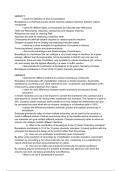
Genetic algorithms:
A set of randomly generated candidate solutions evolves iteratively and converges to the optimal
solution of a given problem.
1. A population of random N individuals is created
2. The fitness value of all N individuals is calculated
3. Survival of the fittest: a selection mechanism is used to choose pairs of individuals with a
probability proportional to their fitness values
4. Each pair of selected individuals (the parents) undergoes a genetic crossover: their
chromosomes are randomly exchanged to produce new individuals (the offspring)
5. The offspring undergo genetic mutation: some symbols of the individuals are randomly
changed
6. When N offsprings are created, they replace the previous population
7. If the termination criterion is met, the algorithm returns the best fitting individuals as
solution; else, perform a new generation by iterating the process from step 2.
Termination criterion:
1. Fitness value threshold
2. Fixed amount of generations
3. Loss of diversity in the population
Selection methods:
, - Roulette wheel: the probability of selecting an individual is proportional to its fitness value:
f ( xi )
Psel ( x i )= N
∑ ❑ f ( xn)
n=1
- Ranking: rank solutions according to their fitness value, the probability of selecting an
1
individual is proportional to its ranking: Psel ( x i )=
r i +1
- Tournament: a selection of individuals are chosen from the population to compete in a
tournament. The best individual wins the tournament and is selected.
Crossover:
Each of the parents, extract a random number. If this number is smaller than the crossover
probability, the parents undergo crossover.
- Single point crossover: select a random crossover point and exchange the parts from this
line.
- Uniform crossover: randomly generate a bit-mask. The mask denotes which bit is kept on
from parents 1 to offspring 1 and which are swapped form parent 1 to offspring 2.
- Partially matched crossover: special type of crossover preserving
relative order:
Mutation:
Mutation introduces new genetic material into the population.
- Uniform mutation: bit flip (1 becomes 0 and the other way
around). A high mutation probability corresponds to a random
search
Elitism: during the evolution, one excellent individual might be “destroyed” by the genetic operators.
Elitism preserves such individual, by copying the best individual to the next generation.
Premature convergence: when a GA converges too fast to a suboptimal population.
Loss of diversity: when the individuals of a GA population are too similar, so that the crossover is no
longer effective.
Handling constraints:
- Set the fitness of unfeasible solutions to extreme values,
- Penalize the fitness function,
- Fix wrong solutions,
- Use special encodings,
- Manipulate the search space.
Lecture 2: evolutionary and swarm computation
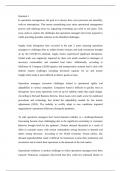
Differential evolution is a parallel direct search method based on parameters vectors for real-valued
global optimization. Evolutionary computation approach: a population of solutions evolves
Lecture 1: evolutionary computation
Computational intelligence is the theory, design, application and development of biologically and
linguistically motivated computational paradigms. CI consists of three pillars:
1. Evolutionary computation (and swarm intelligence)
2. Fuzzy systems
3. Neural networks
CI tends to focus on bio-inspired algorithms (genetic programming, artificial immune systems). AI is
about deductive and symbolic reasoning aiming at replicating animal (human) behavior (logic
programming, Hodgkin-Huxley neuronal models). The main overlap between CI and AI are machine
learning and neural networks.
Bio-inspired meta-heuristic are population-based iterative stochastic algorithms for global
optimization.
Any objective function can be re-stated as an optimization problem. Real-world problems are often
non-convex, non-linear, multi-model etc. Computational intelligence optimization meta-heuristics
can be employed.
- Create a random set of candidate solutions to a given optimization problem and simulate
Darwinian processes to evolve the population towards optimal solutions.
- A candidate solution is encoded as a fixed-length vector which is a feasible solution and its
quality can be evaluated by means of an objective function f (fitness function).
Genetic algorithms:
A set of randomly generated candidate solutions evolves iteratively and converges to the optimal
solution of a given problem.
1. A population of random N individuals is created
2. The fitness value of all N individuals is calculated
3. Survival of the fittest: a selection mechanism is used to choose pairs of individuals with a
probability proportional to their fitness values
4. Each pair of selected individuals (the parents) undergoes a genetic crossover: their
chromosomes are randomly exchanged to produce new individuals (the offspring)
5. The offspring undergo genetic mutation: some symbols of the individuals are randomly
changed
6. When N offsprings are created, they replace the previous population
7. If the termination criterion is met, the algorithm returns the best fitting individuals as
solution; else, perform a new generation by iterating the process from step 2.
Termination criterion:
1. Fitness value threshold
2. Fixed amount of generations
3. Loss of diversity in the population
Selection methods:
, - Roulette wheel: the probability of selecting an individual is proportional to its fitness value:
f ( xi )
Psel ( x i )= N
∑ ❑ f ( xn)
n=1
- Ranking: rank solutions according to their fitness value, the probability of selecting an
1
individual is proportional to its ranking: Psel ( x i )=
r i +1
- Tournament: a selection of individuals are chosen from the population to compete in a
tournament. The best individual wins the tournament and is selected.
Crossover:
Each of the parents, extract a random number. If this number is smaller than the crossover
probability, the parents undergo crossover.
- Single point crossover: select a random crossover point and exchange the parts from this
line.
- Uniform crossover: randomly generate a bit-mask. The mask denotes which bit is kept on
from parents 1 to offspring 1 and which are swapped form parent 1 to offspring 2.
- Partially matched crossover: special type of crossover preserving
relative order:
Mutation:
Mutation introduces new genetic material into the population.
- Uniform mutation: bit flip (1 becomes 0 and the other way
around). A high mutation probability corresponds to a random
search
Elitism: during the evolution, one excellent individual might be “destroyed” by the genetic operators.
Elitism preserves such individual, by copying the best individual to the next generation.
Premature convergence: when a GA converges too fast to a suboptimal population.
Loss of diversity: when the individuals of a GA population are too similar, so that the crossover is no
longer effective.
Handling constraints:
- Set the fitness of unfeasible solutions to extreme values,
- Penalize the fitness function,
- Fix wrong solutions,
- Use special encodings,
- Manipulate the search space.
Lecture 2: evolutionary and swarm computation
Differential evolution is a parallel direct search method based on parameters vectors for real-valued
global optimization. Evolutionary computation approach: a population of solutions evolves