Video’s ARM
Factor analysis (W46-48)
1. Introduction
Purpose: estimate a model which explains variance/covariance between a set of
observed variables (in a population) by a set of (fewer) unobserved factors &
weightings.
How do the variances interrelate?
What is a factor analysis?
Interdependence technique: you are interested in how these items
interrelate with each other
Define structure among variables
Interrelationships among large number of variables to identify underlying
dimensions (= factors)
Data summarization and data reduction
Measurement model:
Why do we do multi-item measurement?
It increases reliability and validity of measures
It allows measurement assessment
o Measurement error
o Reliability
o Validity
Two forms of measurement models:
o Formative (more items emerge as the construct) and Reflective
(latent, there is a construct, the items reflect the construct)
reflective is most used
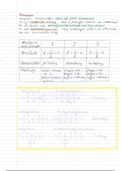
,Reliable: nicely close together
Not valid: not on target
Reflective measurement models
Direction of causality is from construct to measure
Correlated indicators
Takes measurements error into account at the item level
Validity of items is usually tested with factor analysis
2. Conducting a Factor analysis
All our methods follow a similar process – form problem formulation to model fit.
Problem formulation:
The objectives of factor
analysis should be
identified. This can
either be data
summarization or data
reduction
Problem formulation will
determine which variables to
measure. Therefore, we have
different criteria
Which variables:
, Based on past research, theory, and judgement of the researcher
Measurement properties (ratio, interval)
Sample size (4-5 * N per variable)
Distinguish between:
Exploratory factor analysis: is about exploration of the data. You are
interested in finding an underlying structure of the data. The assumptions
that superior factors cause correlations between variables. It is also used
to reveal interrelationships. The main purpose is the generation of
hypothesis.
Confirmatory factor analysis: we have a priori ideas of underlying factors,
derived from theory. Relationships between variables and factors before
conducting the factor analysis, you have expectations about those. The
main purpose is testing hypotheses.
Correlation matrix: analytical process is based on a matrix of correlations
between the variables.
Construct the correlation matrix – useful statistics
Kaiser-Meyer-Olkin (KMO) measure of sampling adequacy
Bartlett’s test of sphericity
o Test the null hypothesis that the variables are uncorrelated in the
population
3. Selecting an extraction method
It is an important step in factor analysis. Usually we have two major types of
extraction methods.
We distinguish between:
Principal Components Analysis
o Looks at total variance in the data
o Diagonal of the correlation matrix consists of unities
o Full variance is brought into the factor matrix
o Primary concern: we want to have a minimum nr of factors that will
account for maximum variance
o The factors are called principal components
o Mathematically: each variable is expressed as a linear combination
of the components.
o The covariation among the variables is described in terms of a small
number of principal components
Factor analysis (W46-48)
1. Introduction
Purpose: estimate a model which explains variance/covariance between a set of
observed variables (in a population) by a set of (fewer) unobserved factors &
weightings.
How do the variances interrelate?
What is a factor analysis?
Interdependence technique: you are interested in how these items
interrelate with each other
Define structure among variables
Interrelationships among large number of variables to identify underlying
dimensions (= factors)
Data summarization and data reduction
Measurement model:
Why do we do multi-item measurement?
It increases reliability and validity of measures
It allows measurement assessment
o Measurement error
o Reliability
o Validity
Two forms of measurement models:
o Formative (more items emerge as the construct) and Reflective
(latent, there is a construct, the items reflect the construct)
reflective is most used
,Reliable: nicely close together
Not valid: not on target
Reflective measurement models
Direction of causality is from construct to measure
Correlated indicators
Takes measurements error into account at the item level
Validity of items is usually tested with factor analysis
2. Conducting a Factor analysis
All our methods follow a similar process – form problem formulation to model fit.
Problem formulation:
The objectives of factor
analysis should be
identified. This can
either be data
summarization or data
reduction
Problem formulation will
determine which variables to
measure. Therefore, we have
different criteria
Which variables:
, Based on past research, theory, and judgement of the researcher
Measurement properties (ratio, interval)
Sample size (4-5 * N per variable)
Distinguish between:
Exploratory factor analysis: is about exploration of the data. You are
interested in finding an underlying structure of the data. The assumptions
that superior factors cause correlations between variables. It is also used
to reveal interrelationships. The main purpose is the generation of
hypothesis.
Confirmatory factor analysis: we have a priori ideas of underlying factors,
derived from theory. Relationships between variables and factors before
conducting the factor analysis, you have expectations about those. The
main purpose is testing hypotheses.
Correlation matrix: analytical process is based on a matrix of correlations
between the variables.
Construct the correlation matrix – useful statistics
Kaiser-Meyer-Olkin (KMO) measure of sampling adequacy
Bartlett’s test of sphericity
o Test the null hypothesis that the variables are uncorrelated in the
population
3. Selecting an extraction method
It is an important step in factor analysis. Usually we have two major types of
extraction methods.
We distinguish between:
Principal Components Analysis
o Looks at total variance in the data
o Diagonal of the correlation matrix consists of unities
o Full variance is brought into the factor matrix
o Primary concern: we want to have a minimum nr of factors that will
account for maximum variance
o The factors are called principal components
o Mathematically: each variable is expressed as a linear combination
of the components.
o The covariation among the variables is described in terms of a small
number of principal components