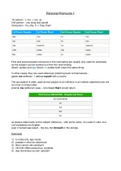
Personal Pronouns 1
1st person - I, me -> we, us
2nd person - you (sing and plural)
3rd person - he, she, it -> they, them
1st Person Singular 1st Person Plural 2nd Person Singular 2nd Person Plural
ego nos tu vos
me nos te vos
mei nostrum tui vestrum
mihi nobis tibi vobis
Me nobis te vobis
First and second person pronouns in the nominative are usually only used for emphasis
as the subject can be worked out from the verb ending:
dicam, audies and ego dicam, tu audies both mean the same thing.
In other cases, they are used reflexively (referring back to themselves) -
gladio me defendo - I defend myself with a sword.
The accusative is often used as the subject of an infinitive in an indirect statement (we will
do more on these later):
promisi me rediturum esse - I promised that I would return.
Third Person REFLEXIVE - Singular and Plural
(no nominative)
se
sui
sibi
se
se always refers back to the subject (reflexive) - with some verbs, it is used in Latin, but
not translated into English:
puer in templo se celavit - the boy hid (himself) in the temple.
Exercises
1) tu miles eris, ego nauta.
2) puellae in silva se celaverunt.
3) liberi cenam sibi parabant.
4) nihil tibi offere possumus, sceleste.
5) dea hominibus se olim ostendit.
1st person - I, me -> we, us
2nd person - you (sing and plural)
3rd person - he, she, it -> they, them
1st Person Singular 1st Person Plural 2nd Person Singular 2nd Person Plural
ego nos tu vos
me nos te vos
mei nostrum tui vestrum
mihi nobis tibi vobis
Me nobis te vobis
First and second person pronouns in the nominative are usually only used for emphasis
as the subject can be worked out from the verb ending:
dicam, audies and ego dicam, tu audies both mean the same thing.
In other cases, they are used reflexively (referring back to themselves) -
gladio me defendo - I defend myself with a sword.
The accusative is often used as the subject of an infinitive in an indirect statement (we will
do more on these later):
promisi me rediturum esse - I promised that I would return.
Third Person REFLEXIVE - Singular and Plural
(no nominative)
se
sui
sibi
se
se always refers back to the subject (reflexive) - with some verbs, it is used in Latin, but
not translated into English:
puer in templo se celavit - the boy hid (himself) in the temple.
Exercises
1) tu miles eris, ego nauta.
2) puellae in silva se celaverunt.
3) liberi cenam sibi parabant.
4) nihil tibi offere possumus, sceleste.
5) dea hominibus se olim ostendit.