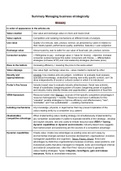
Summary Managing business strategically
Glossary
In order of appearance in the articles etc.
Value creation Use value and exchange value on micro and macro level
Value capture Competition and isolating mechanisms at different levels of analysis
Use value Quality of a new job, task, product, service, as perceived by users in relation to
their needs (speed, performance quality, aesthetics, features) = user subjective
Exchange value Amount paid by user to seller for use value of focal task, job, product, service.
Consumer surplus = Willingness to pay - exchange value (= Value for money) - objective: increase
consumer surplus because this option consumers will choose → differentiation
strategies (increase WTP) and cost leadership strategies (decrease price)
Race to the bottom Increasing efficiency = lowering the price to the same extent
Value slippage Use value high, exchange value low - value created is captured by other
Novelty and Amabile: how creative acts are judged - conditions: to evaluate must possess
appropriateness specialized knowledge, understand meaning new entity specific context, can’t be
done independently of social or cultural context in which it is introduced.
Porter’s five forces Industry based view to evaluate industry attractiveness: threat new entrants;
threat of substitutes; bargaining power of buyers; bargaining power of suppliers;
and industry rivalry (identify threats and opportunities) - perspective of focal firm
VRIN-framework Resource based view (Barney), sources of firm-specific competitive advantages if:
resource heterogeneity + mobility. Resource must have 4 attributes for this:
"valuable" (enable strategies to improve efficiency and effectiveness), "rare",
"inimitable", and "non-substitutable” → isolating mechanisms
Isolating mechanisms Any knowledge, physical, or legal barrier that may prevent replication of the
value-creating entity by a competitor (e.g. patent)
(Sustainable) When implementing value creating strategy not simultaneously implemented by
competitive advantage any competitor (sustainable if unable to duplicate benefits of the strategy) - develop
and exploit valuable, rare and costly-to-imitate resource base (RBV) + having
dynamic capabilities in dynamic environments. Industry-based view suggests
that market power and positioning are the sources of a competitive advantage
Dynamic capabilities Create value: create new advantages as existing ones are worn away by
environmental changes (product & process development, organizational evolution,
managerial capabilities and cognition). Teece, Pisano, Shuen: firms build
advantages by distinctive organizational processes (routines), asset positions, and
evolutionary paths that allow managers to integrate, build, and reconfigure internal
and external competencies - alter their firms’ resource base to generate
value-creating strategies. Types: integrate, reconfigure, gain and release
resources. Ability to orchestrate resources.
,Social networks Networks externally directed to detect needs of customers have greater potential
for novel and appropriate product/service innovations.
Knowledge-based Kang: firm success = ability to offer new and superior customer value, which
context depends on ability to explore and exploit employee knowledge (basis innovations)
Stakeholder approach Broader, longer-term view targets of value creation (investor = short-term profit)
Schumpeter Interdependent nature marketplace leads to continuous innovation & technical
progress. Creative destruction = firms succeed and markets advance through
processes of innovation and competition. Successful innovation will be replicated
by competitors (destruction) (e.g. stealing key employees, reverse engineering)
Value appropriation Some organisations will lose or have to share value with other stakeholders
(employees, competitors, society). Also relates to the fairness of value distribution
Circular / codependent Between competition and value creation: value creation → competition and
relationship competition → value creation
Value chain Ways firms configure primary and support activities to maximize and sustain
competitive advantage (Porter).
Resource Mechanism through which value is captured once created: organisations must take
management actions to: structure resource portfolio, bundle resources to build capabilities, and
leverage capabilities to exploit market opportunities.
Utility function Consumers income to maximize (expected) satisfaction products → total utility:
satisfaction possession commodity, marginal utility: possessing one extra unit
Core competencies Complementary to RBV; focus from SBUs to firm-level routines and capabilities.
Each firm core competencies that translate into modular core products,
subsequently into "end products" sold through SBU’s (reservoir of and contributor
of competencies). Competitive advantages reside in a limited number of
firm-specific routines and capabilities (same RBV). Model is "tree diagram" -
identify causes products’ competitive advantages. Advantage core competencies
perspective (vs. SBU): longer-term orientation continuous improvement
Appropriation is key: are competencies valuable, rare, and difficult to imitate?
1. Representation Digital representation information enables analysis and algorithmic manipulation
Qualitative shift Aspects reality not considered data past (location people, on status light) captured,
digitized, and incorporated as inputs into algorithmic processes
2. Connectivity Digitization creates new + enhances existing connections organizations, objects,
(network) individuals→ one-to-one to one-to-many. Change size/density, range/number
3. Aggregation Qualitative shift ability to combine previously disjoint data. Enhancing such
synergies explains the drive toward diversification and the blurring of boundaries
Complementarities Development one increases value other - aggregation enables better connectivity
(friend suggest), connectivity produces data can benefit if aggregated (rating)
Always-on Every product / service can be used to facilitate connections if digital
connectedness
,Dynamic capabilities The firm’s processes that use resources - specifically the processes to integrate,
reconfigure, gain and release resources - to match and even create market
change. Dynamic capabilities thus are the organizational and strategic routines by
which firms achieve new resource configurations as markets emerge, collide, split,
evolve, and die. The ability to continuously create, extend, upgrade, protect, and
keep relevant an enterprise’s unique asset base.
Integrate resources Product development routines by which managers combine their varied skills and
functional backgrounds to create revenue producing products and services
Orchestrating Orchestrate resources and complements (arrangeren) is a very important dynamic
capability
Basic capabilities “basic” capabilities for managing a firm—in terms of operational procedures,
budgeting, planning, and so forth—are sufficient in slow-moving environments,
success in a fast-moving environment requires “dynamic” capabilities, which can
be further broken down into clusters based on sensing, seizing, and reconfiguring
Sensing Identification and assessment of threats and opportunities (exploration)
Seizing Mobilization of resources to address threats and opportunities (exploitation)
Reconfiguring Continuous renewal of a firm’s tangible and intangible assets (resource-linking
capability, context-shaping capability, focus-shifting capability, high level)
Ecosystem A set of actors with varying degrees of multilateral, non-generic (unique or
supermodular) complementarities that are not fully hierarchically controlled.
Ecosystem value Unless consumers combine/bundle components, not get full value of it =
system complementarities - reinforce each other’s value. Needs to be coordinated
among producers. Modularity allows for coordination of independent yet
interdependent firms through ecosystems (complex because they draw on
different capabilities, economics, and varying innovation rates - relationships are
not decomposable). A firm cannot create value unless all complements present
* Glossary is incomplete
, Content module 1
________________________________________________________________________
Lepak, Smith, Taylor - Value creation and value capture: a multilevel
perspective
1. What is value, with a focus on the difference between use and exchange value?
Value creation refers to the content and process → focus value creation on target
user/buyer, whether individual, organization, or society and subjective use value realization
must translate into user’s willingness to exchange a monetary amount for the value received
= exchange value. Exchange value is a function of perceived performance difference
between value created (new focal task, product, service) and target user’s closest
alternative. Amabile: use value increases with greater level of novelty and appropriateness
2. How can (a) individuals, (b) organizations, and (c) society create value?
How value is created depends on source and targets value creation and level of analysis:
Individual level: creative acts (developing novel & appropriate tasks, services, ...) perceived
of value by a target user (greater utility + lower unit costs than alternative); set of individual
attributes (job performance - ability, motivation, intelligence - knowledge creation, creativity).
Organization source: innovation (using new methods/technologies/raw material for new
products/services/management practices), knowledge creation, invention, and management.
Intentional effort to develop novel ideas involving significant market, technical/ organizational
ambiguity + requiring more resources. More likely to innovate in an uncertain environment.
Societal: entrepreneurship and macro-economic external environment (laws, regulations).
Government: create value overall benefit society. Programs and incentives/policies for
entrepreneurship and innovation/invention: encourage existing and new ventures to innovate
and expand their value to society and its members. This value is also created unintentionally.
3. What determines the ability of (a) individuals, (b) organizations, and (c) society to capture
value?
The amount of value that can be captured is contingent on bargaining power - competition
(industry based view - other suppliers want to replicate new value that was created) and
isolating mechanisms (resource-based view). Understand: willingness to pay for value;
recognize (un/intentional) targets; knowledge targets; context value evaluation is made.
Individual level: personal attributes = specialized expertise or knowledge (e.g. tacit
knowledge from performance new task is not easily to imitate) can increase bargaining
power because of isolating mechanisms (high salary because no substitutes); unique
position social network; and specialized relation to others organisation.
Organisational level: value chain; use resources with attributes that make them difficult to
imitate = isolating mechanisms; source’s use of creative destruction before competitors can
use innovation (replication → value slips from creating firm to competitors, consumers,
society); resource management.
Glossary
In order of appearance in the articles etc.
Value creation Use value and exchange value on micro and macro level
Value capture Competition and isolating mechanisms at different levels of analysis
Use value Quality of a new job, task, product, service, as perceived by users in relation to
their needs (speed, performance quality, aesthetics, features) = user subjective
Exchange value Amount paid by user to seller for use value of focal task, job, product, service.
Consumer surplus = Willingness to pay - exchange value (= Value for money) - objective: increase
consumer surplus because this option consumers will choose → differentiation
strategies (increase WTP) and cost leadership strategies (decrease price)
Race to the bottom Increasing efficiency = lowering the price to the same extent
Value slippage Use value high, exchange value low - value created is captured by other
Novelty and Amabile: how creative acts are judged - conditions: to evaluate must possess
appropriateness specialized knowledge, understand meaning new entity specific context, can’t be
done independently of social or cultural context in which it is introduced.
Porter’s five forces Industry based view to evaluate industry attractiveness: threat new entrants;
threat of substitutes; bargaining power of buyers; bargaining power of suppliers;
and industry rivalry (identify threats and opportunities) - perspective of focal firm
VRIN-framework Resource based view (Barney), sources of firm-specific competitive advantages if:
resource heterogeneity + mobility. Resource must have 4 attributes for this:
"valuable" (enable strategies to improve efficiency and effectiveness), "rare",
"inimitable", and "non-substitutable” → isolating mechanisms
Isolating mechanisms Any knowledge, physical, or legal barrier that may prevent replication of the
value-creating entity by a competitor (e.g. patent)
(Sustainable) When implementing value creating strategy not simultaneously implemented by
competitive advantage any competitor (sustainable if unable to duplicate benefits of the strategy) - develop
and exploit valuable, rare and costly-to-imitate resource base (RBV) + having
dynamic capabilities in dynamic environments. Industry-based view suggests
that market power and positioning are the sources of a competitive advantage
Dynamic capabilities Create value: create new advantages as existing ones are worn away by
environmental changes (product & process development, organizational evolution,
managerial capabilities and cognition). Teece, Pisano, Shuen: firms build
advantages by distinctive organizational processes (routines), asset positions, and
evolutionary paths that allow managers to integrate, build, and reconfigure internal
and external competencies - alter their firms’ resource base to generate
value-creating strategies. Types: integrate, reconfigure, gain and release
resources. Ability to orchestrate resources.
,Social networks Networks externally directed to detect needs of customers have greater potential
for novel and appropriate product/service innovations.
Knowledge-based Kang: firm success = ability to offer new and superior customer value, which
context depends on ability to explore and exploit employee knowledge (basis innovations)
Stakeholder approach Broader, longer-term view targets of value creation (investor = short-term profit)
Schumpeter Interdependent nature marketplace leads to continuous innovation & technical
progress. Creative destruction = firms succeed and markets advance through
processes of innovation and competition. Successful innovation will be replicated
by competitors (destruction) (e.g. stealing key employees, reverse engineering)
Value appropriation Some organisations will lose or have to share value with other stakeholders
(employees, competitors, society). Also relates to the fairness of value distribution
Circular / codependent Between competition and value creation: value creation → competition and
relationship competition → value creation
Value chain Ways firms configure primary and support activities to maximize and sustain
competitive advantage (Porter).
Resource Mechanism through which value is captured once created: organisations must take
management actions to: structure resource portfolio, bundle resources to build capabilities, and
leverage capabilities to exploit market opportunities.
Utility function Consumers income to maximize (expected) satisfaction products → total utility:
satisfaction possession commodity, marginal utility: possessing one extra unit
Core competencies Complementary to RBV; focus from SBUs to firm-level routines and capabilities.
Each firm core competencies that translate into modular core products,
subsequently into "end products" sold through SBU’s (reservoir of and contributor
of competencies). Competitive advantages reside in a limited number of
firm-specific routines and capabilities (same RBV). Model is "tree diagram" -
identify causes products’ competitive advantages. Advantage core competencies
perspective (vs. SBU): longer-term orientation continuous improvement
Appropriation is key: are competencies valuable, rare, and difficult to imitate?
1. Representation Digital representation information enables analysis and algorithmic manipulation
Qualitative shift Aspects reality not considered data past (location people, on status light) captured,
digitized, and incorporated as inputs into algorithmic processes
2. Connectivity Digitization creates new + enhances existing connections organizations, objects,
(network) individuals→ one-to-one to one-to-many. Change size/density, range/number
3. Aggregation Qualitative shift ability to combine previously disjoint data. Enhancing such
synergies explains the drive toward diversification and the blurring of boundaries
Complementarities Development one increases value other - aggregation enables better connectivity
(friend suggest), connectivity produces data can benefit if aggregated (rating)
Always-on Every product / service can be used to facilitate connections if digital
connectedness
,Dynamic capabilities The firm’s processes that use resources - specifically the processes to integrate,
reconfigure, gain and release resources - to match and even create market
change. Dynamic capabilities thus are the organizational and strategic routines by
which firms achieve new resource configurations as markets emerge, collide, split,
evolve, and die. The ability to continuously create, extend, upgrade, protect, and
keep relevant an enterprise’s unique asset base.
Integrate resources Product development routines by which managers combine their varied skills and
functional backgrounds to create revenue producing products and services
Orchestrating Orchestrate resources and complements (arrangeren) is a very important dynamic
capability
Basic capabilities “basic” capabilities for managing a firm—in terms of operational procedures,
budgeting, planning, and so forth—are sufficient in slow-moving environments,
success in a fast-moving environment requires “dynamic” capabilities, which can
be further broken down into clusters based on sensing, seizing, and reconfiguring
Sensing Identification and assessment of threats and opportunities (exploration)
Seizing Mobilization of resources to address threats and opportunities (exploitation)
Reconfiguring Continuous renewal of a firm’s tangible and intangible assets (resource-linking
capability, context-shaping capability, focus-shifting capability, high level)
Ecosystem A set of actors with varying degrees of multilateral, non-generic (unique or
supermodular) complementarities that are not fully hierarchically controlled.
Ecosystem value Unless consumers combine/bundle components, not get full value of it =
system complementarities - reinforce each other’s value. Needs to be coordinated
among producers. Modularity allows for coordination of independent yet
interdependent firms through ecosystems (complex because they draw on
different capabilities, economics, and varying innovation rates - relationships are
not decomposable). A firm cannot create value unless all complements present
* Glossary is incomplete
, Content module 1
________________________________________________________________________
Lepak, Smith, Taylor - Value creation and value capture: a multilevel
perspective
1. What is value, with a focus on the difference between use and exchange value?
Value creation refers to the content and process → focus value creation on target
user/buyer, whether individual, organization, or society and subjective use value realization
must translate into user’s willingness to exchange a monetary amount for the value received
= exchange value. Exchange value is a function of perceived performance difference
between value created (new focal task, product, service) and target user’s closest
alternative. Amabile: use value increases with greater level of novelty and appropriateness
2. How can (a) individuals, (b) organizations, and (c) society create value?
How value is created depends on source and targets value creation and level of analysis:
Individual level: creative acts (developing novel & appropriate tasks, services, ...) perceived
of value by a target user (greater utility + lower unit costs than alternative); set of individual
attributes (job performance - ability, motivation, intelligence - knowledge creation, creativity).
Organization source: innovation (using new methods/technologies/raw material for new
products/services/management practices), knowledge creation, invention, and management.
Intentional effort to develop novel ideas involving significant market, technical/ organizational
ambiguity + requiring more resources. More likely to innovate in an uncertain environment.
Societal: entrepreneurship and macro-economic external environment (laws, regulations).
Government: create value overall benefit society. Programs and incentives/policies for
entrepreneurship and innovation/invention: encourage existing and new ventures to innovate
and expand their value to society and its members. This value is also created unintentionally.
3. What determines the ability of (a) individuals, (b) organizations, and (c) society to capture
value?
The amount of value that can be captured is contingent on bargaining power - competition
(industry based view - other suppliers want to replicate new value that was created) and
isolating mechanisms (resource-based view). Understand: willingness to pay for value;
recognize (un/intentional) targets; knowledge targets; context value evaluation is made.
Individual level: personal attributes = specialized expertise or knowledge (e.g. tacit
knowledge from performance new task is not easily to imitate) can increase bargaining
power because of isolating mechanisms (high salary because no substitutes); unique
position social network; and specialized relation to others organisation.
Organisational level: value chain; use resources with attributes that make them difficult to
imitate = isolating mechanisms; source’s use of creative destruction before competitors can
use innovation (replication → value slips from creating firm to competitors, consumers,
society); resource management.