
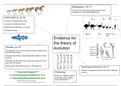
Biogeography (Gr 11)
Animals from similar geographical regions have
converged to have similar appearance.
Fossil evidence (gr 10)
Increase in complexity over time
Increase in diversity over time
Modifications by descent (e.g. horse)
Transitional fossils
Evidence for
the theory of
Genetics (gr 12)
All organisms comer from a central ancestor because they
evolution
all have DNA & RNA.
Chromosomal DNA & mitochondrial DNA similar in similar
animals.
The fewer genetic sequences organisms share the further
back they are related.
Same genes make same proteins in diff organisms
Homologous structures (Gr 11)
Similar in fundamental structure but have a different
Embryology function.
Embryos of different animals
go through similar stages
during development
, 1700 - 1800 1800 - 1900
Charles Darwin (1809 – 1882)
Erasmus Darwin (1731-1802) 5 yr trip on HMS Beagle in 1830’s
Famous book Zoonomia Theory of Natural Selection
Life on earth came from a common ancestor Origin of Species 1859
1 diversity amongst organisms
Important
2 variety amongst organisms of the same
scientists in species
evolution.
3 if the environment changes, only the fittest
Jean-Baptiste Lamarck (1774 – 1829) organisms survive
Theory of inheritance of acquired characteristics 4 The surviving organisms reproduce
1 Use and disuse of body parts
5 Species changes over time
The environment changes and thus the
organism changes. (active phenotypic changes) Branching pattern of evolution
If organ not used it will become smaller
If organ used much, it will become bigger.
2 Inheritance of acquired characteristics Alfred Wallace (1823 – 1913)
Physical changes that were acquired are passed British naturalist
onto offspring.
Father of biogeography
Happened in a linear pattern.
Worked in Malaysia
Branching pattern of evolution
Animals from similar geographical regions have
converged to have similar appearance.
Fossil evidence (gr 10)
Increase in complexity over time
Increase in diversity over time
Modifications by descent (e.g. horse)
Transitional fossils
Evidence for
the theory of
Genetics (gr 12)
All organisms comer from a central ancestor because they
evolution
all have DNA & RNA.
Chromosomal DNA & mitochondrial DNA similar in similar
animals.
The fewer genetic sequences organisms share the further
back they are related.
Same genes make same proteins in diff organisms
Homologous structures (Gr 11)
Similar in fundamental structure but have a different
Embryology function.
Embryos of different animals
go through similar stages
during development
, 1700 - 1800 1800 - 1900
Charles Darwin (1809 – 1882)
Erasmus Darwin (1731-1802) 5 yr trip on HMS Beagle in 1830’s
Famous book Zoonomia Theory of Natural Selection
Life on earth came from a common ancestor Origin of Species 1859
1 diversity amongst organisms
Important
2 variety amongst organisms of the same
scientists in species
evolution.
3 if the environment changes, only the fittest
Jean-Baptiste Lamarck (1774 – 1829) organisms survive
Theory of inheritance of acquired characteristics 4 The surviving organisms reproduce
1 Use and disuse of body parts
5 Species changes over time
The environment changes and thus the
organism changes. (active phenotypic changes) Branching pattern of evolution
If organ not used it will become smaller
If organ used much, it will become bigger.
2 Inheritance of acquired characteristics Alfred Wallace (1823 – 1913)
Physical changes that were acquired are passed British naturalist
onto offspring.
Father of biogeography
Happened in a linear pattern.
Worked in Malaysia
Branching pattern of evolution


