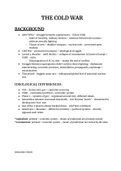
THE COLD WAR
BACKGROUND
● After WW2 - struggle between superpowers - USA & USSR
○ State of hostility, military tension + mistrust between the nations -
without actually fighting.
○ Threat of new + deadlier weapons - nuclear tech - prevented open
warfare.
● Cold War - protracted economic + ideological struggle.
● Lasted 4 decades - until decline + collapse of communism in Eastern Europe +
USSR - 1989.
○ Disintegration of SU in 1991 - marks the end of conflict.
● Struggle between superpowers didn’t involve direct fighting - diplomatic
manoevering, economic pressure, intimidation, propaganda, espionage +
assassination.
● This period - biggest arms race - widespread global fear of potential nuclear
war.
IDEOLOGICAL DIFFERENCES:
● USA - democratic gov + capitalist economy
● USSR - communist political + economic system
● These 2 - systems of gov - organised around very different ideals.
● Sometimes tensions increased drastically - war became ‘warm’ - threatened to
develop into ‘hot’ war.
● One of the 2 powers always backed down - Cold War continued.
● Americans + Russians - different economic + political systems - directly
opposed each other.
*capitalism: political + economic system - means of production are privately owned.
*communism: political + economic system - means of production are owned by the state.
SANJANA VINOD
, RELATIONSHIP BETWEEN THE USSR & USA BEFORE WW2:
● Origins of the Cold War - lie in the period directly after WW2 - ended in 1945.
○ Long term reasons for mistrust - Bolshevik revolution 1917 + Russian
Civil War.
● 1917 Lenin - Bolshevik revolution - communist gov in Russia.
○ New gov - wanted to remove the concept of private ownership.
○ This was in contrast to America's economic system - based on
capitalism.
○ Americans feared - spread of communism + it’s belief in the elimination
of private wealth + ownership.
REASONS OF WEST’S MISTRUST OF REASONS OF SOVIET’S MISTRUST OF
USSR WEST
1. Communism threatened - Communists - capitalist system is wrong
western values + way of life. - rich people prosper @ expenses of the
poor.
2. During WW1 - Bolshevik gov - After Bolsheviks seized power in 1917 -
deserted Russia’s allies by making West sent aid - ‘white’ army - fought
peace with G. against Bs.
3. They disliked Stalin’s totalitarian 1919- Allies - result of Paris Peace
policies - led to forced labour, Conference - gave away Russian lands to
public trials, deaths + purges. other countries - Poland.
4. Stalin signed - Nazi-soviet 1930s - Stalin distrusted policies of
Non-Aggression Pact in august appeasement - felt that Britain + France
1939. saw SU as enemy not Germany.
Suspicion confirmed - SU excluded from
Munich Conference in 1938.
SANJANA VINOD
BACKGROUND
● After WW2 - struggle between superpowers - USA & USSR
○ State of hostility, military tension + mistrust between the nations -
without actually fighting.
○ Threat of new + deadlier weapons - nuclear tech - prevented open
warfare.
● Cold War - protracted economic + ideological struggle.
● Lasted 4 decades - until decline + collapse of communism in Eastern Europe +
USSR - 1989.
○ Disintegration of SU in 1991 - marks the end of conflict.
● Struggle between superpowers didn’t involve direct fighting - diplomatic
manoevering, economic pressure, intimidation, propaganda, espionage +
assassination.
● This period - biggest arms race - widespread global fear of potential nuclear
war.
IDEOLOGICAL DIFFERENCES:
● USA - democratic gov + capitalist economy
● USSR - communist political + economic system
● These 2 - systems of gov - organised around very different ideals.
● Sometimes tensions increased drastically - war became ‘warm’ - threatened to
develop into ‘hot’ war.
● One of the 2 powers always backed down - Cold War continued.
● Americans + Russians - different economic + political systems - directly
opposed each other.
*capitalism: political + economic system - means of production are privately owned.
*communism: political + economic system - means of production are owned by the state.
SANJANA VINOD
, RELATIONSHIP BETWEEN THE USSR & USA BEFORE WW2:
● Origins of the Cold War - lie in the period directly after WW2 - ended in 1945.
○ Long term reasons for mistrust - Bolshevik revolution 1917 + Russian
Civil War.
● 1917 Lenin - Bolshevik revolution - communist gov in Russia.
○ New gov - wanted to remove the concept of private ownership.
○ This was in contrast to America's economic system - based on
capitalism.
○ Americans feared - spread of communism + it’s belief in the elimination
of private wealth + ownership.
REASONS OF WEST’S MISTRUST OF REASONS OF SOVIET’S MISTRUST OF
USSR WEST
1. Communism threatened - Communists - capitalist system is wrong
western values + way of life. - rich people prosper @ expenses of the
poor.
2. During WW1 - Bolshevik gov - After Bolsheviks seized power in 1917 -
deserted Russia’s allies by making West sent aid - ‘white’ army - fought
peace with G. against Bs.
3. They disliked Stalin’s totalitarian 1919- Allies - result of Paris Peace
policies - led to forced labour, Conference - gave away Russian lands to
public trials, deaths + purges. other countries - Poland.
4. Stalin signed - Nazi-soviet 1930s - Stalin distrusted policies of
Non-Aggression Pact in august appeasement - felt that Britain + France
1939. saw SU as enemy not Germany.
Suspicion confirmed - SU excluded from
Munich Conference in 1938.
SANJANA VINOD