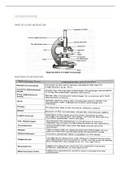
PARTS OF A LIGHT MICROSCOPE
FUNCTIONS OF MICROSCOPE
, calculating total magnification:
total magnification = magnification of eyepiece lens X magnification of objective lens
- a cell is the smallest unit of life – mostly made up of proteins, carbohydrates, lipids, nucleic
acids, water
- both plant and animals cells consists of a cell nucleus, cytoplasm and a cell membrane
- not all cells contain a nucleus (bacteria)
prokaryotic cell – cell without a nucleus
eukaryotic cell – cell with a nucleus
- ratio of surface area : volume is large as it facilitates the movement of substances into and
out of the cell, but the volume must be small enough for easy diffusion of substances
- all cells don’t look the same; size, shape and structure change to perform specific functions
[differentiation]
- cells become specialised to perform a specific function [specialisation]
eg: muscle cells contract and relax
nerve cells conduct impulses
glandular cells secrete substances (secretion)
MAIN COMPONENTS OF PLANT AND ANIMAL CELLS
- all cells are made up of protoplasm (the living material in plant and animal cells)
- plant cells also have a non-living part, the cell wall, surrounding the living component,
protoplasm – animal cells don’t have cell walls
- protoplasm consists of the cytoplasm and nucleoplasm in the nucleus
- all organelles occur within the cytoplasm which is enclosed by cell membrane or plasma
membrane
organelle: a membrane-bound structure that is found in the cytoplasm of a cell and that
performs a specific function
FUNCTIONS OF MICROSCOPE
, calculating total magnification:
total magnification = magnification of eyepiece lens X magnification of objective lens
- a cell is the smallest unit of life – mostly made up of proteins, carbohydrates, lipids, nucleic
acids, water
- both plant and animals cells consists of a cell nucleus, cytoplasm and a cell membrane
- not all cells contain a nucleus (bacteria)
prokaryotic cell – cell without a nucleus
eukaryotic cell – cell with a nucleus
- ratio of surface area : volume is large as it facilitates the movement of substances into and
out of the cell, but the volume must be small enough for easy diffusion of substances
- all cells don’t look the same; size, shape and structure change to perform specific functions
[differentiation]
- cells become specialised to perform a specific function [specialisation]
eg: muscle cells contract and relax
nerve cells conduct impulses
glandular cells secrete substances (secretion)
MAIN COMPONENTS OF PLANT AND ANIMAL CELLS
- all cells are made up of protoplasm (the living material in plant and animal cells)
- plant cells also have a non-living part, the cell wall, surrounding the living component,
protoplasm – animal cells don’t have cell walls
- protoplasm consists of the cytoplasm and nucleoplasm in the nucleus
- all organelles occur within the cytoplasm which is enclosed by cell membrane or plasma
membrane
organelle: a membrane-bound structure that is found in the cytoplasm of a cell and that
performs a specific function