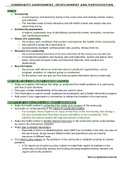
COMMUNITY ASSESSMENT, DEVELOPMENT AND PARTICIPATION
DEFINE
Community
o A social group connected by being in the same area and sharing similar values
and interests.
o The members need to have interaction and will exhibit similar and create rules and
values they live by.
Community assessment
o A logical, systematic way of identifying community needs, strengths, resources
and clarifying problems
Status of a community
o the actions and conditions that protect and improve the health of the community
o how well off or worse off a community is
o socioeconomic standard: unemployment rate, poverty, literacy level etc.
Structure of a community
o the environmental structure of an area and how all the resources are laid out
o It includes the population and housing, jobs and production, service and leisure time
areas, along with transport routes and technical networks, their location and
relationships.
Key informants
o the person with whom an interview about a particular organization, social
program, problem, or interest group is conducted.
o It’s the person who can give you the most accurate information about a community
WHY DO WE DO A COMMUNITY ASSESSMENT(CA)?
Helps us to gather information that helps us understand the health problems in a community
and how to best intervene
Thus gain a better understanding of the area you want to serve
This information is used to create, implement and evaluation and a health intervention program
Help prove if your organization’s intervention is relevant and needed in the community
BENEFITS OF CONDUCTING A COMMUNITY ASSESSMENT
Helps the health worker to understand the needs and concerns of the community
It provides an understanding of the nature of a particular problem
o For example, there might be an issue of diarrhea in the community, but during a
CA you can determine that there is poor sanitation in the community. This
clarifies the reason behind the high prevalence of diarrhea.
Helps the health worker to identify relevant resources in the community (which could perhaps
be used in the intervention program)
Helps plan a relevant intervention
o Especially if done in a Multidisciplinary team (MDT) as it provides more than one view of
the same issue; brings forward different skills and experience and can identify
resources in different eyes
Can inform policy makers on the problems in the community to establish priorities to resolve
problems
o A CA report can be given to policy makers to make them aware of problems in the
community so that their policies and funding are being targeted towards relevant and
urgent community problems
Notes by @silibazisomupereki
, COMMUNITY ASSESSMENT, DEVELOPMENT AND PARTICIPATION
BASIC STEPS FOR CONDUCTING A COMMUNITY ASSESSMENT
1. Build a relationship with the community
o You are entering other people’s living space. Thus, you need to make them comfortable
and create the trust. It will make them more willing to participate and be more
cooperative
2. Gain consent
o Ask permission from community to study how they live. You will be asking personal
questions about how they live and struggles they face. The community needs to know
what will be required of them and their privacy should not be violated.
3. Collect data
o There are different forms of ways to collect data: questionaries, surveys, interviews
o The method selected will depend on the type of community, funds available, time to
complete the project and people involved in the assessment
o Each method has its pros and cons, therefore determine what information you want to
gather and this will guide what method to use
For example, trying to gather information about social problems would
need to be conducted using an interview as it provides in depth reasonings
and feelings
4. Coalition and interpretation of information
o Organization/group synthesizes and analyses the information gathered.
o Determine which information is accurate and make conclusions about the community:
Strengths
Shortcomings
Social or economic problems
Major health related problems
Risks factors
Needs, wants
Current and proposed actions to solve problems
5. Prioritize a problem
o Information gathered will provide a list of problems: prioritize the most important or
urgent (and one that the organization can provide solutions to)
o Prioritizing a problem can be done by choosing a problem that is mentioned frequently
or the problem that the organization/group feels is the most important and would be
most beneficial to the community
COMMUNITY ASSESSMENT METHODS
1. Analysis of secondary data
This is the analysis of previously collected information in a community from
sources such as census data and monthly statistics
Gives your starting data so that you don't duplicate interventions.
Helps you to see what went wrong previously and where you can improve on.
2. Key community informants
These are community members that are well-informed in the particular issue of
concern.
Hear information from the "horse’s mouth"
3. Observation, listening and analysis
Notes by @silibazisomupereki
DEFINE
Community
o A social group connected by being in the same area and sharing similar values
and interests.
o The members need to have interaction and will exhibit similar and create rules and
values they live by.
Community assessment
o A logical, systematic way of identifying community needs, strengths, resources
and clarifying problems
Status of a community
o the actions and conditions that protect and improve the health of the community
o how well off or worse off a community is
o socioeconomic standard: unemployment rate, poverty, literacy level etc.
Structure of a community
o the environmental structure of an area and how all the resources are laid out
o It includes the population and housing, jobs and production, service and leisure time
areas, along with transport routes and technical networks, their location and
relationships.
Key informants
o the person with whom an interview about a particular organization, social
program, problem, or interest group is conducted.
o It’s the person who can give you the most accurate information about a community
WHY DO WE DO A COMMUNITY ASSESSMENT(CA)?
Helps us to gather information that helps us understand the health problems in a community
and how to best intervene
Thus gain a better understanding of the area you want to serve
This information is used to create, implement and evaluation and a health intervention program
Help prove if your organization’s intervention is relevant and needed in the community
BENEFITS OF CONDUCTING A COMMUNITY ASSESSMENT
Helps the health worker to understand the needs and concerns of the community
It provides an understanding of the nature of a particular problem
o For example, there might be an issue of diarrhea in the community, but during a
CA you can determine that there is poor sanitation in the community. This
clarifies the reason behind the high prevalence of diarrhea.
Helps the health worker to identify relevant resources in the community (which could perhaps
be used in the intervention program)
Helps plan a relevant intervention
o Especially if done in a Multidisciplinary team (MDT) as it provides more than one view of
the same issue; brings forward different skills and experience and can identify
resources in different eyes
Can inform policy makers on the problems in the community to establish priorities to resolve
problems
o A CA report can be given to policy makers to make them aware of problems in the
community so that their policies and funding are being targeted towards relevant and
urgent community problems
Notes by @silibazisomupereki
, COMMUNITY ASSESSMENT, DEVELOPMENT AND PARTICIPATION
BASIC STEPS FOR CONDUCTING A COMMUNITY ASSESSMENT
1. Build a relationship with the community
o You are entering other people’s living space. Thus, you need to make them comfortable
and create the trust. It will make them more willing to participate and be more
cooperative
2. Gain consent
o Ask permission from community to study how they live. You will be asking personal
questions about how they live and struggles they face. The community needs to know
what will be required of them and their privacy should not be violated.
3. Collect data
o There are different forms of ways to collect data: questionaries, surveys, interviews
o The method selected will depend on the type of community, funds available, time to
complete the project and people involved in the assessment
o Each method has its pros and cons, therefore determine what information you want to
gather and this will guide what method to use
For example, trying to gather information about social problems would
need to be conducted using an interview as it provides in depth reasonings
and feelings
4. Coalition and interpretation of information
o Organization/group synthesizes and analyses the information gathered.
o Determine which information is accurate and make conclusions about the community:
Strengths
Shortcomings
Social or economic problems
Major health related problems
Risks factors
Needs, wants
Current and proposed actions to solve problems
5. Prioritize a problem
o Information gathered will provide a list of problems: prioritize the most important or
urgent (and one that the organization can provide solutions to)
o Prioritizing a problem can be done by choosing a problem that is mentioned frequently
or the problem that the organization/group feels is the most important and would be
most beneficial to the community
COMMUNITY ASSESSMENT METHODS
1. Analysis of secondary data
This is the analysis of previously collected information in a community from
sources such as census data and monthly statistics
Gives your starting data so that you don't duplicate interventions.
Helps you to see what went wrong previously and where you can improve on.
2. Key community informants
These are community members that are well-informed in the particular issue of
concern.
Hear information from the "horse’s mouth"
3. Observation, listening and analysis
Notes by @silibazisomupereki