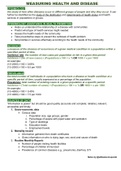
MEASURING HEALTH AND DISEASE
EPIDIMIOLOGY
the study of how often diseases occur in different groups of people and why they occur. It can
further be identified as the study of the distribution and determinants of health status and health
services in populations or groups.
EPIDEMIOLOGY ASSISTANCE IN HEALTH PROMOTION
Helps us understand the relationship of a disease with communities
Predict what type of health services might needed
Assess the health needs of the community
Take preventative steps to prevent the outbreak of health problem
Set priorities in services effectively according to the health needs of the community
INCIDENCE
a measure of the chances of occurrence of a given medical condition in a population within a
specified period of time.
Incidence rate: the number of new cases per population at risk in a given time period
Incidence = (No of new cases) ÷ (Population) x 100 = x % OR 1000 = x per 1000
An example:
(13÷2000) ×100 = 0.65%
(13÷2000) ×100 = 6.5 per 1000
PREVELANCE
the total number of individuals in a population who have a disease or health condition at a
specific period of time, usually expressed as a percentage of the population.
Prevalence: total number of existing cases in a given population at a specific period
Incidence = (Total number of cases) ÷ (Population) x 100 = x % OR 1000 = x per 1000
An example:
(13÷4000) ×100 = 0.45%
(13÷4000) ×100 = 7.5 per 1000
SOURCES OF DATA
“Information is power” but should be good quality (accurate and complete; reliable), relevant,
accessible and timely.
1. Socio-economic data
Census data
i. Population size, age groups, gender
ii. Percentage of people with piped water and sanitation
iii. Type of dwellings
iv. Education levels
v. Employment levels
2. Mortality record
Information gathered from death certificates
Gives information on who is dying (age, sex, race) and cause of death
3. Routine Monthly Reports
Number of people visiting health facilities
Percentage of children immunized
Prevalence of common diseases e.g., pneumonia, diarrhea, STI
Notes by @silibazisomupereki
EPIDIMIOLOGY
the study of how often diseases occur in different groups of people and why they occur. It can
further be identified as the study of the distribution and determinants of health status and health
services in populations or groups.
EPIDEMIOLOGY ASSISTANCE IN HEALTH PROMOTION
Helps us understand the relationship of a disease with communities
Predict what type of health services might needed
Assess the health needs of the community
Take preventative steps to prevent the outbreak of health problem
Set priorities in services effectively according to the health needs of the community
INCIDENCE
a measure of the chances of occurrence of a given medical condition in a population within a
specified period of time.
Incidence rate: the number of new cases per population at risk in a given time period
Incidence = (No of new cases) ÷ (Population) x 100 = x % OR 1000 = x per 1000
An example:
(13÷2000) ×100 = 0.65%
(13÷2000) ×100 = 6.5 per 1000
PREVELANCE
the total number of individuals in a population who have a disease or health condition at a
specific period of time, usually expressed as a percentage of the population.
Prevalence: total number of existing cases in a given population at a specific period
Incidence = (Total number of cases) ÷ (Population) x 100 = x % OR 1000 = x per 1000
An example:
(13÷4000) ×100 = 0.45%
(13÷4000) ×100 = 7.5 per 1000
SOURCES OF DATA
“Information is power” but should be good quality (accurate and complete; reliable), relevant,
accessible and timely.
1. Socio-economic data
Census data
i. Population size, age groups, gender
ii. Percentage of people with piped water and sanitation
iii. Type of dwellings
iv. Education levels
v. Employment levels
2. Mortality record
Information gathered from death certificates
Gives information on who is dying (age, sex, race) and cause of death
3. Routine Monthly Reports
Number of people visiting health facilities
Percentage of children immunized
Prevalence of common diseases e.g., pneumonia, diarrhea, STI
Notes by @silibazisomupereki