

PYC3703 – COGNITIVE PSYCHOLOGY
NOTES
CHAPTER 1 – Introduction to Cognitive Psychology
Key Terms
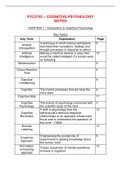
Key Term Explanation Page
A technique in which trained participants 6
Analytic
described their sensations, feelings and
Introspection
thought processes in response to stimuli
Artificial Making a machine behave in ways that 13
Intelligence would be called intelligent if a human were
so behaving
Behaviourism 9
Choice Reaction 4
Time
Classical 9
Conditioning
Cognition The mental processes that are what the 4
mind does
Cognitive Map 11
Cognitive The branch of psychology concerned with 3
Psychology the scientific study of the mind
A shift in psychology from the 12
Cognitive behaviourist’s stimulus-response
Revolution relationships to an approach whose main
thrust was to understand the operation of
the mind – 1950s
Dichotic 13
Listening
Emphasising the pivotal role of 6
Empiricist
experiments in gaining knowledge about
Approach
the human mind
Information- 12
Traces sequences of mental operations
processing
involved in cognition
approach
, Intermixing different topics within a particular 17
Interleaving
domain
Logic Theorist 13
3
Mind
Operant How behaviour is strengthened by the 9
Conditioning presentation of positive reinforcers
Represent the processes that are involved in 15
Process Model
cognitive mechanisms
How long it takes for a person to make a 4
Reaction Time
decision
Retrieval-Based 17
Retrieving information from memory
Learning
7
Savings
7
Savings Curve
Simple Reaction 4
Time
Our overall experience is determined by 5
Structuralism combining basic elements of experience which
were called sensation
15
Structural Model Representations of a physical structure
NOTES
CHAPTER 1 – Introduction to Cognitive Psychology
Key Terms
Key Term Explanation Page
A technique in which trained participants 6
Analytic
described their sensations, feelings and
Introspection
thought processes in response to stimuli
Artificial Making a machine behave in ways that 13
Intelligence would be called intelligent if a human were
so behaving
Behaviourism 9
Choice Reaction 4
Time
Classical 9
Conditioning
Cognition The mental processes that are what the 4
mind does
Cognitive Map 11
Cognitive The branch of psychology concerned with 3
Psychology the scientific study of the mind
A shift in psychology from the 12
Cognitive behaviourist’s stimulus-response
Revolution relationships to an approach whose main
thrust was to understand the operation of
the mind – 1950s
Dichotic 13
Listening
Emphasising the pivotal role of 6
Empiricist
experiments in gaining knowledge about
Approach
the human mind
Information- 12
Traces sequences of mental operations
processing
involved in cognition
approach
, Intermixing different topics within a particular 17
Interleaving
domain
Logic Theorist 13
3
Mind
Operant How behaviour is strengthened by the 9
Conditioning presentation of positive reinforcers
Represent the processes that are involved in 15
Process Model
cognitive mechanisms
How long it takes for a person to make a 4
Reaction Time
decision
Retrieval-Based 17
Retrieving information from memory
Learning
7
Savings
7
Savings Curve
Simple Reaction 4
Time
Our overall experience is determined by 5
Structuralism combining basic elements of experience which
were called sensation
15
Structural Model Representations of a physical structure



