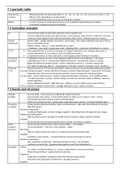
7.1 periodic table
Trend across - What period they are shows sub shell, 1s – 2s – 2p – 3s – 3p – 4s – 3d – 4p. (s-2, p-6, d-10, f – 14)
a period - Filled in order depending on period except 4.
- P4, 3d is involved but only n=4 so only 4s and 4p are occupied
blocks - 1-2 are s, 3-12 are d, 13-18 minus He are p, 4-17 on bottom separate block are f blocks.
- Correspond to highest energy level subshell.
7.2 ionisation energies
IE - measures how easily an atom loses electrons to form positive ions.
- 1st IE is E required to remove one electron from 1 mol of gaseous atom to form 1 mole of 1+ ion atom.
- 1st IE lost is from highest E level with least attraction with nucleus – furthest away from nucleus.
Factors - Atomic radius – greater distance out outer e- and nucleus = less nuclear attraction and easy to lose as
affecting IE force of attraction falls off.
- Nuclear charge – more p+ = more attraction for p+ and e-.
- E- shielding – inner shell e- repels outer shell = shielding effect = decrease in attraction in e- and p+.
2nd IE More powerful than 1st as the 2e- turning to 1e- keeps it attracted to p+ = distance decreases so
nuclear attraction on 1e- increases so more IE needed to remove e-.
E required to remove 1e- from each ion in 1 mol of gaseous atom forming 2+ ion atom.
Successive - E required to remove 1e- from 1 mol of gaseous atom to form 1 mol of gaseous 1+ ion atom.
ionisation - Large difference in IE= e- removed from higher shell and 2e- removed from closer to nucleus.
- Bigger the difference between points = more E required to remove e- = another energy level.
- On a table, the big jump after IE – what group it is, if IE after a jump is consistent, count = group no.
Trends in - General increase in 1st IE across each period = shows increase as you go along the elements on graph.
1st IE 1) nuclear charge increases = nuclear attraction increases as atomic radius decreases = same shell = IE increase.
- Sharp decrease at the end of each period and start of next, increasing for that period again.
1) a new shell – atomic radius increase = nuclear charge and attraction to decrease = IE to rapidly decrease.
- 1st IE decreases down a group – nuclear charge increases but increased radius + shielding = decrease
nuclear attraction.
- Jump to different sub shell = slight decrease – adding e- to each orbital and increases to fill up.
1) 2s e- is harder to remove as there's less = stronger attraction so 2p e- easier to remove.
7.3 bonds and structure
Metallic - At room temp – most metals are solid but all conduct electricity.
bonding - atom donates outer shell e- to pool of delocalised so cations are in nucleus + inner = strong
electrostatic attraction between cations and delocalised.
- Cations are in fixed structure = giving shape, delocalised move around – all in giant metallic lattice.
Properties - Strong metallic attraction between cations and delocalised = high electrical conductivity therefore,
of metals high M.P and B.P.
Electrical conductivity -
- In solid and liquid states so when voltage is applied = delocalised move through and carry charge.
Melting and boiling points -
- High m.p and b.p due to strength of metallic bonds in lattice so high E required to bonds.
Solubility -
- Do not dissolve but interaction between polar solvents and metal can happen.
Giant - Can be strong covalent bonds = giant covalent lattice – non-metallic.
covalent - Can be tetrahedral – 109.5 by e- pair repulsion - stable.
structure Mp and bp -
- High as covalent bonds are strong, so E required to overcome bonds is high.
Solubility -
- Insoluble in most solvents – covalent bond too strong to be broken in solvent.
Electrical conductivity-
- Non-conductors of electricity - diamond and silicon as all 4 e- are occupied.
- Conductors of electricity – graphene and graphite as each have delocalised e-.
examples Carbon -
- 3 e- used in covalent bonding so 1e- is used as delocalised e- shared by all atoms.
- Planar hexagonal layers = good electrical conductors.
Graphene -
- Single layer of graphite, hexagonal carbon with strong covalent bonds
- Good electrical conductivity and thinnest + strongest material.
Graphite -
Trend across - What period they are shows sub shell, 1s – 2s – 2p – 3s – 3p – 4s – 3d – 4p. (s-2, p-6, d-10, f – 14)
a period - Filled in order depending on period except 4.
- P4, 3d is involved but only n=4 so only 4s and 4p are occupied
blocks - 1-2 are s, 3-12 are d, 13-18 minus He are p, 4-17 on bottom separate block are f blocks.
- Correspond to highest energy level subshell.
7.2 ionisation energies
IE - measures how easily an atom loses electrons to form positive ions.
- 1st IE is E required to remove one electron from 1 mol of gaseous atom to form 1 mole of 1+ ion atom.
- 1st IE lost is from highest E level with least attraction with nucleus – furthest away from nucleus.
Factors - Atomic radius – greater distance out outer e- and nucleus = less nuclear attraction and easy to lose as
affecting IE force of attraction falls off.
- Nuclear charge – more p+ = more attraction for p+ and e-.
- E- shielding – inner shell e- repels outer shell = shielding effect = decrease in attraction in e- and p+.
2nd IE More powerful than 1st as the 2e- turning to 1e- keeps it attracted to p+ = distance decreases so
nuclear attraction on 1e- increases so more IE needed to remove e-.
E required to remove 1e- from each ion in 1 mol of gaseous atom forming 2+ ion atom.
Successive - E required to remove 1e- from 1 mol of gaseous atom to form 1 mol of gaseous 1+ ion atom.
ionisation - Large difference in IE= e- removed from higher shell and 2e- removed from closer to nucleus.
- Bigger the difference between points = more E required to remove e- = another energy level.
- On a table, the big jump after IE – what group it is, if IE after a jump is consistent, count = group no.
Trends in - General increase in 1st IE across each period = shows increase as you go along the elements on graph.
1st IE 1) nuclear charge increases = nuclear attraction increases as atomic radius decreases = same shell = IE increase.
- Sharp decrease at the end of each period and start of next, increasing for that period again.
1) a new shell – atomic radius increase = nuclear charge and attraction to decrease = IE to rapidly decrease.
- 1st IE decreases down a group – nuclear charge increases but increased radius + shielding = decrease
nuclear attraction.
- Jump to different sub shell = slight decrease – adding e- to each orbital and increases to fill up.
1) 2s e- is harder to remove as there's less = stronger attraction so 2p e- easier to remove.
7.3 bonds and structure
Metallic - At room temp – most metals are solid but all conduct electricity.
bonding - atom donates outer shell e- to pool of delocalised so cations are in nucleus + inner = strong
electrostatic attraction between cations and delocalised.
- Cations are in fixed structure = giving shape, delocalised move around – all in giant metallic lattice.
Properties - Strong metallic attraction between cations and delocalised = high electrical conductivity therefore,
of metals high M.P and B.P.
Electrical conductivity -
- In solid and liquid states so when voltage is applied = delocalised move through and carry charge.
Melting and boiling points -
- High m.p and b.p due to strength of metallic bonds in lattice so high E required to bonds.
Solubility -
- Do not dissolve but interaction between polar solvents and metal can happen.
Giant - Can be strong covalent bonds = giant covalent lattice – non-metallic.
covalent - Can be tetrahedral – 109.5 by e- pair repulsion - stable.
structure Mp and bp -
- High as covalent bonds are strong, so E required to overcome bonds is high.
Solubility -
- Insoluble in most solvents – covalent bond too strong to be broken in solvent.
Electrical conductivity-
- Non-conductors of electricity - diamond and silicon as all 4 e- are occupied.
- Conductors of electricity – graphene and graphite as each have delocalised e-.
examples Carbon -
- 3 e- used in covalent bonding so 1e- is used as delocalised e- shared by all atoms.
- Planar hexagonal layers = good electrical conductors.
Graphene -
- Single layer of graphite, hexagonal carbon with strong covalent bonds
- Good electrical conductivity and thinnest + strongest material.
Graphite -